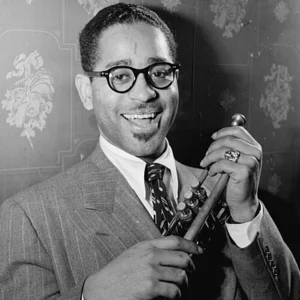

An American jazz trumpeter, composer, and bandleader, Dizzy Gillespie was, alongside Charlie Parker, one of the principal founders of bebop in the 1940s. A trumpet virtuoso recognizable by his bent-bell horn and his puffed-out cheeks, he was also a pioneer of Afro-Cuban jazz.
Dizzy Gillespie(1917 — 1993)
Dizzy Gillespie
États-Unis
6 min read
Frequently asked questions
Famous Quotes
« It's taken me all my life to learn what not to play.»
Key Facts
- Born on October 21, 1917, in Cheraw, South Carolina (United States)
- Co-founds bebop with Charlie Parker in the early 1940s
- Composes major standards such as “A Night in Tunisia,” “Salt Peanuts,” and “Groovin' High”
- A pioneer of Afro-Cuban jazz in the late 1940s, notably with percussionist Chano Pozo (“Manteca”)
- Dies on January 6, 1993, in Englewood, New Jersey
Works & Achievements
A composition by Gillespie that became one of the most frequently played standards in jazz, emblematic of bebop.
A frantic bebop theme co-written with Kenny Clarke, in which Gillespie sings the title in a joyful shout.
A recording with Charlie Parker that helped introduce bebop to a wider audience.
A piece created with Chano Pozo, regarded as the founding work of Afro-Cuban jazz.
A suite combining a jazz orchestra with Cuban percussion, extending the cubop adventure.
A ballad with refined harmonies, one of Gillespie's most beautiful personal compositions.
An autobiography in which he recounts his life, the birth of bebop, and his tours around the world.
Anecdotes
In January 1953, during a birthday party for his wife Lorraine, two dancers tripped over Dizzy's trumpet that was resting on a stand: the bell ended up bent upward. When he played it again, Gillespie found that he could hear himself better and that he liked the sound. He then had his trumpets made with this bell angled at 45°, which became his trademark.
The nickname “Dizzy” (the “scatterbrain,” the “goofball”) came from his constant clowning, both on stage and in life. A tireless joker, he loved to make his audience laugh as much as to dazzle them with his virtuosity, which clashed with the serious image cultivated by many bebop musicians.
When he played, Gillespie's cheeks puffed out like two balloons, to the point of being studied by doctors. This embouchure technique, which every teacher advises against, had nonetheless been his since childhood, and it became one of the most famous images in jazz.
In 1947, Dizzy brought the Cuban percussionist Chano Pozo into his big band. Together they created “Manteca” and “Cubana Be, Cubana Bop,” blending jazz with Afro-Cuban rhythms and inventing a style that came to be called “cubop.”
In 1964, as a satire and to denounce racism, Gillespie ran a mock campaign to become President of the United States. He promised to rename the White House “the Blues House” and imagined a government made up of musicians like Miles Davis and Max Roach.
Primary Sources
In it, Gillespie recounts how, after his trumpet was bent at his wife's birthday party, he discovered that he liked the new sound and decided to keep the upturned bell.
The tune, one of the most famous in bebop, was composed by Gillespie in the early 1940s; he recorded it with his orchestras and the piece became a standard performed all over the world.
This recording, bringing together Gillespie's orchestra and percussionist Chano Pozo, is considered one of the founding works of Afro-Cuban jazz.
Key Places
Small town in the southern United States where Gillespie was born in 1917 and discovered music as a child.
Harlem club that hosted the late-night jam sessions where bebop was born in the early 1940s.
“The Street,” lined with jazz clubs where Gillespie and Parker made bebop their own in the 1940s.
Prestigious venue where Gillespie gave a landmark 1947 concert blending bebop and Afro-Cuban rhythms.
Town where Gillespie lived for much of his life and where he died in 1993.
Typical Objects

Trumpet whose bell is angled 45° upward, which became Gillespie's visual signature after the 1953 incident.

Accessory slipped into the bell to muffle and color the sound, used by Gillespie to vary the timbres.

Headwear worn by Gillespie and bebop musicians, a symbol of the 1940s “hipster” style.

Heavy-framed glasses that, together with the beret and goatee, made up his instantly recognizable look.

Small chin beard popularized by Gillespie, which became an emblem of bebop musicians.

Afro-Cuban drum played by Chano Pozo in Gillespie's band, at the heart of the invention of cubop.

Sheet music for one of his most famous tunes, studied and replayed by generations of jazz musicians.

The medium on which his first bebop recordings appeared, quickly worn out from being played over and over by fans.
School Curriculum
Vocabulary & Tags
Key Vocabulary
Tags
Daily Life
Morning
A musician of the night, Gillespie woke up late, after concerts that ended in the early hours of the morning. Mornings were for rest, correspondence, and sometimes for handling the business of his orchestra.
Afternoon
Afternoons were devoted to rehearsals, composing, and arranging new pieces. On tour, these hours were often spent in buses, trains, or dressing rooms, waiting for the evening concert.
Evening
In the evening, he took the stage in clubs or concert halls, alternating dazzling virtuosity with comic routines. After the show came the jam sessions, where musicians improvised freely until dawn.
Food
Raised in the South, Gillespie kept his taste for African American cuisine (“soul food”). Life on tour meant above all meals grabbed on the go between cities, depending on which restaurants were open at night.
Clothing
Gillespie cultivated the “hipster” look of bebop: elegant suits, a beret, thick-rimmed glasses, and a small goatee on his chin. This polished silhouette was part of his image as a star.
Housing
After his early days in Philadelphia and then New York, he lived for a long time in New Jersey, in Englewood. But much of his life actually unfolded in hotels over the course of his world tours.