 flip
flipPayasa — rice pudding with jaggery and cardamom
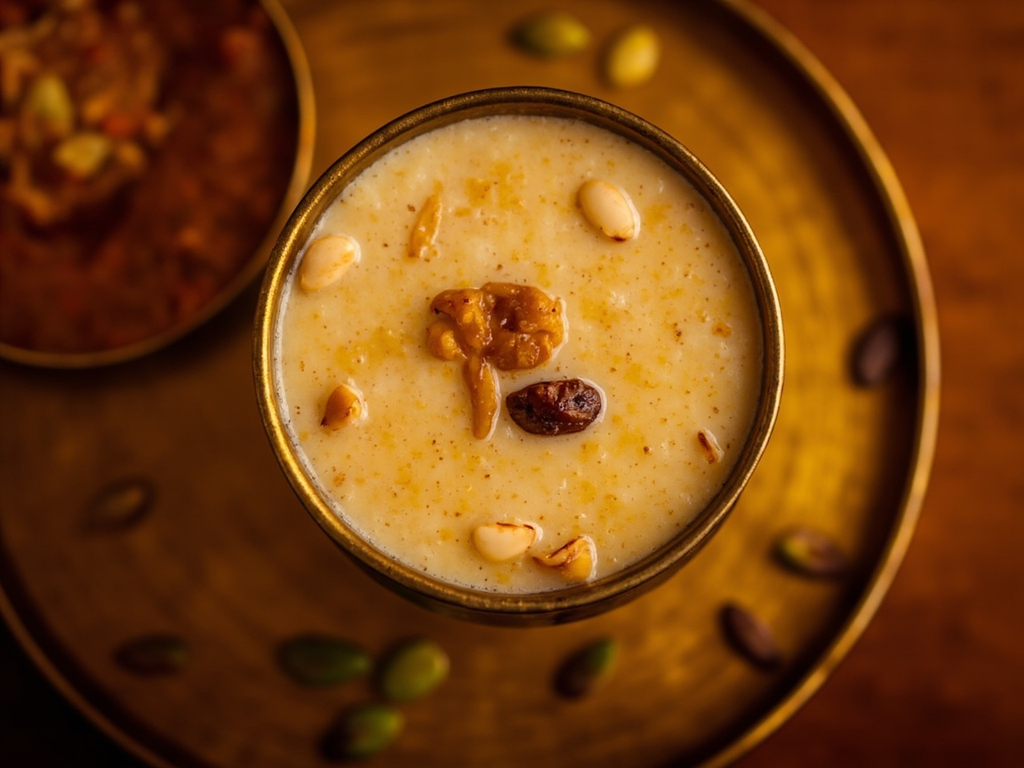
Payasa — rice pudding with jaggery and cardamom
Why this dish? Payasa (kheer) is the ceremonial dessert par excellence of Indian courts and great royal sacrifices; for a queen of Panchala, a king's daughter offered at a splendid svayamvara, it evokes wedding banquets and festivals where milk, rice, and sugar celebrate abundance and divine blessing.
Rice simmered long in milk until creamy, sweetened with jaggery (unrefined cane sugar), perfumed with cardamom, and enriched with ghee and raisins. Sweet, comforting, it is the taste of joy and blessings.
On the day of my svayamvara, when only Arjuna could string the bow and pierce the target, the drums resounded and milk was poured by whole jars. Here is the dish served on such a day: a rice that one coaxes in milk until it surrenders, sweetened with cane juice and perfumed with cardamom. First it is offered to the gods and brahmins, then one tastes it — for no bliss is kept for oneself alone. Taste it warm, and let your tongue know the first of the six flavors.
- •Cow's milk — abundant (creamy base)
- •Rice — a handful (thickener)
- •Jaggery (raw cane sugar) or honey — as needed (sweetness)
- •Cardamom — a few pods (perfume)
- •Ghee — a spoonful (richness)
- •Raisins — a handful (sweetness, texture)
Payasa — rice pudding with jaggery and cardamom
Rice simmered long in milk until creamy, sweetened with jaggery (unrefined cane sugar), perfumed with cardamom, and enriched with ghee and raisins. Sweet, comforting, it is the taste of joy and blessings.
Why this dish? Payasa (kheer) is the ceremonial dessert par excellence of Indian courts and great royal sacrifices; for a queen of Panchala, a king's daughter offered at a splendid svayamvara, it evokes wedding banquets and festivals where milk, rice, and sugar celebrate abundance and divine blessing.
On the day of my svayamvara, when only Arjuna could string the bow and pierce the target, the drums resounded and milk was poured by whole jars. Here is the dish served on such a day: a rice that one coaxes in milk until it surrenders, sweetened with cane juice and perfumed with cardamom. First it is offered to the gods and brahmins, then one tastes it — for no bliss is kept for oneself alone. Taste it warm, and let your tongue know the first of the six flavors.
Ingredients (period version)
- Cow's milk — abundant (creamy base)
- Rice — a handful (thickener)
- Jaggery (raw cane sugar) or honey — as needed (sweetness)
- Cardamom — a few pods (perfume)
- Ghee — a spoonful (richness)
- Raisins — a handful (sweetness, texture)
Ingredients
- Whole milk — 1 liter (base)
- Basmati or short-grain rice — 60 g (thickener)
- Jaggery (or whole cane sugar) — 100 g (sweetener)
- Ground green cardamom — 1/2 tsp (perfume)
- Ghee — 1 tbsp (richness)
- Raisins — 30 g (garnish)
- Slivered almonds — 20 g (garnish (optional))
Method
- Briefly sauté the rinsed rice in ghee, then pour in the milk.
- Simmer on low heat 35-45 minutes, stirring often, until the rice breaks down and the milk thickens.
- Off heat (to prevent curdling), stir in grated jaggery until fully dissolved.
- Add cardamom, raisins, and almonds; mix.
- Serve warm or chilled in small bowls.
How it was made : Payasa appears in ancient texts and epic tales as a propitiatory offering — in the Ramayana, a bowl of sacred payasa grants the queens of Dasharatha their sons. It was sweetened with jaggery or honey, since refined white sugar was rare; cardamom, saffron, and long pepper enhanced its perfume.
The contemporary twist : A hint of saffron infused in a spoonful of warm milk, swirled in a golden spiral on the surface just before serving.
Sources : K.T. Achaya, A Historical Dictionary of Indian Food, Oxford University Press, 1998
Draupadi · Charactorium