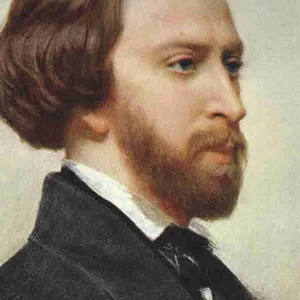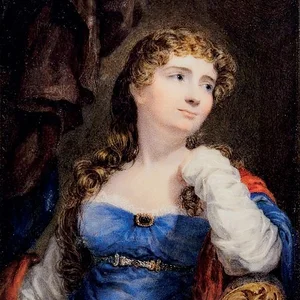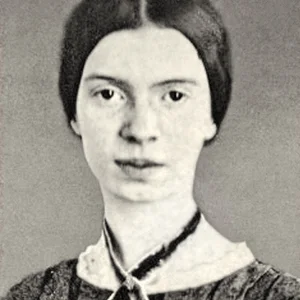

Emily Dickinson is one of the greatest American poets of the 19th century. A recluse in her home in Amherst, she composed nearly 1,800 poems, most of which were not published until after her death. Her work, innovative in form and depth, explores death, nature, and the human soul.
Emily Dickinson(1830 — 1886)
Emily Dickinson
États-Unis
7 min read
Frequently asked questions
Famous Quotes
« I'm Nobody! Who are you? Are you – Nobody – too?»
« Hope is the thing with feathers that perches in the soul.»
Key Facts
- Born on December 10, 1830, in Amherst, Massachusetts, into a prominent Protestant family.
- From the 1860s onward, she adopted a reclusive life, rarely leaving her home.
- She composed approximately 1,800 poems, but only around a dozen were published during her lifetime.
- Her poems are characterized by dashes, irregular rhymes, and unconventional punctuation.
- Her complete works were published starting in 1890, four years after her death in 1886.
Works & Achievements
Forty hand-sewn booklets in which Dickinson copied her poems, forming a monumental manuscript work of nearly 800 poems. They represent the editorial form the poet herself chose for her texts.
Published four years after her death by Mabel Loomis Todd and Thomas Wentworth Higginson, this collection introduced Dickinson to the American public at large. It was an immediate success and was reprinted eleven times in two years.
One of her most celebrated poems, in which Death is personified as a courtly carriage driver. This poem is considered a masterpiece of American literature on the theme of mortality.
A poem describing the moment of death from the inside, with the ironic and unsettling presence of a fly. It perfectly illustrates Dickinson's taste for concrete detail at the heart of great metaphysical questions.
A poem built on an extended metaphor comparing hope to a bird singing in the soul. One of the most studied texts in English-language school curricula for its clarity and depth.
A collection of letters exchanged over more than twenty years with the literary critic who was her principal intellectual interlocutor. This correspondence is an essential document on Dickinson's poetics and personality.
Anecdotes
Emily Dickinson lived in near-total isolation in Amherst, Massachusetts. From her forties onward, she refused to leave her home and received her rare visitors from behind a slightly open door, speaking to them without ever showing herself.
During her lifetime, only ten of her poems were published, often without her consent and with modifications she disapproved of. Yet she wrote nearly 1,800, sewn into small booklets called 'fascicles', discovered after her death in a chest.
Dickinson had a singular passion for gardening. She cultivated her own garden and an herbarium from adolescence, preserving hundreds of carefully dried and labeled plants. Nature was for her a constant source of poetic inspiration.
She was a renowned baker within her family and even won a prize at a local fair for her rye bread. This woman considered a recluse was in reality very present in the domestic life of the family home.
Dickinson wore almost exclusively white dresses in the final years of her life, which fueled her legend as a mysterious and eccentric figure. Her contemporaries sometimes nicknamed her 'The Woman in White of Amherst'.
Primary Sources
Are you too deeply occupied to say if my Verse is alive? [...] I had a terror since September — I could tell to none — and so I sing, as the Boy does by the Burying Ground — because I am afraid.
Hope is the thing with feathers / That perches in the soul / And sings the tune without the words / And never stops at all.
With the exception of Shakespeare, you have told me of more knowledge than any one living. To be Susan is Imagination, To have been Susan, is an Ecstasy, To be Susan, is a power.
Because I could not stop for Death — / He kindly stopped for me — / The Carriage held but just Ourselves — / And Immortality.
A collection of 424 dried and labeled plant specimens, gathered from the age of fourteen, bearing witness to her meticulous observation of the natural world.
Key Places
The Dickinson family home where Emily was born and spent nearly her entire life. Now a national museum, it was in this house that she wrote almost all of her work from her first-floor bedroom.
Founded by her grandfather, this prestigious college profoundly shaped the intellectual environment in which Dickinson grew up. Her herbarium is now preserved there.
The institution where Dickinson studied for one year (1847–1848). Her refusal to make a public profession of faith there was an early sign of her singular relationship to religion and social conformity.
The burial place of Emily Dickinson, located a few minutes' walk from the Homestead. Her gravestone bears simply the inscription 'Called Back', an allusion to her last letter.
Typical Objects
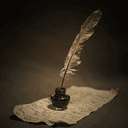
Dickinson composed nearly all of her poems with a quill pen, often on loose sheets or recycled envelopes. Her handwriting, distinctive and irregular, is now studied as an integral part of her work.
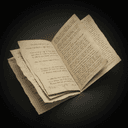
She sewed small booklets of four to five sheets herself, called fascicles, in which she copied her poems in fair copies. Forty of them were found after her death, containing approximately eight hundred poems.
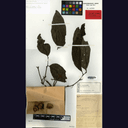
From adolescence, Dickinson assembled a herbarium of more than four hundred dried plants, carefully labeled. This object reflects her scientific and poetic relationship with nature.
📷 CC0 · Wikimedia Commons ↗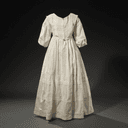
From her forties onward, Dickinson wore only white dresses, refusing colored clothing. This deliberate and meaningful sartorial choice contributed to her legend and to the image of the 'Lady in White'.

She would lower her famous bread and cakes in a wicker basket from her window to the neighborhood children, refusing to receive them directly. This gesture illustrates her indirect mode of contact with the outside world.
📷 CC BY-SA 3.0 · Wikimedia Commons ↗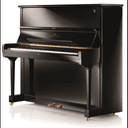
Emily Dickinson was a competent pianist and played regularly in the family home. The musicality of her verses, with their rhythms inspired by Protestant hymns, reflects this musical sensibility.
📷 CC BY-SA 3.0 · Wikimedia Commons ↗School Curriculum
Vocabulary & Tags
Key Vocabulary
Tags
Daily Life
Morning
Dickinson rose early and attended to household tasks, particularly cooking and baking, to which she devoted great care. She prepared the family's bread and meals before retreating to her room to write.
Afternoon
The afternoon was dedicated to gardening on the property grounds, correspondence — she wrote over a thousand preserved letters — and reading. She cultivated her plants methodically and observed nature with a scientist's eye.
Evening
In the evenings, the family gathered in the parlor; Emily sometimes played the piano and read. She often wrote at night by candlelight, the noise of the outside world quieted, in the silence she cherished.
Food
Her diet was that of a prosperous Puritan family from New England: rye bread she baked herself, garden vegetables, roasted meats, and fruit pies. She was renowned for her chocolate and lemon cakes.
Clothing
Dickinson wore simple, practical dresses in her early years, then adopted in the 1870s a white muslin dress that she wore almost exclusively until her death. She rejected the ostentatious fashions of the Victorian era.
Housing
She lived in the Homestead, a large Federal-style red brick mansion built by her grandfather in Amherst. She occupied her first-floor bedroom, overlooking the garden and the street, from which she received the entire world through correspondence while almost never leaving it.
Historical Timeline
Period Vocabulary
Visual Style
Intérieur victorien de Nouvelle-Angleterre, lumière douce et tamisée, tons sépia et blancs ivoire, atmosphère intime et recueillie propre à la demeure familiale d'Amherst.
Sound Ambience
Les sons du Homestead d'Amherst : le silence studieux d'une chambre, les oiseaux du jardin et les cloches de la ville que Dickinson observait depuis sa fenêtre pour écrire ses poèmes.
Liens externes & ressources
Références
Œuvres
Fascicules (manuscrits reliés)
c. 1858-1865
Poems (Premier recueil posthume)
1890
'Because I could not stop for Death' (Poème n°712)
c. 1863
'I heard a Fly buzz — when I died' (Poème n°465)
c. 1862
'Hope is the thing with feathers' (Poème n°254)
c. 1861
Correspondance avec Thomas Wentworth Higginson
1862-1886