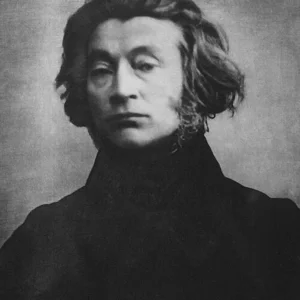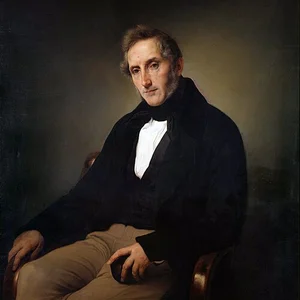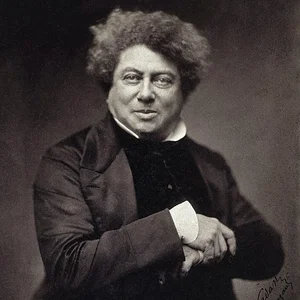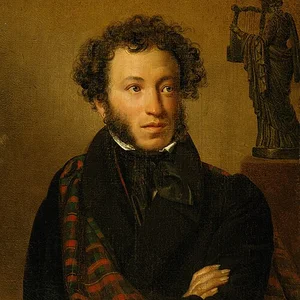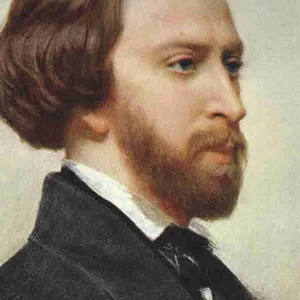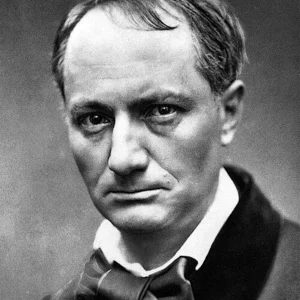

19th-century French poet and founder of modern poetry. Baudelaire is best known for his collection "The Flowers of Evil" (Les Fleurs du Mal, 1857), which revolutionized literature by exploring the beauty of evil, decadence, and existential torment. His work, considered scandalous at the time, profoundly influenced contemporary poetry and subsequent literary movements.
Charles Baudelaire(1821 — 1867)
Charles Baudelaire
France
7 min read
Frequently asked questions
Famous Quotes
« I adore you as much as the vault of night»
« Plunge to the depths of the abyss, whether Hell or Heaven, what does it matter? To the depths of the Unknown to find something new»
« Nature is a temple where living pillars sometimes let slip confused words»
Key Facts
- 1841: Voyage to Île Bourbon (Réunion), which deeply shaped his imagination and poetry
- 1857: Publication of Les Fleurs du Mal; the collection is prosecuted for obscenity and six poems are censored
- 1861: Expanded edition of Les Fleurs du Mal with 35 new poems
- 1862: Translation of Edgar Allan Poe's works, whose writing fascinated Baudelaire and reinforced his literary influence
- 1867: Death in Paris following a long illness; belated recognition of his literary genius
Works & Achievements
Major poetry collection that establishes the foundation of modernity in poetry. The work explores spleen, the ideal, beauty and death through verse of remarkable perfection.
Essay on the effects of hashish and opium, blending personal experience with philosophical reflection on the quest for the ideal through substances.
Collection of fifty prose poems that radically renews the poetic genre by abandoning verse in favor of a musical and free-form prose.
Collections of art criticism in which Baudelaire theorizes aesthetic modernity and champions painters such as Delacroix and Constantin Guys.
Translations of Poe's Extraordinary Tales and New Extraordinary Tales, regarded as literary works in their own right.
Fragmentary intimate journals in which Baudelaire shares his most personal reflections on art, society and the human condition.
Anecdotes
In 1857, Baudelaire was prosecuted for 'outrage to public morality' following the publication of Les Fleurs du Mal. Six poems were condemned and removed from the collection. It would take until 1949 for the Court of Cassation to rehabilitate the work and overturn the conviction.
Baudelaire maintained a passionate relationship with Jeanne Duval, a mixed-race actress whom he nicknamed his 'Black Venus'. She was one of his principal muses and inspired numerous poems in the love cycle of Les Fleurs du Mal, notably 'La Chevelure' and 'Le Serpent qui danse'.
At 21, Baudelaire was set to inherit his father's fortune, approximately 75,000 gold francs. But his family, alarmed by his extravagant spending on clothes and art objects, secured the appointment of a legal guardian who paid him a modest monthly allowance, condemning him to chronic financial hardship.
Baudelaire was a passionate admirer of Edgar Allan Poe, whose major works he translated into French over nearly seventeen years. These translations are still regarded today as literary masterpieces in their own right and introduced Poe to European audiences.
In 1864, Baudelaire moved to Brussels hoping to earn money through lectures. The venture was a resounding failure: Belgian audiences shunned his talks. Embittered, he began drafting a scathing pamphlet titled 'Pauvre Belgique!' ('Poor Belgium!'), which was left unfinished.
Primary Sources
I have felt struck by a great discouragement. An immense accumulation of debts, the necessity of perpetual work, and above all the horrible mistakes of my youth — these are what torment me.
This book was made for no other purpose than to amuse myself and to exercise my passionate taste for obstacles.
The author wished to paint everything, to lay everything bare. He probes human nature in its most intimate recesses; he employs vigorous and striking tones to render it, exaggerating above all its hideous aspects.
There is in every man, at every hour, two simultaneous impulses, one toward God, the other toward Satan. The invocation of God, or spirituality, is a desire to rise in rank; that of Satan, or animality, is a joy in descending.
Key Places
Baudelaire lived here from 1843 to 1845. It was in this place that he frequented the Club des Hashischins and led his life as a dandy.
The neighborhood of Baudelaire's literary youth, where he frequented cafés, bookshops, and artistic circles on the Left Bank.
Baudelaire's burial place, where he has rested since 1867. His grave is regularly adorned with flowers by admirers.
Baudelaire's mother owned a house there. The poet stayed there on several occasions and found inspiration for some of his maritime poems.
Baudelaire lived there from 1864 to 1866, a period of isolation and physical decline marked by the failure of his lecture series.
Typical Objects

Baudelaire regularly consumed laudanum (diluted opium) to soothe his pain and fuel his reflections on artificial paradises.

Baudelaire cultivated the austere elegance of a dandy, always dressed in black with a carefully knotted cravat, in opposition to the ordinary bourgeois.

The poet's daily instruments, with which he worked his verses with obsessive meticulousness, tirelessly rewriting each poem.

Baudelaire was a regular smoker. The pipe appears in several of his poems, notably "La Pipe" in Les Fleurs du Mal.

Baudelaire owned and annotated the works of Poe, whom he considered a spiritual brother and whose major work he translated.

Tending to his appearance was a daily ritual for Baudelaire, who attached paramount importance to his dress and his dandyish bearing.
School Curriculum
Vocabulary & Tags
Key Vocabulary
Tags
Mouvement
Daily Life
Morning
Baudelaire rarely rose before noon, having stayed up late the previous night. His grooming was a meticulous ritual: he attended to every detail of his appearance with a dandy's care, from his cravat to his gloves. He would drink very strong black coffee, often his only meal before midday.
Afternoon
In the afternoon, Baudelaire frequented the literary cafés of the Latin Quarter or the Left Bank, where he met with other writers and artists. He regularly visited painting galleries and art salons. He also devoted time to his translations of Poe or to his correspondence, often to demand money from his publishers.
Evening
In the evening, Baudelaire worked on his poems, often until the late hours of the night. He also frequented literary salons and artistic circles. He would sometimes seek inspiration in long nocturnal strolls through Paris, observing the urban life that fed his prose poems.
Food
Baudelaire ate little and irregularly, often due to lack of money. He was fond of black coffee and wine, consumed laudanum, and experimented with hashish. His meals, when he had them, were often taken in modest restaurants in the Latin Quarter.
Clothing
Baudelaire cultivated a severe elegance: black coat, immaculate white linen, black or dark red cravat. He rejected any garish sartorial excess, preferring the sobriety of the dandy who distinguishes himself through the perfection of details rather than ostentation. His gloves were always impeccable.
Housing
Baudelaire changed lodgings frequently, often compelled by debt. He lived in furnished hotels and modest apartments in various neighborhoods of Paris. His most celebrated residence was the Hôtel Pimodan on the Île Saint-Louis, a fine 17th-century building where he occupied a small apartment under the eaves.
Historical Timeline
Period Vocabulary
Visual Style
Une esthétique sombre et romantique inspirée du Paris du Second Empire, mêlant clair-obscur, intérieurs haussmanniens aux lourds velours et éclairage au gaz dans des tons de pourpre, noir et or.
Sound Ambience
L'atmosphère sonore d'une chambre parisienne du Second Empire : le grattement de la plume, le tic-tac d'une pendule, les bruits étouffés de la rue pavée et les cloches lointaines des églises.
Liens externes & ressources
Références
Œuvres
Les Fleurs du Mal
1857
Les Paradis artificiels
1860
Le Spleen de Paris (Petits Poèmes en prose)
1869 (posthume)
Curiosités esthétiques et L'Art romantique
1868 (posthume)
Traductions d'Edgar Allan Poe
1856-1865
Mon cœur mis à nu
1887 (posthume)