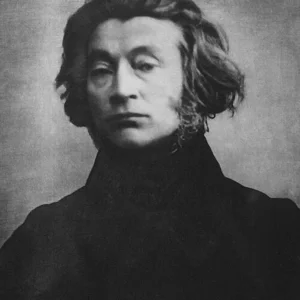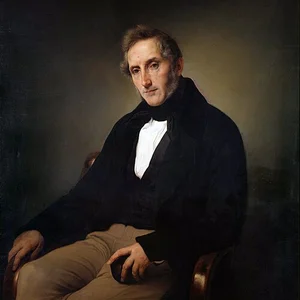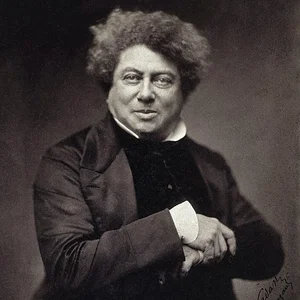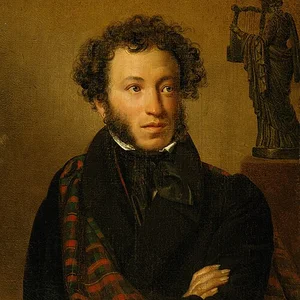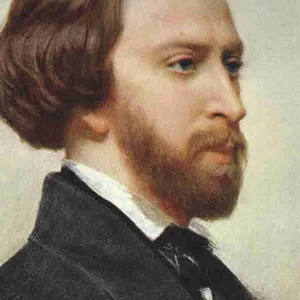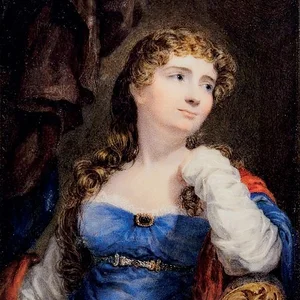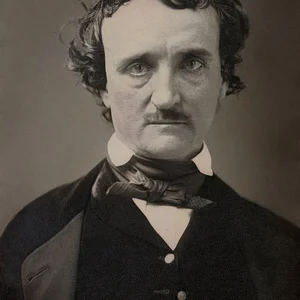

An American writer of the 19th century, Edgar Allan Poe is the undisputed master of the gothic tale and horror literature. His psychological short stories and dark poems deeply influenced world literature and laid the foundations of the modern detective genre.
Edgar Allan Poe(1809 — 1849)
Edgar Allan Poe
États-Unis
7 min read
Frequently asked questions
Famous Quotes
« While I deliberated, hesitating on the threshold of that door, a sudden icy chill came over me.»
« I am a living incarnation of death.»
Key Facts
- 1827: Publication of his first book, Tamerlane and Other Poems, published anonymously in Boston
- 1838: Publication of The Narrative of Arthur Gordon Pym of Nantucket, his first novel of adventure and mystery
- 1841: Publication of The Murders in the Rue Morgue, considered the first modern detective story
- 1845: Publication of the poem The Raven, which brought him widespread fame
- 1849: Mysterious death in Baltimore on October 7th, at the age of 40
Works & Achievements
Considered the first detective story in history, it features detective Auguste Dupin and lays the foundations of the modern mystery genre.
A narrative poem about a man haunted by a raven repeating "Nevermore". A masterpiece of musicality and melancholy, it made Poe famous throughout the country.
An iconic Gothic short story in which a crumbling mansion mirrors the degeneration of its inhabitants. It perfectly exemplifies Poe's art of atmospheric storytelling.
A terrifying psychological short story exploring guilt and human perversity, which has become a landmark of the horror genre.
An adventure and cryptography tale that won a $100 prize and enjoyed immense popular success, contributing to Poe's renown.
Poe's only complete novel, a maritime narrative blending adventure, horror, and mystery, which influenced Jules Verne and H.P. Lovecraft.
The third investigation of detective Dupin, a foundational mystery story in which the solution rests on logic and observation rather than action.
Anecdotes
Edgar Allan Poe was adopted by John Allan, a wealthy tobacco merchant from Richmond, after the death of his biological parents when he was only three years old. Although never officially adopted in a legal sense, he took Allan as his middle name.
Poe married his first cousin Virginia Clemm in 1835, when she was only thirteen years old and he was twenty-seven. Their marriage was described by those close to them as deeply affectionate, and Virginia's death from tuberculosis in 1847 plunged him into a despair from which he never recovered.
The publication of the poem "The Raven" in January 1845 made Poe instantly famous throughout the country. Yet he received only 9 dollars for a text that became one of the most well-known poems in American literature.
The circumstances of Poe's death remain a mystery to this day. Found delirious in the streets of Baltimore on October 3, 1849, wearing clothes that were not his own, he died four days later in the hospital without ever having been able to explain what had happened to him.
Poe had a tortoiseshell cat named Catterina who would sit on his shoulder while he wrote. This feline companion most likely inspired his famous short story "The Black Cat", published in 1843.
Primary Sources
Nothing is more clear than that every plot, worth the name, must be elaborated to its dénouement before anything be attempted with the pen.
I am in the greatest necessity, not having tasted food since yesterday morning. I have no where to sleep at night, but roam about the Streets.
There are fatal destinies; in the literature of every country there exist men who bear the word ill-luck written in mysterious characters in the sinuous folds of their brow.
A skilful literary artist has constructed a tale. If wise, he has not fashioned his thoughts to accommodate his incidents; but having conceived a certain unique single effect to be wrought out, he then invents such incidents.
Key Places
Small house where Poe spent his final years with Virginia and his mother-in-law Maria Clemm. It was here that he composed some of his last works in extreme poverty.
City where Poe grew up in the Allan family and began his literary career at the Southern Literary Messenger. Richmond was the backdrop of his adolescence and early successes.
City where Poe lived for several years, married Virginia, and where he died mysteriously in October 1849. His grave is located at Westminster Cemetery.
Poe lived here from 1838 to 1844, his most productive period. He wrote many of his masterpieces here, including The Murders in the Rue Morgue and The Black Cat.
Founded by Thomas Jefferson, this university welcomed Poe in 1826. A brilliant student but a compulsive gambler, he was forced to leave after one year, burdened with debt.
Typical Objects

Poe's everyday writing instruments, with which he drafted his manuscripts in a fine, careful, almost calligraphic hand.

A Richmond literary magazine of which Poe served as editor-in-chief, publishing sharp criticism and short stories that forged his reputation.

Poe kept a portrait of his young wife, painted a few years before her death, which he always kept close to him.

Poe often wrote at night by candlelight, in a dark atmosphere conducive to his macabre inspiration.

Poe obsessively reworked his texts, crossing out and rewriting each verse until he achieved the desired effect.

A mixture of opium and alcohol commonly used in the 19th century as a medicine, which Poe is said to have used during his periods of distress.
School Curriculum
Vocabulary & Tags
Key Vocabulary
Tags
Mouvement
Daily Life
Morning
Poe often woke late, exhausted from his nights of writing. He would have a frugal breakfast — sometimes just a cup of coffee and a piece of bread — in the modest kitchen of his lodgings. He spent part of the morning rereading and correcting texts he had written the night before.
Afternoon
The afternoon was generally devoted to his editorial work: writing literary criticism, corresponding with publishers, and reading manuscripts submitted to the magazines he edited. He would sometimes go to the offices of the magazines where he worked, walking through the streets of Philadelphia or New York.
Evening
Poe's evenings were spent on creative writing, often until the small hours of the night by candlelight. Virginia would sometimes play the piano or sing for him. During his darker periods, he frequented local taverns, where alcohol worsened his nervous fragility.
Food
The Poe family often lived in great poverty. Their diet was simple and frugal: bread, potatoes, seasonal vegetables, and occasionally a little meat. Maria Clemm, his mother-in-law, worked miracles on a meager budget to feed the household.
Clothing
Poe dressed with austere elegance despite his poverty, wearing a black suit, a dark waistcoat, a carefully knotted cravat, and an overcoat. He was careful to maintain a dignified, well-groomed appearance, characteristic of a Southern gentleman of the era.
Housing
Poe lived in numerous modest lodgings throughout his moves between Richmond, Baltimore, Philadelphia, and New York. His last home, the Fordham Cottage, was a small four-room wooden house where the winter cold was fought off by an inadequate stove and the family cat, which would curl up against the ailing Virginia.
Historical Timeline
Period Vocabulary
Visual Style
Esthétique gothique romantique américaine des années 1840, dominée par des clairs-obscurs dramatiques, des architectures en ruine et une atmosphère de mélancolie inquiétante évoquant les gravures de Gustave Doré.
Sound Ambience
Ambiance nocturne d'un cabinet d'écriture américain du XIXe siècle, entre grattement de plume, craquements de bois, orage lointain et cris de corbeau, évoquant l'atmosphère gothique chère à Poe.
Liens externes & ressources
Références
Œuvres
Double Assassinat dans la rue Morgue
1841
Le Corbeau (The Raven)
1845
La Chute de la maison Usher
1839
Le Chat noir
1843
Le Scarabée d'or
1843
Les Aventures d'Arthur Gordon Pym
1838
La Lettre volée
1844