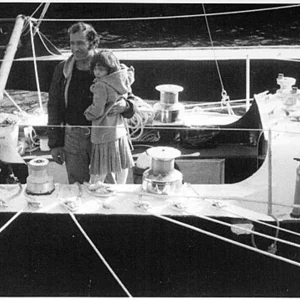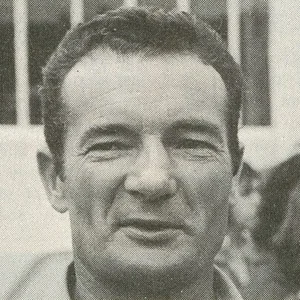

Éric Tabarly was a French sailor and naval officer, a major figure in offshore racing. Winner of the solo transatlantic race in 1964 and 1976, he revolutionized the design of racing yachts and inspired an entire generation of French skippers.
Éric Tabarly(1931 — 1998)
Éric Tabarly
France
8 min read
Frequently asked questions
Key Facts
- Born on 24 July 1931 in Nantes
- Wins the solo transatlantic race (OSTAR) in 1964 aboard Pen Duick II, becoming a national hero
- Wins the English solo transatlantic race a second time in 1976 aboard Pen Duick VI
- Trains and inspires a generation of skippers (Alain Colas, Olivier de Kersauson, Marc Pajot)
- Lost at sea on 13 June 1998, having fallen from his yacht Pen Duick off the coast of Wales
Works & Achievements
France's first major victory in a single-handed ocean race. It made Tabarly a national hero and launched the golden age of offshore racing in France.
A series of sailboats he designed or had built, each one exploring an innovation: lightweight plywood, aluminium multihulls, large ketches. They revolutionized the design of racing boats.
The remarkable feat of single-handedly sailing a boat designed for a large crew. This new victory confirmed his dominance in single-handed transatlantic racing.
By breaking a record that had stood since 1905, Tabarly demonstrated the potential of foils, the technology that today equips the fastest racing sailboats in the world.
A book in which Tabarly recounts his victorious crossing. A first-hand account that helped popularize sailing among the wider French public.
A collection of recollections published shortly before his death, in which he shares his vision of the sea, of boats and of racing, and passes on the experience of a lifetime at sea.
A lasting influence on a generation of skippers (Colas, Kersauson, Pajot, Poupon). Many learned their craft at his side before becoming champions in their own right.
Anecdotes
In 1964, Éric Tabarly was a nearly unknown naval officer when he set off in the single-handed English transatlantic race (OSTAR) aboard Pen Duick II, a ketch he had designed himself out of plywood. His self-steering gear failed within the first few days: he steered by hand for almost the entire crossing. He arrived first at Newport without realizing he had beaten the British favorite Francis Chichester, and discovered on arrival that he had become a national hero. General de Gaulle made him a Knight of the Legion of Honour.
The name “Pen Duick” means “coal tit” (a small black-headed bird) in Breton. The very first Pen Duick was an 1898 cutter designed by the Scottish architect William Fife and bought by Éric's father in 1938. Since its wooden hull had rotted, the young Tabarly saved it in the 1950s by moulding a new plastic hull over the old one. This sailboat would stay with him for the rest of his life.
In 1980, Tabarly broke the record for sailing across the North Atlantic aboard the foiling trimaran Paul Ricard. The previous record, held by the American schooner Atlantic, dated back to 1905 and had stood for seventy-five years! By betting on submerged fins (foils) that make the hull “fly,” Tabarly once again proved himself a pioneer of the technology.
Tabarly trained and inspired an entire generation of skippers — Alain Colas, Olivier de Kersauson, Marc Pajot, Philippe Poupon — to the point that people speak of “the Tabarly school.” A man of few words, almost shy on land, he shunned fame and preferred the silence of the open sea to honours. His reserve and his rigour made him a legend.
On the night of 12–13 June 1998, Tabarly was sailing to Scotland aboard his old Pen Duick, the one from 1898, for a gathering of Fife sailboats. Out in the middle of the Irish Sea, in heavy weather, he was struck by the gaff of the mast during a sail maneuver and fell overboard. He was lost at sea at the age of 66, on the very boat his father had passed down to him. His body would be found a month later by fishermen.
Primary Sources
A firsthand account of his victorious 1964 crossing: he recounts the failure of his self-steering gear and the weeks spent helming his ketch Pen Duick II alone, day and night, across the Atlantic.
In this book of recollections published shortly before his death, Tabarly looks back on his passion for the sea, the saga of the Pen Duick boats and his demanding vision of offshore racing, far from the honors and the media spotlight.
Here Tabarly describes the design and the bold technical choices behind his successive boats, from the restored 1898 cutter to the great ketch Pen Duick VI, which he sailed single-handed despite a size intended for a full crew.
Key Places
Tabarly's birthplace, born on 24 July 1931. A major port on the Loire estuary, opening onto the Atlantic.
An emblematic Breton offshore-racing port, closely linked to Tabarly and his Pen Duick yachts. A high temple of French competitive sailing.
Home of the Naval Academy, where Tabarly trained as an officer in the French Navy and as a naval aviation pilot.
The starting port of the solo English Transatlantic race (OSTAR), which Tabarly set out to compete in in 1964 and 1976.
The finishing port of the OSTAR, where Tabarly arrived first in 1964 and 1976, sealing his two transatlantic victories.
The area where Tabarly fell overboard from the Pen Duick on the night of 12 to 13 June 1998, while sailing toward a gathering of sailing yachts in Scotland.
Typical Objects

The sailboat of a lifetime, inherited from his father and restored with his own hands. Tabarly was so attached to it that he met his death aboard it in 1998.

A plywood ketch he designed for solo racing, with which he won the OSTAR in 1964. Its lightness heralded a new generation of racing sailboats.

A multihull fitted with submerged fins (foils) that lifted the hull out of the water, with which he broke the Atlantic record in 1980. A technical insight that was decades ahead of its time.

A mechanical device that holds the boat's course in place of the helmsman. Its failure during the 1964 transatlantic race forced Tabarly to steer by hand for almost the entire crossing.

An instrument used to measure the altitude of celestial bodies in order to fix one's position at sea. Before GPS, it was the indispensable tool of the solo sailor for locating himself on the ocean.

A waterproof jacket and trousers, often yellow, protecting against sea spray and cold. Tabarly's permanent working garment during long voyages in all weather.

Tabarly spent his entire career as a naval officer and naval aviation pilot. The Navy granted him leave to race and helped him finance his Pen Duick boats.

A notebook in which the sailor records course, weather, position, and incidents. Tabarly's logbooks fed into his books and document his crossings.
School Curriculum
Vocabulary & Tags
Key Vocabulary
Daily Life
Morning
During a solo race, Tabarly slept only in stretches of a few minutes: the moment he woke, he immediately checked his heading, the trim of the sails and the boat's position. He took a sextant reading whenever the sky allowed, then quickly gulped down a basic meal before returning to the helm.
Afternoon
The afternoon was spent in endless maneuvers: changing sails to suit the wind, repairing whatever broke, bailing out water, battling wear and fatigue. The meticulous Tabarly kept an eye on every detail of his rigging, for when sailing alone the slightest breakdown could ruin everything.
Evening
When evening came, sailing grew harsher: night watches to avoid collisions, cold, sea spray and solitude in the face of the elements. Tabarly faced the darkness with legendary composure, barely dozing so as to stay in command of his boat.
Food
On board, he made do with canned food, freeze-dried meals, biscuits and coffee, with fresh water strictly rationed. Far from any comfort, the key was to last for weeks on light provisions that were easy to keep.
Clothing
At sea, Tabarly lived in a yellow oilskin, boots and woollen sweaters to withstand the cold and the waves breaking over the deck. On land and on duty, he wore the uniform of a French Navy officer, but he hated pomp and always preferred simple attire.
Housing
During a race, his “quarters” came down to a cramped, damp cabin cluttered with charts, ropes and gear. On land, true to his reserved nature, he led a modest life, attached to Brittany and its ports along the Atlantic coast.
Historical Timeline
Period Vocabulary
Liens externes & ressources
Références
Œuvres
Victoire à la Transat anglaise en solitaire (OSTAR) sur Pen Duick II
1964
La saga des Pen Duick (Pen Duick à VI)
1958-1976
Seconde victoire à l'OSTAR sur Pen Duick VI
1976
Record de l'Atlantique sur le trimaran à foils Paul Ricard
1980
Victoire en solitaire : Atlantique 1964
1964
Mémoires du large
1997
« L'école Tabarly »
1964-1998