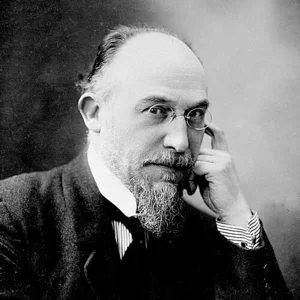

French composer and pianist, a singular figure in music of the late 19th and early 20th centuries. A pioneer through his bareness and his humor, he influenced Debussy, Ravel, and the 20th-century avant-gardes.
Erik Satie(1866 — 1925)
Erik Satie
France
6 min read
Frequently asked questions
Famous Quotes
« When I was young, people told me: You'll see when you're fifty. I'm fifty now. I haven't seen a thing.»
Key Facts
- Born on 17 May 1866 in Honfleur, died on 1 July 1925 in Paris
- Composed the three Gymnopédies in 1888, piano works of pared-down simplicity
- Composed the Gnossiennes around 1890, marked by whimsical performance instructions
- Pianist at the Le Chat Noir cabaret in Montmartre during the 1890s
- Composed the music for the ballet Parade (1917) with Cocteau, Picasso, and the Ballets Russes
Works & Achievements
Three slow, pared-down piano pieces that became Satie's most famous works and a symbol of his stripped-back music.
A series of piano pieces with strange, free harmonies, written without bar lines and accompanied by poetic performance directions.
Piano pieces for four hands with a humorous title (*Three Pieces in the Shape of a Pear*), an ironic reply to those who criticized his music for lacking form.
A ballet created with Cocteau, Picasso and the Ballets Russes, incorporating real-world sounds (typewriter, siren); a foundational work of the avant-garde.
A grave, austere vocal work set to texts by Plato, regarded by Satie as one of his most serious creations.
A provocative ballet and the score for René Clair's avant-garde film, among Satie's last major creations.
Anecdotes
Erik Satie lived for nearly thirty years in a tiny room in Arcueil, on the outskirts of Paris, which he nicknamed his “closet.” When he died in 1925, his friends entered it for the first time and discovered an incredible mess: two pianos stacked on top of each other, dozens of brand-new umbrellas that had never been used, and hundreds of little drawings and hidden notes.
Satie loved to give his works absurd and funny titles like “Three Pieces in the Shape of a Pear” or “Dried-Up Embryos.” On his scores, he wrote whimsical instructions for the pianist, for example “play like a nightingale with a toothache” instead of the usual terms like “softly.”
For seven years, Satie wore nothing but absolutely identical grey velvet suits: he had bought a dozen of them all at once. This taste for a uniform earned him the nickname “the Velvet Gentleman.”
In 1917, his ballet “Parade,” created with Jean Cocteau, Pablo Picasso and the Ballets Russes, caused a scandal. Satie worked everyday noises into it — a typewriter, a siren, pistol shots — which shocked the audience. A critic insulted him in writing, and Satie replied with a postcard so rude that he was sentenced to a prison term.
Toward the end of his life, Satie invented “furniture music”: music meant not to be listened to, made to fill the silence the way an armchair fills a room. It was a revolutionary idea that foreshadowed, much later, ambient music.
Primary Sources
“Everyone will tell you that I am not a musician. That is correct. From the very beginning of my career, I classed myself among the phonometrographers.”
Performance indication written by Satie: “Slow and sorrowful.”
Debussy hailed Satie as “a gentle, medieval musician lost in this century,” acknowledging his influence on Debussy's own quest for a freer kind of music.
Key Places
Port town in Normandy where Erik Satie was born in 1866 and spent part of his childhood.
Famous Montmartre cabaret where Satie worked as an accompanying pianist and mingled with the artists and poets of the Parisian bohemian scene.
Town in the southern suburbs of Paris where Satie lived for nearly thirty years in a small room, walking into Paris on foot every day.
Institution where Satie studied music in his youth without distinction, his teachers judging him mediocre and undisciplined.
Parisian theater where the ballet Parade premiered in 1917, causing a scandal with its everyday noises and Picasso's cubist sets.
Typical Objects

The central instrument of Satie's entire body of work; he composed mainly for the piano. He owned two of them, stacked one on top of the other, in his room in Arcueil.

Satie bought a dozen identical velvet suits and wore nothing else for years. This uniform earned him the nickname “the velvet gentleman.”

Satie collected umbrellas: more than a hundred were found in his room after his death, many of them brand new.

Satie wrote out his works in a very careful calligraphy, adding humorous and poetic titles and performance directions instead of the usual technical terms.

Small frameless glasses that rest on the nose, typical of the late 19th century, which Satie wore and which are part of his recognizable silhouette.

An alcoholic drink very much in fashion in the artistic Paris of the Belle Époque, which Satie consumed in abundance in the cabarets of Montmartre.
School Curriculum
Vocabulary & Tags
Key Vocabulary
Daily Life
Morning
Satie would wake up in his room in Arcueil and often set off on foot for Paris, a long walk of several kilometres that he made regularly. He liked to walk alone and observe, his umbrella under his arm.
Afternoon
In the afternoon, he composed, met fellow musicians and artists, or sat down in the Parisian cafés. He worked slowly and with great care for the beauty of his manuscripts.
Evening
In the evening, he frequented the cabarets of Montmartre such as the Chat Noir, where he had long earned his living playing the piano. He sometimes returned late to Arcueil, on foot, in all weathers.
Food
Satie loved cafés and the drinks of the bohemian life, including absinthe, then very much in fashion. He had unusual eating habits and would playfully declare that he ate only white foods.
Clothing
For years, he wore nothing but identical grey velvet suits, with a bowler hat and a pince-nez. This look of a “velvet gentleman” became his trademark.
Housing
He lived for nearly thirty years in a single small room in Arcueil, which no one ever entered during his lifetime. After his death, an astonishing heap of pianos, umbrellas and papers was discovered there.