
Esimirin is an aquatic deity from the Ijaw (Ijo) mythology, a people of the Niger Delta in Nigeria. A spiritual figure associated with water and prosperity, she holds a central place in the beliefs and traditional rituals of this community.
Esimirin
Esimirin
8 min read
Frequently asked questions
Key Facts
- Esimirin is a female aquatic deity venerated by the Ijaw people of the Niger Delta (Nigeria)
- The Ijaw tradition is one of the oldest cultures of the Niger Delta, dating back several millennia BCE
- Water spirits (Owuamapu) occupy a central place in Ijaw cosmology
- The worship of aquatic deities structures the social and political organization of Ijaw communities
- Ijaw mythology is transmitted orally across generations through songs, dances, and ritual ceremonies
Works & Achievements
A cosmogonic narrative in which Woyengi, the creator goddess, shapes humans from earth and water. Esimirin appears as one of the aquatic powers responsible for distributing destinies and gifts to newly created souls.
Complex ritual performances in which masked dancers embody water spirits before the assembled community. These ceremonies dedicated to deities such as Esimirin serve to heal the sick, administer justice, and ensure the fertility of both waters and families.
A corpus of ritual hymns addressed to aquatic deities (*amain* = water), transmitted orally by initiated priestesses. These songs invoke Esimirin's protection for fishermen, pregnant women, and travelers on the waters of the delta.
A collection of myths explaining the origin of rivers, seasonal floods, and the fishing resources of the Niger Delta. Esimirin is presented as the mistress of the waters who grants or withdraws her favor from communities depending on the quality of their offerings and rituals.
Anecdotes
Esimirin is one of the great water deities (owu) of Ijaw mythology from the Niger Delta in Nigeria. According to oral traditions, she dwells in the depths of the rivers and protects fishermen who pay her tribute before each canoe outing. Without her blessing, nets come back empty and floods can sweep away entire villages.
Rituals in honor of Esimirin include sacred masquerades called Owu, during which masked dancers embody the spirits of the water. These ceremonies, reserved for initiates, can last several days, punctuated by songs, the beating of slit drums (ekwe), and offerings laid at the water's edge at sunset.
In Ijaw cosmology, water deities like Esimirin serve as intermediaries between the human world and Woyengi, the supreme creator goddess. It is said that Esimirin can grant wealth and children to families who honor her riverside shrines with smoked fish, palm wine, and glass beads.
The Esiminirin River in the Niger Delta bears the name of this deity — a living testament to the merging of sacred geography and spiritual belief. Every bend in its dark waters is seen as a manifestation of her presence, and travelers in canoes recite prayers as they pass through.
The priestesses responsible for the cult of Esimirin played a central role in Ijaw community life: they consulted the deity before major collective decisions — war, alliances, deep-sea fishing — and their trances and visions guided clan leaders through the labyrinth of the delta's channels.
Primary Sources
Among the Ijo, the water spirits (owu) are regarded as powerful beings dwelling in rivers and creeks. They are propitiated through elaborate ceremonies involving masked dancers and offerings placed at the water's edge, for without their favour the fishing grounds yield nothing.
The Ijo cosmology places water spirits at the centre of spiritual and political life. Rivers and creeks are not merely geographical features but living presences inhabited by powerful owu who grant prosperity and legitimacy to those communities that honour them faithfully.
The foundation narratives of Ijaw clans frequently reference water spirits as guarantors of the group's prosperity. The alliance between a clan and its tutelary owu is sealed through ritual pacts passed down from generation to generation, binding the fate of the people to that of the aquatic deity.
The Owu masquerades serve as the primary means by which water spirits manifest in the human world. Through the masquerade performance, the spirit's power is channelled to heal the sick, render justice, and bestow blessings of fertility and abundance on the assembled community.
Key Places
A waterway in the Niger Delta that bears the deity's name, bearing witness to the sacred fusion between geography and the Ijaw pantheon. Its banks are dotted with small shrines dedicated to water spirits, perpetually adorned with offerings.
A vast estuary made up of hundreds of channels, mangroves, and lagoons — the natural kingdom of the Ijaw *owu* and the cradle of Ijo civilization. Esimirin reigns over its waters as guardian of prosperity and mistress of the floods.
An ancient Ijaw city and the political and spiritual heart of the region, where religious traditions connected to water spirits are best documented. Nembe was also a major trading crossroads between the interior of the continent and the Atlantic coast.
A territory at the heart of Ijaw lands, where ritual practices surrounding water deities remain very much alive. Owu masquerades are still performed here during the major annual community festivals.
A collection of sacred sites established along riverbanks, marked by carved posts and ritual pottery. These spaces serve as the official points of contact between the human world and water deities such as Esimirin.
Typical Objects

A mask carved from lightweight wood, adorned with cowries and painted in white and blue, representing the water spirit during ritual ceremonies. It is the physical vessel through which Esimirin manifests and communicates with the world of the living.

A carved and decorated mangrove wood vessel used during ritual processions on the delta waterways. It symbolizes the journey between the human world and Esimirin's subterranean aquatic realm.

Ritual ornaments placed as offerings at Esimirin's riverside shrines, symbolizing wealth, fertility, and connection to the waters. Cowries also served as currency throughout pre-colonial West Africa.

A clay vessel containing fermented palm wine, the primary offering during rites honoring Ijaw water deities. It is ritually poured into the river at sunset to nourish and honor Esimirin.

A hollowed wooden drum used during ceremonies to invoke the water spirits and provide rhythm for Owu masquerades. Its deep tone, carried by the water, is believed to transmit prayers down to the depths where the deity resides.

A carved wooden statuette depicting a full-figured woman, a symbol of fertility and abundance dedicated to Esimirin. It is kept in family shrines along the water's edge and regularly anointed with palm oil.
School Curriculum
Vocabulary & Tags
Key Vocabulary
Tags
Daily Life
Morning
At daybreak, the waters of the delta awaken under Esimirin's protection. Ijaw fishermen place small offerings — palm wine, smoked fish, cowrie shells — at the water's edge before setting out to sea, reciting the prayers that priestesses have taught them to win the deity's favor.
Afternoon
In the middle of the day, the delta waters hum with activity: dugout canoes laden with fish, women sorting nets on the riverbanks. Esimirin's riverside shrines are silent but never neglected — fresh flowers and beads serve as reminders that the deity watches over her people's daily labor.
Evening
At sunset, initiated priestesses gather at Esimirin's shrine. They light resin torches and ritually pour palm wine into the river, singing sacred hymns (*oru amain*) to thank the goddess for the day's abundance and to ask her protection through the coming night.
Food
The offerings made to Esimirin perfectly reflect the diet of the delta peoples: river fish, crabs, shrimp, palm oil, yams, and fermented palm wine. The deity is associated with aquatic abundance — a generous catch is a sign that she is satisfied and well honored through communal rites.
Clothing
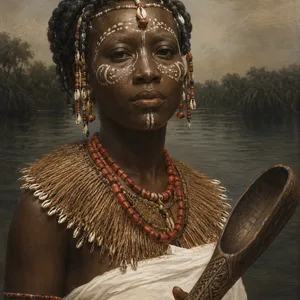
In the Owu masquerades that embody her, Esimirin is dressed in white and blue — the colors of water and sky — with veils of plant fiber evoking the aquatic grassbeds of the delta. Her ritual representations bear abundant adornments of cowrie shells, glass beads, and copper bracelets, signs of divine prosperity.
Housing
Esimirin dwells in the depths of the delta's rivers and channels — an aquatic palace imagined as an underwater city with mangrove columns and chambers lined with aquatic grasses. On land, her shrines are small open structures of wood and bamboo, always built at the water's edge, adorned with nets, shells, and votive figurines.
Historical Timeline
Period Vocabulary
Visual Style
Style inspiré des mascarades Owu Ijaw et de la sculpture sacrée du delta du Niger — formes puissantes et géométriques, parures rituelles de cauris et perles, palette bleu-vert des eaux profondes et ocre chaud de la forêt tropicale.
Sound Ambience
L'ambiance sonore du delta du Niger à l'aube — eau sombre et lente, tambours rituels, chants de prêtresses et nature foisonnante des mangroves, espace vivant et sacré d'Esimirin.
Liens externes & ressources
Références
Œuvres
Cycle mythologique de la création Ijaw (tradition orale)
Antiquité / transmission continue
Mascarades Owu (tradition vivante)
v. Ier millénaire / actuelles
Chants sacrés Ijaw (oru amain)
Traditions orales ancestrales
Récits étiologiques du delta (documentés par E.J. Alagoa, XXe siècle)
Collectés 1960-1989