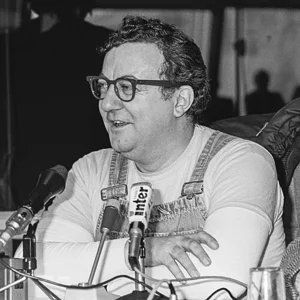

Fernand Raynaud (1926-1973) was one of the most popular French comedians of the postwar boom years. A pioneer of the French-style one-man show, he left his mark on radio, television and music hall with sketches that became classics of popular comedy.
Fernand Raynaud(1926 — 1973)
Fernand Raynaud
France
5 min read
Frequently asked questions
Famous Quotes
« Le 22 à Asnières»
« It used to pay, but it doesn't anymore»
« There's some kind of flaw»
Key Facts
- Born on 19 May 1926 in Clermont-Ferrand into a modest family
- Broke through in the Paris cabarets in the early 1950s and became a music-hall star
- Popularised the sketch “Le 22 à Asnières”, a satire of the slow telephone service, during the 1950s and 1960s
- Created iconic characters and catchphrases such as “It used to pay” and the “cannon barrel”
- Died on 28 September 1973 in a car accident near Toulouse, aged 47
Works & Achievements
A cult comedy sketch about telephone breakdowns, whose title became a proverbial French expression.
The monologue of a nostalgic peasant whose catchphrase entered everyday French speech.
A tender sketch featuring a naive character, one of his best-loved by audiences.
A comic sketch built on misunderstandings and absurd repetitions, typical of his style.
A sketch based on repetition and misunderstanding, which became a classic of popular comedy.
An autobiography recounting his childhood in Auvergne and his rise in the world of show business.
Numerous LP records that spread his humor into every French household.
Anecdotes
Fernand Raynaud was born in Clermont-Ferrand in 1926 into a modest family; his father ran a café. Before making it big, he worked a thousand odd jobs, including candy seller and messenger, before heading up to Paris to try his luck in the music hall.
His most famous sketch, “Le 22 à Asnières,” pokes fun at the sluggishness of the telephone system in the 1950s: a man can never manage to get his call connected and ends up running all the way to Asnières himself. The phrase became proverbial for describing a convoluted procedure.
In the sketch “Ça eut payé,” a peasant explains that working the land “used to pay” in the old days but that “it doesn't pay anymore” today. The line entered everyday speech as a nostalgic way to evoke an activity that has become barely profitable.
A lover of speed and beautiful cars, Fernand Raynaud met his death on 28 September 1973 in a road accident near Clermont-Ferrand, at just 47 years old, while he was at the peak of his popularity.
His recurring character, a naïve fellow wearing a beret and a big red nose in “Bourreau d'enfants,” embodied the average Frenchman—tender and a bit dim—in whom the whole audience could recognize itself.
Primary Sources
“Hello, is this number 22 in Asnières?… What? I can hardly hear you!”
“Culture, let me tell you: it used to pay, but it doesn't pay anymore.”
An account of his childhood in Clermont-Ferrand and his difficult beginnings in show business before finding fame in Paris.
“And the barrel of the cannon… the cannon barrel, that's where you put the powder!”
Key Places
Fernand Raynaud's birthplace, in Auvergne, where he grew up in the café run by his father. He often returned there and met his death there in 1973.
The capital where he made his debut in the cabarets of the Left Bank and then triumphed in the great music halls. The heart of his career as a comedian.
The legendary Parisian music-hall venue where Fernand Raynaud enjoyed his greatest triumphs on stage. The crowning of his national fame.
A town in the Paris suburbs made famous by his sketch “Le 22 à Asnières” (Number 22 at Asnières). It became a popular nod to his humor.
It was on a road in the Puy-de-Dôme that Fernand Raynaud was killed in a car crash on 28 September 1973. His sudden death shocked all of France.
Typical Objects
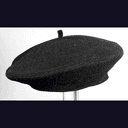
Traditional French headwear that he wore in several naïve characters. A symbol of the average post-war Frenchman.
📷 CC BY-SA 3.0 · Wikimedia Commons ↗
Iconic device from the sketch “Le 22 à Asnières”, where the operator and faulty lines make any call impossible. It embodies the fledgling telecommunications of the 1950s.

An essential tool for Raynaud's one-man shows and radio recordings. It carried his voice through the great music-hall theatres.

The medium on which his sketches were pressed and sold in large numbers. It allowed his humour to enter every French home.

The centrepiece of homes during the Trente Glorieuses, it made Raynaud a national star. His appearances drew millions of viewers.

Fernand Raynaud was passionate about beautiful, fast cars, a symbol of success in the motorised France of the 1960s. It was behind the wheel that he met his death.
School Curriculum
Vocabulary & Tags
Key Vocabulary
Daily Life
Morning
As a man of the stage, Fernand Raynaud often had late mornings after the previous night's performances. He used this time to rehearse his lines, polish his sketches, and answer his fans' letters.
Afternoon
His afternoons were filled with rehearsals, radio or television recordings, and meetings with his producers. A car enthusiast, he also loved getting behind the wheel of his fast cars.
Evening
The evening was the heart of his craft: he took to the stage in music halls and cabarets, performing one sketch after another before an enchanted audience. The shows often ended late into the night.
Food
The son of an Auvergnat café owner, Raynaud enjoyed traditional, hearty French cuisine. Like many performers, his meals were often irregular, grabbed between two rehearsals or after the show.
Clothing
Around town, he wore the elegant suits of a 1960s star. On stage, he slipped into character costumes, such as the beret and big red nose of his simple-minded characters.
Housing
Having become a national star, he split his life between Paris, where his career played out, and his native region of Auvergne, to which he remained deeply attached.
Historical Timeline
Period Vocabulary
Liens externes & ressources
Références
Œuvres
Le 22 à Asnières
années 1950
Ça eut payé
années 1950-1960
Bourreau d'enfants
années 1950
Le fût du canon
années 1960
Les Croissants
années 1960
Heureux !
1975 (posthume)
Enregistrements de sketches sur disque
années 1950-1970