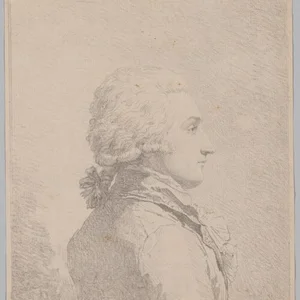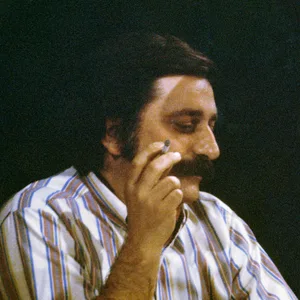

Copi (1939-1987) was an Argentine writer, playwright, and cartoonist who worked in French. A figure of the Parisian avant-garde, he blended ferocious humor, provocation, and theatre of the absurd.
Copi(1939 — 1987)
Copi
Argentine
6 min read
Frequently asked questions
Key Facts
- Born in 1939 in Buenos Aires into an upper-bourgeois family connected to the press (the newspaper Crítica)
- Settled in Paris in the early 1960s and adopted French as his language of creation
- From 1964 published the comic strip 'La Femme assise' (The Seated Woman) in Le Nouvel Observateur
- Wrote and performed provocative, absurdist theatre (L'Homosexuel ou la difficulté de s'exprimer, 1971; Les Quatre Jumelles, 1973)
- Died of AIDS in Paris in 1987
Works & Achievements
A series of humorous drawings published in the press, featuring a little woman on her chair. It became a classic of absurdist comics.
A play that established his world of gentle madness and absurd dialogue. One of his first major works for the stage.
A provocative comedy about identity and desire, emblematic of his transgressive and burlesque theatre.
A delirious science-fiction monologue that Copi performed himself. A solo performance that became a cult favourite.
A novel blending exile, Argentine family memory and unbridled fantasy. It showcases his flair for fiction.
A fantastical and satirical novel in which Parisian rats become the sardonic heroes of an urban fable.
A play mixing black humour and the fantastic, one of his great theatrical successes of the 1980s.
His final play, a tender and cruel comedy about an actor dying in hospital. An echo of his own illness.
Anecdotes
Copi's real name was Raúl Damonte Botana. The nickname “Copi” came from his grandmother, who called him that tenderly when he was a child in Argentina. He kept this pet name his whole life, including as his artist's signature.
He came from a famous newspaper family: his grandfather Natalio Botana had founded Crítica, one of the largest Argentine newspapers. With politics forcing his family into exile, Copi spent part of his childhood travelling, which explains why he grew up between Spanish and French.
Every week, readers of the Nouvel Observateur found his drawing of a little woman sitting on a chair, talking to herself or to a duck. This “Seated Woman” became a cult character of absurd humour comics in the 1960s.
Copi wrote his plays directly in French, a language that was not his mother tongue. He played with it through fierce humour, blending cross-dressing, provocation and the fantastical, which turned his shows into genuinely joyful scandals.
He was one of the figures of the FHAR (Homosexual Front for Revolutionary Action) in early 1970s Paris, combining his art of mockery with a commitment to gay freedom and visibility.
Primary Sources
A play in which Copi sets up his world of loneliness, gentle madness and absurd dialogue, characteristic of his theatre of derision.
A little woman on her chair chats with a duck about life, death and boredom, in silent, zany vignettes.
A provocative comedy set in Siberia, where cross-dressing and the grotesque serve a biting reflection on identity and desire.
A novel in which Copi draws on his Argentine vein, blending exile, family memory and unbridled fantasy.
Copi's last play, a comedy about an actor dying in hospital, written while he himself was ill.
Key Places
Copi's birthplace, where he grew up in a famous newspaper-publishing family. His Argentine roots feed his entire body of work.
The city he made his own, where Copi settled in the early 1960s and pursued his whole career as a writer, cartoonist, and man of the theatre. He died here in 1987.
The city on the other bank of the Río de la Plata where Copi's family stayed during their successive political exiles.
Small Left Bank venues where his provocative plays premiered in the 1960s–1980s. They were the laboratory of his theatre of mockery.
A grand Parisian cemetery where many figures of the arts rest, in the city that was the stage for Copi's entire career.
Typical Objects

The press cartoonist's tools with which Copi sketched his weekly little scenes. His simple, nervous line served an absurd sense of humour.

The signature object of his comic-strip character: a little woman perpetually seated on her chair. The chair becomes the sole, absurd setting for her dialogues.

The dresses, wigs and make-up Copi wore in his shows. Cross-dressing was at the heart of his provocative and liberating theatre.

The tool on which Copi wrote his plays and novels directly in French. On it he forged an inventive, funny and deliberately offbeat language.

The recurring and silent companion of the Seated Woman in his drawings. This duck embodies the absurdity and nonsense of her dialogues.

The Parisian weekly that published Copi's drawings for many years. It brought his humour to a wide, cultured audience.
School Curriculum
Vocabulary & Tags
Key Vocabulary
Daily Life
Morning
Copi often started his day late, a nocturnal artist by nature. In the morning, he returned to his drawing board to prepare the weekly sketch awaited by the newspapers.
Afternoon
The afternoon was devoted to writing his plays and novels, typed directly in French on his typewriter. He also frequented the Parisian cafés, gathering places for the avant-garde.
Evening
In the evening, he joined the small theaters of the Left Bank to rehearse or perform. Copi loved the stage, where he himself embodied his cross-dressing, over-the-top characters.
Food
As a Parisian bohemian, he shared bistro and café meals, washed down with lively discussions. His Argentine roots also connected him to the flavors of the Río de la Plata, such as maté and grilled meat.
Clothing
In everyday life, Copi sported the casual look of the Parisian artists of the 1960s and 1970s. On stage, he transformed himself, adopting provocative dresses, wigs, and makeup.
Housing
He lived in Parisian apartments, at the heart of a city he had chosen as his artistic homeland. His home was that of an exiled writer, caught between two cultures and two languages.
Historical Timeline
Period Vocabulary
Liens externes & ressources
Références
Œuvres
La Femme assise
années 1960
La Journée d'une rêveuse
1968
L'Homosexuel ou la difficulté de s'exprimer
1971
Loretta Strong
1974
La Vie est un tango
1979
La Cité des rats
1981
La Nuit de Madame Lucienne
1985