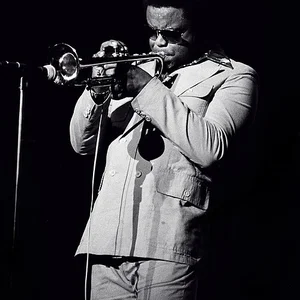

Freddie Hubbard (1938-2008) was an American jazz trumpeter, one of the major figures of hard bop. Blessed with a brilliant technique and a dazzling sound, he left his mark on the 1960s and 1970s before broadening his style toward jazz fusion.
Freddie Hubbard(1938 — 2008)
Freddie Hubbard
États-Unis
5 min read
Frequently asked questions
Key Facts
- Born on April 7, 1938, in Indianapolis (Indiana), died on December 29, 2008, in Sherman Oaks (California).
- Member of Art Blakey's Jazz Messengers in the early 1960s, a benchmark school of hard bop.
- Took part in landmark avant-garde albums: Ornette Coleman's 'Free Jazz' (1960), Eric Dolphy's 'Out to Lunch' (1964), John Coltrane's 'Ascension' (1965), and Herbie Hancock's 'Maiden Voyage' (1965).
- Recorded as a leader for Blue Note ('Open Sesame', 1960; 'Ready for Freddie', 1961; 'Hub-Tones', 1962).
- Won a Grammy Award for the album 'First Light' (1972), during his shift toward jazz fusion at CTI Records.
Works & Achievements
Hubbard's first album as a leader, on Blue Note; at just 22, he already shows off his dazzling technique.
A revolutionary collective recording he takes part in, blending two quartets improvising at the same time.
A landmark album from his Blue Note period, surrounded by musicians like Wayne Shorter and McCoy Tyner.
Major, daring records on which Hubbard plays the trumpet, proof of his versatility.
His most famous album, blending hard bop, soul, and funk; a classic of 1970s jazz.
An album with refined orchestrations that earns him a Grammy Award.
An onstage reunion of Miles Davis's former quintet, where Hubbard takes back the role of star trumpeter.
Anecdotes
When Freddie Hubbard arrived in New York in 1958, he shared an apartment with the multi-instrumentalist Eric Dolphy. The two musicians rehearsed together for hours and pushed each other to explore new ideas, which shaped the young trumpeter.
In December 1960, at only 22, Hubbard took part in the recording of Ornette Coleman's “Free Jazz”: two quartets improvised at the same time for nearly forty minutes. It was one of the boldest experiments in the history of jazz.
Hubbard idolized the trumpeter Clifford Brown, who died in a car accident in 1956 at only 25. His brilliant, lightning-fast technique was directly inspired by his hero, whose virtuosity he dreamed of matching.
In 1961, he joined drummer Art Blakey's Jazz Messengers, a true “university of jazz” through which the greatest soloists passed. Alongside Blakey, Hubbard learned to lead a band and earned an international reputation.
In 1992, a split lip that was poorly treated became infected and severely damaged his embouchure — the lip control essential to any trumpeter. Despite years of effort, he never regained all of his former power, a tragedy for such a virtuoso.
Primary Sources
Freddie Hubbard's first album as a leader, recorded on June 19, 1960; this record already showcases the dazzling maturity of the 22-year-old trumpeter.
Album recorded in January 1970; its title track “Red Clay” became one of the most widely covered themes in soul- and funk-tinged jazz.
Hubbard often repeated that Clifford Brown was his idol and that he had first tried to reproduce his playing before finding his own voice.
Key Places
City in Indiana where Freddie Hubbard was born in 1938 and took his first steps as a musician.
The world capital of jazz, where Hubbard settled in 1958 and launched his career in the clubs and studios.
New Jersey studio where engineer Rudy Van Gelder recorded much of Hubbard's Blue Note output.
Los Angeles neighborhood where Hubbard, settled on the West Coast, died in December 2008.
Typical Objects

His instrument of choice, from which he drew a brilliant tone and a dazzling technique that made his reputation.

A rounder, more velvety cousin of the trumpet; Hubbard uses it notably on the album “First Light.”

A cone or cup placed in the bell of the brass instrument to dampen and color the sound, widely used in jazz.

The small part on which the trumpeter rests their lips; this is where the 1992 injury upended his playing.

The famous 33 rpm records on the Blue Note label, on which Hubbard cut his first masterpieces in the 1960s.

A sheet noting the melody and chords, the basis from which musicians improvise their solos.
School Curriculum
Vocabulary & Tags
Key Vocabulary
Tags
Daily Life
Morning
Like many jazz musicians, Hubbard rose late after the previous night's concerts. His morning often began with long sessions of working on his instrument: scales, long tones, and exercises to maintain his embouchure.
Afternoon
Afternoons were devoted to rehearsals with his band or recording sessions in the studio, notably at Rudy Van Gelder's. There, arrangements and improvisations were fine-tuned.
Evening
In the evening came the concerts in New York's jazz clubs, where musicians often played several sets late into the night. The jam sessions that followed allowed musicians to test themselves against one another and to invent.
Food
Life on tour meant meals grabbed on the go and irregular schedules. Hubbard remained attached to American cuisine and the Southern dishes (soul food) of his youth in Indiana.
Clothing
In the 1960s, jazz musicians took great care with their appearance, sporting elegant suits, slim ties, and impeccable shirts. In the 1970s, Hubbard adopted a freer, more colorful style, in keeping with jazz fusion.
Housing
When he first arrived in New York, he lived in modest apartments, at first sharing one with Eric Dolphy. Once success came, he settled more comfortably, and later moved to the West Coast, in Los Angeles.