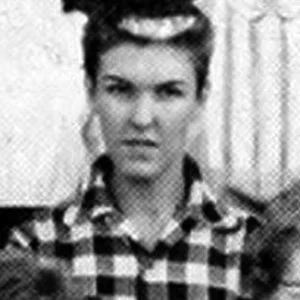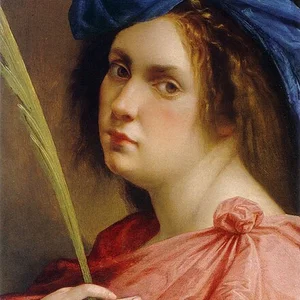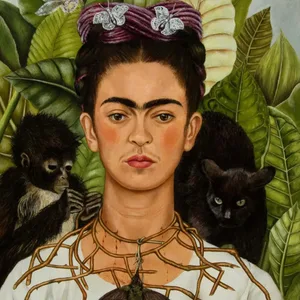

Mexican painter (1907–1954), renowned for her expressionist self-portraits and works exploring physical pain and identity. An iconic figure of surrealism and feminism, she transformed her personal suffering into major artistic creation.
Frequently asked questions
Famous Quotes
« Feet, what do I need you for when I have wings to fly?»
« I paint my own reality»
« I am my own muse. I am the subject I know best»
Key Facts
- 1925: serious bus accident that marks the beginning of her series of self-portraits
- 1938: first solo exhibition in New York, international recognition
- 1939: involvement in the surrealist movement, meeting with André Breton
- Created more than 55 self-portraits during her lifetime
- 1954: death in Mexico City, on the day of her 47th birthday
Works & Achievements
Frida's first self-portrait, painted at age 19 during her convalescence after the accident. It already anticipates her characteristic style of intense and meticulous self-portraits, influenced by Renaissance masters.
Double portrait depicting Frida and her husband Diego Rivera hand in hand, in which she presents herself as a proud wife but also as an artist in her own right. Now held at the San Francisco Museum of Modern Art.
An autobiographical work depicting Frida after one of her miscarriages in Detroit. The painting illustrates her physical and psychological pain with uncompromising brutality, inaugurating her most personal style.
Masterpiece painted after her divorce from Rivera, depicting two versions of Frida with exposed hearts connected by a vein. The largest canvas she ever painted, now at the Museo de Arte Moderno in Mexico City.
A poignant self-portrait showing Frida with her body split open, her spine replaced by a crumbling Ionic column riddled with nails. Painted after one of her many back surgeries, it symbolizes her permanent pain.
Painting depicting Frida dressed in her Tehuana costume, holding her own spine in a lunar landscape, facing her operated and recumbent body. A symbol of her will to resist in the face of suffering.
Frida's last completed work, painted eight days before her death. On slices of watermelon, she inscribed "Viva la vida" — a vibrant testament to her love of life despite all the ordeals she endured.
Anecdotes
At the age of six, Frida Kahlo contracted polio, which left her right leg thinner and shorter than her left. Her classmates nicknamed her "Frida pata de palo" (Frida peg-leg). To compensate for this disability, she wore extra socks and platform shoes, hidden beneath her long Tehuana skirts.
On September 17, 1925, the bus Frida was riding home was struck by a tram. She suffered multiple fractures — spine, collarbone, ribs, pelvis — as well as a metal rod that pierced her body all the way through. It was during her long, immobilized recovery, equipped with a special easel fixed to the ceiling above her bed, that she truly began to paint.
In 1938, André Breton, father of Surrealism, visited Frida Kahlo in Mexico and was dazzled by her work. He wrote that she practiced Surrealism "spontaneously." Frida, who did not identify with the movement, replied with humor: "They think I am a Surrealist, but I am not. I never paint dreams. I paint my own reality."
Frida Kahlo and Diego Rivera married twice: in 1929, and again in 1940 after their divorce. Their passionate and tumultuous relationship was marked by mutual infidelities. Rivera himself admitted he did not deserve such a woman, calling her "the best proof that teleological evolution exists."
At her first and only solo exhibition in Mexico, in April 1953 at the Lola Álvarez Bravo gallery, doctors forbade her from getting up due to her declining health. Frida had her four-poster bed transported into the exhibition hall and received her guests lying down, in full traditional dress, refusing to let illness triumph over her artistic presence.
Primary Sources
I suffered two serious accidents in my life, one in which a streetcar knocked me down… The other accident is Diego.
Diego, my love, do not forget that as soon as the brushes are in my hands, the world will be too small to contain my joy.
I never painted dreams. What I painted was my most intimate reality.
My art is not revolutionary, why keep calling it that? I cannot, because I am too honest for that.
Key Places
The blue house in Coyoacán, where Frida was born, lived, and died, is today the Museo Frida Kahlo. It is there that she painted the majority of her works and received Rivera, Trotsky, Breton, and many notable figures.
Frida accompanied Diego Rivera during his fresco commissions in the United States between 1930 and 1933, discovering American capitalism, which she criticized sharply. It was in New York that she exhibited for the first time in 1938.
In 1939, André Breton organized an exhibition of her work at the Galerie Renou et Colle. The Louvre then acquired her self-portrait "The Frame", the first work by a Mexican artist to enter the museum's collections.
Frida was one of the few girls admitted in 1922, where she met Diego Rivera while he was painting a fresco, and joined the radical student group "Los Cachuchas". It was there that her political and artistic convictions were forged.
A historic neighborhood of Mexico City where Frida grew up and spent most of her life. Its atmosphere of a Mexican colonial town, its colorful markets, and its popular culture deeply nourished her pictorial world.
Typical Objects

Specially designed for her after her accident, this easel attached to her bed canopy and allowed her to paint while lying down. It has become the symbol of her creative resilience in the face of physical pain.

Frida wore the traditional costumes of the Tehuantepec region almost daily: long colorful skirts, embroidered huipil, and floral headdress. This garment was both a Mexican identity statement and a way to conceal her shorter leg.

Following her multiple spinal surgeries, Frida wore up to 35 different orthopedic corsets throughout her life. She painted and decorated them with Mexican motifs, transforming these medical devices into works of art.

Her mother had a large mirror installed on the ceiling of her canopy bed so she could see herself during her long periods of immobility. This mirror is directly responsible for the series of self-portraits that make up the bulk of her work.

Frida used vivid pigments and saturated colors typical of Mexican folk art. Her very fine brushes allowed her to achieve the intimate and meticulous detail characteristic of her technique.

Frida regularly smoked unfiltered cigarettes and drank tequila, going against the feminine norms of the time. These habits, visible in certain photographs, were part of her image as a free and rebellious woman.
School Curriculum
Vocabulary & Tags
Key Vocabulary
Tags
Mouvement
Daily Life
Morning
Frida often woke up late due to the chronic pain that disrupted her sleep. She would begin her day in her four-poster bed at the Casa Azul, writing in her diary or reading political and philosophical works before getting up.
Afternoon
Afternoons were devoted to painting in her studio adjoining the Casa Azul, often lying down or seated in a chair adapted to her corset. She also received friends, intellectuals, and communist activists, hosting passionate discussions over a glass of tequila.
Evening
Evenings at the Casa Azul were often lively and festive, with communal dinners where Frida enjoyed cooking traditional Mexican dishes for her guests. She sang corridos and rancheras, sometimes played guitar, and always wore her finest Tehuana costumes for these occasions.
Food
Frida was a passionate cook who prepared traditional Mexican dishes: mole negro, tamales, enchiladas, and a wide variety of tropical fruits. She regularly drank tequila and very strong black coffee, and loved visiting the colorful markets of Coyoacán for her daily provisions.
Clothing
Frida exclusively wore the traditional costumes of the Isthmus of Tehuantepec: long velvet or cotton embroidered skirts, colorful huipil blouses, rebozo shawls, and huarache sandals. She adorned her black hair with fresh flowers, ribbons, and pre-Columbian gold jewelry, creating an immediately recognizable style.
Housing
The Casa Azul in Coyoacán, painted in vivid cobalt blue, was an 18th-century colonial house surrounded by a lush garden populated with monkeys, parrots, and xoloitzcuintle dogs. The interior walls were adorned with ex-votos, Mexican folk art and pre-Columbian objects, and photographs of revolutionary figures.
Historical Timeline
Period Vocabulary
Visual Style
Style pictural alliant art populaire mexicain, iconographie précolombienne et expressionnisme intime, avec des couleurs vives et une symbolique personnelle dense.
Sound Ambience
Ambiance sonore de la Casa Azul à Coyoacán : jardin tropical, musique mexicaine traditionnelle, bruits du quotidien d'une artiste dans le Mexico des années 1940.
Liens externes & ressources
Références
Œuvres
Autoportrait au collier de velours
1926
Frieda et Diego Rivera
1931
Les Deux Fridas
1939
Vive la vie (Nature morte aux pastèques)
1954