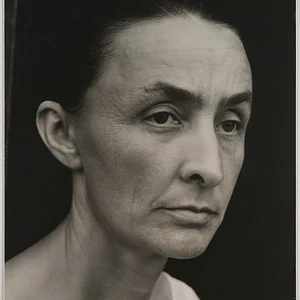

Georgia O'Keeffe was a pioneering American painter of modern art, celebrated for her abstract close-up depictions of flowers and her landscapes of New Mexico. Regarded as the "Mother of American Modernism," she asserted a singular style — balancing figuration and abstraction — over a career spanning more than seven decades.
Georgia O'Keeffe(1887 — 1986)
Georgia O'Keeffe
États-Unis
8 min read
Frequently asked questions
Famous Quotes
« I found I could say things with color and shapes that I couldn't say any other way — things I had no words for.»
« To create one's own world takes courage.»
Key Facts
- Born in 1887 in Wisconsin, she studied art in Chicago and New York in the early twentieth century.
- In 1916, gallerist Alfred Stieglitz exhibited her work in New York, launching her career; they married in 1924.
- During the 1920s and 1930s, her series of monumental close-up flowers brought her international renown.
- From 1949 onward, she settled permanently in Abiquiú, New Mexico, whose desert landscapes became her favorite subject.
- She received the Presidential Medal of Freedom in 1977 and remained active until her death in 1986 at the age of 98.
Works & Achievements
Large oil on canvas depicting a black iris in extreme close-up, held at the Metropolitan Museum of Art in New York. This painting is emblematic of her floral series, which prompted symbolic interpretations that the artist always rejected.
A cow skull set against a background in the colors of the American flag, a provocative work offering an alternative and stark vision of national identity. Held at the Metropolitan Museum of Art in New York.
A nocturnal view of New York City with its illuminated skyscrapers, a testament to O'Keeffe's fascination with American modernist architecture before her departure for the desert.
A New Mexico landscape combining the characteristic red hills of Abiquiú with sun-bleached bones. This painting perfectly encapsulates her poetic vision of the American desert.
One of the largest canvases O'Keeffe ever painted (2.4 × 7.3 m), depicting a sea of clouds seen from an airplane. Created at the age of 77, this monumental work is a testament to her undiminished artistic ambition.
A painting sold in 2014 for $44.4 million, an absolute record for a work by a female painter at the time. It depicts a large white jimsonweed flower seen from above, in a style that is simultaneously realistic and abstract.
Anecdotes
Georgia O'Keeffe once stated that she painted flowers in very large format to force people to truly look at them. Her canvases of poppies and white lilies sometimes measure more than a meter, transforming a simple flower into a monumental landscape that the viewer cannot ignore.
In 1929, O'Keeffe traveled to New Mexico for the first time and literally fell in love with the desert. She returned every summer for years before settling there permanently in 1949, drawn by the raking light, the sun-bleached animal skulls, and the vast ochre expanses she would paint for the rest of her life.
Her husband, the celebrated photographer Alfred Stieglitz, took more than 350 photographs of her between 1917 and 1937, creating one of the most exhaustive portraits ever made of one artist by another. This exceptional artistic collaboration was also a turbulent love story that deeply inspired the work of both artists.
When her eyesight began to decline severely in the 1970s, O'Keeffe, then in her eighties, refused to give up art. She turned to working with clay, creating hand-built sculptures guided by touch rather than sight. She continued to paint with the help of assistants until her final years.
In 1977, President Jimmy Carter awarded her the Presidential Medal of Freedom, the highest civilian distinction in the United States. At 90 years old, O'Keeffe had become the living symbol of artistic freedom and feminine independence, an icon that American feminists claimed as one of their own.
Primary Sources
I found I could say things with color and shapes that I couldn't say any other way — things I had no words for.
I feel there is something unexplored about woman that only a woman can explore. Men have done all they can do about it.
The desert is the most wonderful thing I have ever seen. I want to paint it — I must paint it.
I have lived on a land that I love. All my work is simply an expression of that relationship between myself and the place where I live.
When I got to New Mexico that was mine. As soon as I saw it that was my country. I'd never seen anything like it before but it fitted to me exactly.
Key Places
Ranch where O'Keeffe lived and worked for decades, surrounded by the multicolored cliffs of Cerro Pedernal that she painted hundreds of times. This mineral and sublime landscape is inseparable from her later work.
Alfred Stieglitz's gallery at 291 Fifth Avenue, site of O'Keeffe's first exhibition in 1917 and a temple of the American artistic avant-garde. It was here that her career truly took off.
Museum founded in 1997 and entirely dedicated to O'Keeffe's work, housing more than 3,000 of her pieces. It is the first American museum devoted to a female artist.
Georgia O'Keeffe's hometown where she grew up on a family farm, surrounded by the vast flat expanses of the American Midwest. This early relationship with open nature left a lasting mark on her artistic sensibility.
The Stieglitz family property where O'Keeffe spent many summers, painting the lake, trees, and clouds. This lakeside period contrasts with her desert paintings and speaks to the diversity of her work.
Typical Objects

O'Keeffe collected bones and animal skulls found in the New Mexico desert. She painted them in celebrated series where these remains float against a blue sky, poetic symbols of the arid beauty of the American West.

Although it was Stieglitz who photographed her, O'Keeffe used a camera herself to document landscapes and found objects. Photography influenced the way she framed and zoomed in on details, defining her distinctive style.

O'Keeffe worked with high-quality brushes that allowed for very smooth, gradual color transitions. This chromatic sfumato technique is characteristic of her flower petals and desert landscapes.

O'Keeffe drove her own Ford to explore the desert trails of New Mexico. Her freedom of movement in this wild landscape was essential to her artistic practice and to her identity as an independent woman.

She often painted directly in the desert, setting up her easel at the foot of the red and orange cliffs of Ghost Ranch. This direct contact with the scorching, silent nature was at the heart of her daily artistic practice.

O'Keeffe was known for her minimalist, almost monastic wardrobe: plain black, white, or gray dresses with no ornamentation. This deliberate choice reflected her artistic philosophy: the essential, with no decorative excess.
School Curriculum
Vocabulary & Tags
Key Vocabulary
Tags
Daily Life
Morning
O'Keeffe rose before dawn at Ghost Ranch to take advantage of the raking morning light on the cliffs. She began her day with a long walk through the desert, observing nature and collecting bones, stones, or flowers that inspired her.
Afternoon
In the afternoon, she painted in her studio or outdoors, working in the natural light of the Southwest. She could spend hours on a single painting, applying layers of oil paint in imperceptible gradations with great precision.
Evening
In the evenings, O'Keeffe read extensively, particularly Eastern philosophy and Zen Buddhism, which influenced her conception of emptiness and space in her compositions. She would sometimes receive artist or writer friends in her spare and unadorned home in Abiquiú.
Food
A committed vegetarian since the 1920s, O'Keeffe grew her own vegetable garden in Abiquiú and consumed fresh vegetables, grains, and aromatic herbs. She attributed her exceptional longevity (98 years) in part to this healthy and simple diet.
Clothing
O'Keeffe was famous for her minimalist and timeless wardrobe: simple-cut black, white, or gray dresses and tunics, with no jewelry or ornamentation. This rejection of decorative excess in her clothing directly reflected her artistic philosophy.
Housing
Her house in Abiquiú, purchased in 1945 and renovated by her own hand, was a traditional adobe dwelling typical of New Mexico, with thick raw earth walls and windows framing views of the patio and the desert. The interior was stripped back, almost monastic, with natural objects — bones, rocks, dried flowers — arranged like sculptures.
Historical Timeline
Period Vocabulary
Visual Style
Style moderniste américain caractérisé par des gros plans d'objets organiques, des dégradés de couleur ultra-lisses et une simplification géométrique des formes naturelles évoquant à la fois le réalisme et l'abstraction.
Sound Ambience
Ambiance sonore du désert du Nouveau-Mexique à Ghost Ranch : vent chaud sur les falaises ocre, silence immense du plateau désertique, coyotes et corbeaux ponctuant une solitude créatrice choisie.
Liens externes & ressources
Références
Œuvres
Cow's Skull: Red, White, and Blue
1931
Radiator Building — Night, New York
1927
Sky Above Clouds IV
1965