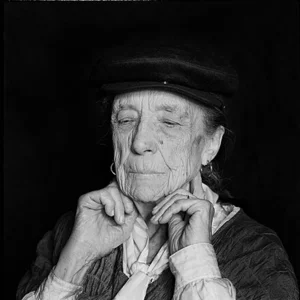

Franco-American sculptor
Louise Bourgeois(1911 — 2010)
Louise Bourgeois
France, États-Unis
7 min read
Frequently asked questions
Famous Quotes
« L'art est une garantie de santé mentale.»
« Je suis une femme sans inconscient — je suis toute sur la surface.»
Key Facts
- Née à Paris en 1911, elle émigre aux États-Unis en 1938 après son mariage avec l'historien d'art Robert Goldwater
- Sa série des « Cells » (années 1990) explore la douleur, le désir et les traumatismes de l'enfance
- Ses araignées monumentales « Maman » (1999) sont exposées dans les plus grands musées du monde, dont le musée Guggenheim de Bilbao
- Elle connaît une reconnaissance internationale tardive : rétrospective au MoMA de New York en 1982, à plus de 70 ans
- Décède à New York en 2010 à l'âge de 98 ans, laissant une œuvre de plus de 80 ans de création
Works & Achievements
Series of vertical wooden sculptures evoking solitary human silhouettes, exhibited as early as 1949 at MoMA. Each figure represents a loved one who remained in France after her emigration.
Installation in latex, plaster and bone, depicting a fantasy scene in which the children devour the tyrannical father. A pivotal work in her career, combining symbolic violence and psychoanalysis.
Series of drawings and prints depicting a woman whose head is replaced by a house. A feminist icon ahead of its time, it illustrates the domestic confinement imposed on women.
Enclosed environments of metal and glass containing personal objects, sculptures and body fragments. Each 'cell' explores a form of pain or encapsulated memory.
Monumental spider in bronze, steel and marble, standing 9.27 meters tall. Created for the Tate Modern, it pays tribute to the artist's weaver mother and has become one of the most celebrated sculptures of the 20th century.
The first large bronze spider in the series, preceding 'Maman'. It condenses the maternal symbolism and the ambivalence between protection and threat that runs throughout Bourgeois's work.
Installation of three steel towers presented at the Tate Modern, inviting the public to climb and cross paths. It embodies the perpetual cycle of creation, destruction and reconstruction that defines Bourgeois's approach.
Anecdotes
Louise Bourgeois was born in Paris in 1911 into a family of tapestry restorers. Her mother, Joséphine, was a weaver and represented for Louise a figure of gentleness and resilience. When her mother died as Louise was 21, this bereavement would shape her entire future body of work.
Her father, Louis Bourgeois, maintained a ten-year affair with the family's English governess, Sadie Gordon Richmond, who lived under the same roof. Louise experienced this betrayal as a deep humiliation: she made it the secret driving force behind sculptures such as 'The Destruction of the Father' (1974), a monument to rage and symbolic revenge.
After settling in New York following her marriage to art historian Robert Goldwater in 1938, Louise Bourgeois remained largely overlooked by the art market for years. Her first major retrospective at MoMA did not come until 1982, when she was 71. She thus became one of the most celebrated artists in the world at an age when many people retire.
The sculpture 'Maman' (1999), a monumental bronze and steel spider standing over nine metres tall, was created for the inauguration of Tate Modern in London. For Louise Bourgeois, the spider symbolised her mother: a skilled weaver, protective, patient, and formidable all at once. Casts of 'Maman' are now installed outside several major museums around the world.
From the 1950s onwards, Louise Bourgeois held 'Sunday Sessions' in her New York studio: weekly gatherings where artists, critics, and friends freely debated art and psychoanalysis. She herself underwent psychoanalysis for more than twenty years and regarded her intimate journals as a work in their own right, published in 1994 under the title 'Destruction of the Father / Reconstruction of the Father'.
Primary Sources
I am alone, I am always alone. My work is there to protect me. It represents the fear I have of losing control.
Art is a guaranty of sanity. That is the most important thing I have said.
My work grows from the duel between the isolated individual and the shared awareness of the group.
Sculpture is a body. It has a nervous system, moods, feelings. It can look unwell. It changes from day to day.
The Cells represent different types of pain: the physical, the emotional and psychological, and the mental and intellectual. The fear of pain is the fear of vulnerability.
Key Places
Town where Louise Bourgeois grew up, in her family's tapestry restoration workshop. This artisanal environment shaped her relationship with materials and craftsmanship.
Louise Bourgeois's studio and residence for decades, home to her legendary 'Sunday Sessions' and the creation of nearly all of her American work.
Venue of her landmark 1982 retrospective, which brought her work international recognition at the age of 71 and changed the art world's perception of this long-overlooked artist.
Museum inaugurated in 2000 with Bourgeois's installation 'Maman' in the Turbine Hall. This monumental spider has become one of the iconic images of contemporary art.
Where Louise Bourgeois received her training in the 1930s, before also studying with Fernand Léger and Wassily Kandinsky at the Académie de la Grande Chaumière.
Liens externes & ressources
Références
Œuvres
The Destruction of the Father
1974
Femme Maison
1946-1947
I Do, I Undo, I Redo
2000