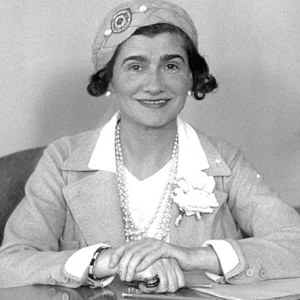

Revolutionary French fashion designer (1883–1971), Coco Chanel transformed women's fashion by offering simple, comfortable, and elegant clothing. Founder of the eponymous fashion house, she established modern style and freedom of movement as the new standards of elegance.
Frequently asked questions
Famous Quotes
« Fashion is something that is found in the streets, inspired, taken on the move by people»
« Fashion is not something that exists in dresses only. Fashion is in the sky, in the street, fashion has to do with ideas, the way we live, what is happening»
Key Facts
- 1910: Opens her first fashion workshop in Paris, on Rue Cambon
- 1920s: Launches the straight, simple dress that frees women from the corset, revolutionizing women's fashion
- 1926: Creates the 'little black dress', which becomes a timeless classic of elegance
- 1921: Launch of Chanel No. 5 perfume, a symbol of French luxury
- 1971: Dies in Paris after having transformed the female silhouette of the 20th century
Works & Achievements
The first fashion designer's perfume, composed by Ernest Beaux with synthetic aldehydes. It became the most famous perfume in the world.
A simple dress in black crêpe de Chine that democratized elegance. It transformed black, a color of mourning, into a universal symbol of chic.
A braid-trimmed tweed jacket-and-skirt ensemble, comfortable and structured, which became the uniform of the modern, active woman of the 20th century.
A quilted handbag with a gold chain, freeing women's hands. Its name comes from its creation date: February 1955.
Chanel designed the costumes for Diaghilev's ballet Le Train Bleu, with Cocteau writing the libretto, blending haute couture with artistic avant-garde.
The introduction of jersey, a supple and inexpensive fabric, into luxury women's fashion, breaking conventions about noble materials.
Anecdotes
Gabrielle Chanel grew up in an orphanage in Aubazine, in the Corrèze region, after her mother's death in 1895. It was there that she learned to sew, and the austerity of the place — white walls, clean lines — profoundly influenced her minimalist sense of style.
The nickname 'Coco' is said to come from her years as a café-concert singer in Moulins, around 1905, where she performed the song 'Qui qu'a vu Coco dans l'Trocadéro'. The garrison officers who came to hear her reportedly gave her the nickname.
In 1926, Chanel introduced her famous 'little black dress', a simple garment made of crêpe de Chine. Vogue magazine compared it to the Ford Model T: a universal design accessible to women of all social classes.
During World War II, Chanel closed her fashion house and did not reopen it until 1954, at the age of 71. Her comeback was initially mocked by the Parisian press, but American audiences gave her a triumphant reception, relaunching her career.
Chanel was one of the first designers to deliberately sunbathe in the 1920s, during cruises along the French Riviera. At a time when pale skin was a sign of distinction, she launched the fashion for tanned skin among high-society women.
Primary Sources
Here is a Ford signed Chanel — the frock that all the world will wear — is model T. The Chanel Ford — the frock that the whole world will wear — is simple, black, and accessible.
I gave women's bodies their freedom back. That body was sweating in ceremonial clothes, under lace, corsets, undergarments, and padding.
The best-selling perfume in the world. Chanel N°5, the perfume of a woman who smells like a woman.
Fashion fades, style never does. I shaped fashion for half a century. Why? Because I knew how to express my time.
Key Places
Former Cistercian monastery where Chanel spent her childhood. The austerity and geometry of the place shaped her entire aesthetic.
Historic headquarters of the House of Chanel since 1918, home to her couture salons and her personal apartment above the boutique.
Chanel lived here for the last thirty years of her life, in a suite on the first floor. It is where she died in January 1971.
Seaside resort where Chanel opened her first proper fashion boutique in 1913, launching her jersey outfits inspired by menswear.
Villa La Pausa, built for Chanel in 1929, where she entertained artists and intellectuals such as Cocteau, Picasso, and Stravinsky.
Typical Objects

An essential tool for Chanel, who cut and adjusted fabrics herself directly on mannequins, refusing to sketch her designs on paper.

Chanel popularized costume jewelry, particularly long pearl sautoirs worn as everyday accessories, breaking the monopoly of precious jewellery.

With its clean, geometric design, this rectangular bottle broke away from the ornate flacons of the era and became an icon of the 20th century.

A masculine fabric that Chanel repurposed as the signature material of her women's suits, symbols of relaxed elegance.

Chanel worked by draping fabric on live mannequins, sculpting her creations in three dimensions rather than from flat patterns.

Chanel's signature flower, which became the emblem of the House. She often wore it in her buttonhole and incorporated it into her designs.

Chanel incorporated gold chains into the straps of her bags and the hems of her jackets to ensure a perfect drape.
School Curriculum
Vocabulary & Tags
Key Vocabulary
Daily Life
Morning
Chanel woke up late, often around 10 o'clock, in her suite at the Ritz. She had a light breakfast, browsed the press and fashion magazines. Then she crossed Rue Cambon to reach her workshops, always impeccably dressed.
Afternoon
The afternoon was devoted to fittings in her couture salons. Chanel worked directly on live models, pinning, cutting and adjusting fabrics for hours, demanding perfection from her head seamstresses. She also received prestigious clients.
Evening
In the evenings, Chanel often dined at the Ritz or at the homes of friends from the arts world. She frequented Parisian intellectual and artistic circles, rubbing shoulders with Cocteau, Stravinsky or Visconti. She went to bed late, sometimes working on her ideas well into the night.
Food
Chanel ate simply and frugally. She appreciated classic French cuisine but in small portions, mindful of keeping her slim figure. She drank little alcohol and preferred water and tea.
Clothing
Chanel wore her own creations on a daily basis: tweed suit, silk blouse, two-tone pumps and pearl sautoirs. She herself embodied the style she championed: understated, elegant, comfortable, with nothing superfluous.
Housing
Chanel spent her last thirty years in a suite at the Hôtel Ritz, Place Vendôme. Her private apartment at 31 Rue Cambon, where she received guests but did not sleep, was decorated with Coromandel screens, mirrors and books, in a style of discreet luxury.
Historical Timeline
Period Vocabulary
Visual Style
Un style visuel noir, blanc et or inspiré de l'Art déco, mêlant élégance parisienne, lignes épurées et sophistication intemporelle propre à l'univers Chanel.
Sound Ambience
L'atmosphère sonore d'un atelier de haute couture parisien des années 1920-1960 : ciseaux, froissements de tissus, murmures élégants et bruits feutrés de la rue Cambon.
Liens externes & ressources
Références
Œuvres
Chanel N°5
1921
La petite robe noire
1926
Le tailleur en tweed Chanel
1954
Le sac 2.55
1955
Les costumes pour le Ballets russes
1924
Le jersey de mode
1916