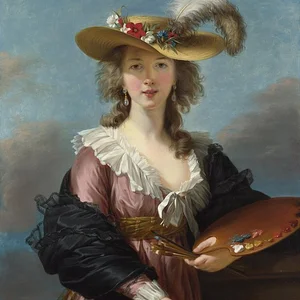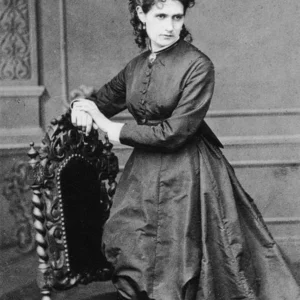
Portrait de Berthe Morisot

Berthe Morisot

Berthe Morisot

1841 — 1895

France

Visual ArtsArtiste19th Century

Émotions disponibles (6)

N

Neutre

par défaut

I

Inspirée

P

Pensive

S

Surprise

T

Triste

F

Fière

Key Facts

    Works & Achievements

    The Cradle (1872)

    A masterpiece exhibited at the first Impressionist exhibition of 1874, this painting depicts her sister Edma watching over her sleeping child. It is considered one of the symbols of feminine Impressionism.

    Reading (Mme Morisot and Her Daughter Mme Pontillon) (1869-1870)

    An intimate portrait of her mother and sister in a sun-drenched garden, attesting to Morisot's early mastery in rendering natural light.

    View of the Small Harbor of Lorient (1869)

    A seascape painted during a stay in Brittany, remarkable for its freedom of brushwork and luminous palette, showing the influence of Corot already surpassed.

    Eugène Manet on the Isle of Wight (1875)

    A portrait of her husband against the sailboats of the Isle of Wight, combining marital intimacy with openness to the outside world in an airy composition.

    Young Woman at a Ball (1875)

    A society scene rendered with a vaporous touch; Morisot excels at conveying the lightness of fabrics and the fleeting brilliance of faces in artificial light.

    The Garden at Bougival (1884)

    A garden landscape of great freshness in which the vegetation seems to vibrate under the summer light, characteristic of the artist's mature period.

    Julie Manet with a Cat (1887)

    A tender portrait of her teenage daughter, who would become one of the favorite subjects of her final years, blending maternal observation with pictorial rigor.

    Anecdotes

    Berthe Morisot was the only woman to exhibit at the first Impressionist exhibition of 1874, alongside Monet, Renoir, and Degas. While critics mocked the movement, she fully embraced this risky choice for a bourgeois woman of the time.

    Édouard Manet, with whom she was very close, painted her on numerous occasions — she appeared in no fewer than eleven of his canvases. In 1874, she married Eugène Manet, the painter's younger brother, sealing an exceptional artistic and familial bond.

    Unlike her male colleagues who painted cafés, train stations, and boulevards, Morisot did not have unaccompanied access to these public spaces. She transformed this social constraint into artistic strength, making interiors, gardens, and family scenes her preferred territory.

    Upon her death in 1895, Degas, Renoir, and Monet personally organized a major posthumous retrospective in her honor at the Galerie Durand-Ruel. It was a rare and moving tribute from her Impressionist peers.

    Morisot taught painting to her daughter Julie Manet, who kept a diary that proved invaluable to the history of Impressionism. Julie described the Sundays when Renoir, Mallarmé, or Degas would come to dine and debate art in their Parisian apartment.

    Primary Sources

    Correspondence of Berthe Morisot with Her Family and Friends (1871-1895)
    I work with an obstinacy that nothing can discourage... I am always reproached for neglecting form; it is true that I sometimes sacrifice precision for the overall impression.
    Journal of Julie Manet (1893)
    Mama painted all morning in the garden at Mézy. She looks for a long time before setting down her brush, as if she wanted to capture something elusive in the light.
    Letter from Berthe Morisot to Her Sister Edma (1869)
    Monsieur Manet advised me to retouch my painting... but I preferred to leave it as it was. There is a freshness in the sketch that I never recapture afterwards.
    Catalogue of the First Impressionist Exhibition (1874)
    Mademoiselle Berthe Morisot presents nine works including The Cradle and The Reading, noted for their free brushwork and their keen sense of natural light.

    Key Places

    Paris, 16th arrondissement — rue de Villejust (now rue Paul Valéry)

    Main residence of Berthe Morisot and Eugène Manet from 1883, where the famous Thursday dinners were held, gathering Renoir, Mallarmé, and Degas.

    Isle of Wight, England

    In 1875, Morisot stayed there and painted seaside scenes of great freedom, including sailboats and women by the water.

    Bougival, banks of the Seine

    A fashionable bourgeois resort popular among the Impressionists; Morisot spent several summers there and painted garden and boating scenes.

    Mézy-sur-Seine

    Country property where the Manet-Morisot family stayed in the late 1880s; Julie Manet describes in her journal her mother's painting sessions there.

    Musée d'Orsay, Paris

    Today holds the largest collection of works by Berthe Morisot, including The Cradle (1872), an iconic painting of female Impressionism.

    Typical Objects

    Field easel

    Light and foldable, it allowed Morisot to paint outdoors in gardens and the countryside, capturing natural light directly from the subject.

    Painted fan

    A fashionable object that Morisot, like other Impressionists, occasionally decorated. It also symbolizes the bourgeois feminine world she depicted in her paintings.

    Sketchbooks

    Morisot drew extensively before painting; her sketchbooks bear witness to her careful observation of everyday gestures and light.

    Dressing mirror

    A recurring object in her interior scenes, the mirror allowed her to play with reflections and multiply viewpoints within domestic space.

    Oil paint box

    Her palette favored light, pearlescent, and luminous tones — white, pale blue, pink, soft green — applied in rapid, vibrant brushstrokes characteristic of Impressionism.

    Muslin dress

    The light, airy garments worn by her models are central to her aesthetic; fabric served as a pretext for exploring the interplay of light and transparency.

    School Curriculum

    Cycle 4 (5e-3e)Arts plastiques
    LycéeArts plastiques

    Vocabulary & Tags

    Key Vocabulary

    Tags

    Berthe Morisotarts-visuelsartisteArtiste visuelfeminismeFéminisme, droits des femmes

    Daily Life

    Morning

    Berthe Morisot began her day early, often sketching in her notebooks before the light grew too high. She devoted her mornings to painting in her Parisian studio or outdoors in the garden, pausing to oversee her daughter Julie's lessons.

    Afternoon

    Afternoons were often reserved for visits to museums, galleries, or sittings with her models — usually women from her circle or her own daughter. In summer she would also paint outdoors, particularly in Bougival or Mézy, seeking the right light until the end of the day.

    Evening

    On Thursday evenings, Morisot and her husband Eugène hosted dinner for a circle of artist and intellectual friends: Renoir, Mallarmé, Degas, and sometimes Monet. These gatherings blended conversations about art, music, and poetry readings in a bourgeois yet unpretentious salon.

    Food

    The Manet-Morisot household kept the table of a wealthy bourgeois family in Third Republic Paris: multi-course meals, French wines, game, and seasonal vegetables. During stays in the countryside, meals were simpler, often taken in the garden.

    Clothing

    Morisot wore the elegant attire of the Parisian bourgeoisie: silk or muslin dresses in soft colors, a corset, and a neat chignon. In her studio she sometimes wore a painter's apron over her everyday clothes, refusing to dress up as the archetypal artist.

    Housing

    The couple lived in a comfortable apartment in the 16th arrondissement of Paris, with a well-lit studio set up for painting. In summer, the family rented or owned country houses in the Paris suburbs — Bougival, then Mézy — with gardens that became the actual settings of her paintings.

    Historical Timeline

    1841Naissance de Berthe Morisot à Bourges, dans une famille bourgeoise cultivée.
    1857Elle commence l'apprentissage de la peinture avec sa sœur Edma, d'abord auprès de Joseph Guichard, puis de Jean-Baptiste-Camille Corot.
    1864Première participation au Salon officiel de Paris, institution incontournable du monde de l'art.
    1868Rencontre décisive avec Édouard Manet, qui devient un ami proche et la prend pour modèle.
    1870Guerre franco-prussienne et Commune de Paris : les Morisot restent à Paris pendant le siège.
    1874Elle expose lors de la première exposition impressionniste, boulevard des Capucines, et épouse Eugène Manet.
    1878Naissance de sa fille Julie Manet, qui deviendra elle-même peintre et témoin précieux du mouvement.
    1880Participation régulière aux expositions impressionnistes ; sa réputation s'affirme en France et à l'étranger.
    1883Mort d'Édouard Manet ; Berthe Morisot participe activement à préserver sa mémoire et son œuvre.
    1886Dernière exposition impressionniste collective ; le mouvement commence à se disperser.
    1892Première exposition personnelle à la galerie Boussod et Valadon, consacrant sa place de grande artiste.
    1895Mort de Berthe Morisot à Paris. Ses amis Degas, Renoir et Monet organisent une rétrospective en son honneur.

    Period Vocabulary

    ImpressionismA pictorial movement born around 1870, which sought to capture the fleeting impression of a scene rather than reproduce it faithfully. The term, initially mocking, was adopted by the artists themselves.
    Plein airThe practice of painting directly in nature, outdoors, to capture natural light on the spot. A French expression adopted worldwide to describe this technique.
    Official SalonAn art exhibition organized annually by the State in Paris, judged by a conservative academic jury. Exhibiting at the Salon was the official path for artists in the 19th century.
    BrushstrokeThe way in which the brush deposits paint on the canvas. Among the Impressionists, the brushstroke is visible, rapid, and fragmented, in contrast to the academic smooth finish.
    MotifThe subject or scene the artist has before them when painting. Painting 'from the motif' means working directly in front of reality, without recomposing in the studio.
    Gazette des Beaux-ArtsA French art journal founded in 1859, the leading critical publication on the visual arts during Morisot's era, in which her work was regularly discussed.
    SketchThe first state of a painting, laid down quickly to establish the main masses and light. Morisot sometimes valued the sketch as much as the finished work, for its spontaneous freshness.
    Society (adjective: high-society)A term describing what belongs to high society and its social customs. The social life of the Manet-Morisot circle, with its dinners and private views, was inseparable from their artistic milieu.
    StudioA room or space arranged for an artist to work in, typically with a large north-facing window for stable, diffused light.
    VernissageThe opening day of an exhibition, when artists and guests could varnish their canvases before the public opening. An unmissable social occasion in the Parisian art world.
    AcademicismThe official pictorial style taught at the École des Beaux-Arts, based on precise draftsmanship, rigorous perspective, and noble subjects (mythology, history). Impressionism stood in direct opposition to it.
    Third RepublicThe French political regime established in 1870 following defeat against Prussia, which lasted until 1940. It was within this context of modernization and cultural debate that Impressionism flourished.

    Gallery

    
Portrait of a Woman
label QS:Les,"Retrato de una mujer"
label QS:Lhu,"Női portré"
label QS:Let,"Naise portree"
label QS:Lru,"Женский портрет"
label QS:Lde,"Porträt einer Frau"
label QS:Lpt,"Retrato d

    Portrait of a Woman label QS:Les,"Retrato de una mujer" label QS:Lhu,"Női portré" label QS:Let,"Naise portree" label QS:Lru,"Женский портрет" label QS:Lde,"Porträt einer Frau" label QS:Lpt,"Retrato d

    
Portrait of Mademoiselle Clauslabel QS:Les,"Retrato de Mademoiselle Claus"label QS:Lde,"Porträt der Mademoiselle Claus"label QS:Lpt,"Retrato de Mademoiselle Claus"label QS:Len,"Portrait of Mademoisel

    Portrait of Mademoiselle Clauslabel QS:Les,"Retrato de Mademoiselle Claus"label QS:Lde,"Porträt der Mademoiselle Claus"label QS:Lpt,"Retrato de Mademoiselle Claus"label QS:Len,"Portrait of Mademoisel

    Self-Portrait by Berthe Morisot, 1885

    Self-Portrait by Berthe Morisot, 1885

    Berthe Morisot Portrait Jeanne Pontillon

    Berthe Morisot Portrait Jeanne Pontillon

    
German:  Porträt der Berthe Morisot mit dem Veilchenstrauß Berthe Morisot with a Bouquet of Violetstitle QS:P1476,de:"Porträt der Berthe Morisot mit dem Veilchenstrauß "label QS:Lde,"Porträt der Bert

    German: Porträt der Berthe Morisot mit dem Veilchenstrauß Berthe Morisot with a Bouquet of Violetstitle QS:P1476,de:"Porträt der Berthe Morisot mit dem Veilchenstrauß "label QS:Lde,"Porträt der Bert

    
French:  Le balconThe Balconytitle QS:P1476,fr:"Le balcon"label QS:Lfr,"Le balcon"label QS:Len,"The Balcony"

    French: Le balconThe Balconytitle QS:P1476,fr:"Le balcon"label QS:Lfr,"Le balcon"label QS:Len,"The Balcony"

    Bemberg Fondation Toulouse - Femme au jardin (Villa Arnulphi à Nice) - Berthe Morisot 1882 Inv.2113 56x33

    Bemberg Fondation Toulouse - Femme au jardin (Villa Arnulphi à Nice) - Berthe Morisot 1882 Inv.2113 56x33

    Bemberg Fondation Toulouse Jeune fille lisant de Berthe Morisot Pastel 44x33

    Bemberg Fondation Toulouse Jeune fille lisant de Berthe Morisot Pastel 44x33

    Lille appart city rue berthe morisot

    Lille appart city rue berthe morisot

    
Berthe Morisot au bouquet de violettes

    Berthe Morisot au bouquet de violettes

    Visual Style

    Le style de Morisot se caractérise par une touche libre et vibrante, une palette de tons clairs et nacrés, et une attention poétique à la lumière naturelle dans les scènes intimes du quotidien féminin.

    #E8D5C4
    #A8C4D4
    #D4B896
    #C8D8B0
    #F0E8D8
    AI Prompt
    Impressionist painting style, soft and luminous palette, loose feathery brushstrokes, dappled natural light filtering through garden foliage, airy domestic interiors, sheer muslin and silk fabrics rendered in white and pale blue, intimate scenes of women and children, warm afternoon sunlight on skin and grass, pastel tones with vibrant accents, blurred outlines suggesting movement and atmosphere, watercolor-like freshness, Parisian bourgeois settings, late 19th century fashion, French Impressionism at its most delicate and spontaneous.

    Sound Ambience

    L'univers sonore de Berthe Morisot oscille entre la douceur feutrée des intérieurs bourgeois parisiens et la légèreté des jardins et bords de Seine où elle aimait peindre en plein air.

    AI Prompt
    Gentle sounds of a Parisian bourgeois interior in the 1870s-1890s: soft brushstrokes on canvas, the rustle of silk and muslin dresses, quiet conversations in French, children playing in a sunlit garden, birdsong drifting through open windows, distant piano music from an adjacent room, the soft clink of porcelain teacups, carriage wheels on cobblestones below, water lapping against Seine riverbanks in summer, an artist rinsing brushes in a glass jar, pages of a sketchbook turning.

    Portrait Source

    Wikimedia Commons — domaine public — 1850