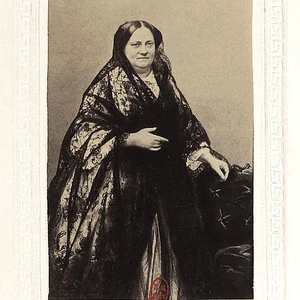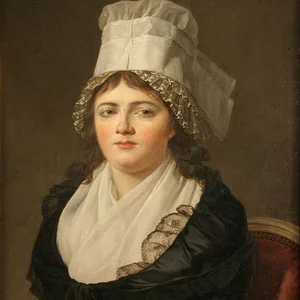

Gabrielle Charpentier (c. 1764–1793) was the wife of Georges-Jacques Danton, a leading orator of the French Revolution. The daughter of a Parisian café owner, she died at 28 in February 1793 while her husband was on a mission in Belgium, just months before the Reign of Terror.
Gabrielle Danton
Gabrielle Charpentier, wife of Danton
8 min read
Frequently asked questions
Key Facts
- Born around 1764, daughter of François Charpentier, a café owner at the Palais de Justice in Paris
- Married Georges-Jacques Danton on June 14, 1787, at the church of Saint-Germain-l'Auxerrois
- Mother of several children, including Antoine (1788) and François-Georges (1792)
- Died on February 10, 1793, while Danton was on a diplomatic mission in Belgium
- Danton, devastated by grief, reportedly had her body exhumed to see her one last time
Works & Achievements
Commissioned by Danton from sculptor Louis-Pierre Deseine following his wife's death, this bust is one of the few sculptural likenesses of Gabrielle Charpentier and stands as a testament to Danton's devotion to her.
Cast immediately after her death on Danton's orders, this plaster mask is a remarkable record of private grief and personal remembrance, created at the height of the Reign of Terror.
An official document preserved in the parish archives of Saint-Germain-l'Auxerrois, it remains the primary documentary source on Gabrielle Charpentier's identity and civil existence.
Anecdotes
Gabrielle Charpentier met Georges-Jacques Danton in the bustling Palais-Royal neighborhood, where her father ran a café. Their wedding was celebrated on June 9, 1787, at the Church of Saint-Germain-l'Auxerrois in Paris, uniting a Parisian café owner's daughter with an ambitious lawyer who would become one of the most powerful voices of the French Revolution.
When Gabrielle died on February 10, 1793, Danton was away on a diplomatic mission in Belgium. Upon learning of his wife's death, he rushed back to Paris, consumed by inconsolable grief. According to several contemporary accounts, he allegedly had Gabrielle's body exhumed so that he could see her one last time.
Devastated by grief, Danton commissioned sculptor Louis-Pierre Deseine to create a bust and a death mask of Gabrielle. This deeply personal act, carried out amid a period of extreme political violence, reveals the hidden side of a man known publicly for his ruthlessness — that of a husband passionately devoted to his wife.
Gabrielle died at around 28 years of age, most likely from complications of a difficult pregnancy, leaving behind two young sons. Her death came just weeks after the execution of Louis XVI, at the very moment the Revolution was tipping into the Terror. Danton remarried as early as June 1793, wedding Louise Gély, a sixteen-year-old girl — a remarriage that many contemporaries considered indecently hasty.
The Danton household was located at 1 Cour du Commerce-Saint-André, in the Odéon neighborhood. This cobblestoned courtyard also housed Jean-Paul Marat's printing press and Dr. Guillotin's workshop. In her daily life, Gabrielle rubbed shoulders with the most radical figures of the Revolution, in an environment of constant political ferment.
Primary Sources
On the ninth of June seventeen hundred and eighty-seven, following the publication of three banns at the parish mass announcements, Georges-Jacques Danton, lawyer to the Parliament, and Marie-Madeleine Gabrielle Charpentier, daughter of François-Jean Charpentier, café owner, were united in marriage.
I have just been struck in my dearest affections. I have lost my companion… But the homeland has need of me; my personal grief must fall silent before it.
Danton's wife was a good and simple creature, deeply attached to her husband. It is said that he wept like a child at her death — he who never wept at anything.
On the tenth of February seventeen hundred and ninety-three, Marie-Madeleine Gabrielle Charpentier, wife of Danton, aged approximately twenty-eight years, residing at Cour du Commerce, section du Théâtre-Français, passed away.
Key Places
The residence of the Danton couple, this cobblestoned courtyard in the Odéon district also housed Marat's printing press. Gabrielle lived here at the heart of the revolutionary ferment, surrounded by the most radical figures of the era.
It was in this royal church, facing the Louvre, that the marriage of Gabrielle Charpentier and Georges-Jacques Danton was celebrated on June 9, 1787, in the presence of their respective families.
A hotbed of revolutionary radicalism and Danton's political stronghold, this Left Bank neighborhood was Gabrielle's everyday world. Here she rubbed shoulders with Marat, Camille Desmoulins, and the other leading figures of the Cordeliers Club.
Danton's hometown, where he owned a family property. Gabrielle stayed there with her husband and children during periods of withdrawal from Parisian political life.
Typical Objects

After Gabrielle's death, Danton commissioned sculptor Deseine to create a death mask of her face. This object — a rare testament to the tribune's personal attachment — stands in stark contrast to the brutality of the revolutionary era.

Sculptor Louis-Pierre Deseine created a bust of Gabrielle at Danton's express request following her death. This work is one of the only surviving physical portraits of Gabrielle that have come down to us.

Daughter of a devout Catholic family, Gabrielle maintained her faith in a climate where the Revolution's dechristianization campaign placed religion under threat. Her prayer book symbolizes the tension between private belief and the dominant revolutionary ideology.

Worn by women and men alike in the revolutionary streets of Paris, the blue-white-red cockade signaled allegiance to the cause. As the wife of a leading figure of the Revolution, Gabrielle wore one when venturing out in the Cordeliers district.

A reminder of Gabrielle's origins as the daughter of a Parisian café owner: during the Revolution, the café was a vital hub of social life and political debate. Gabrielle grew up in this lively, working-class world.

The revolutionary paper currency whose value steadily collapsed, the assignat was the everyday money of every Parisian household. Gabrielle managed the family finances with this unstable currency, a growing source of hardship.
School Curriculum
Vocabulary & Tags
Key Vocabulary
Daily Life
Morning
Gabrielle rises early in their apartment on the Cour du Commerce, overseeing breakfast preparation with the household servant and tending to her young sons. The morning is spent running errands at the neighborhood market, where political news travels as fast as goods change hands, and where the queues outside the bakeries have become a daily ordeal.
Afternoon
In the afternoons, Gabrielle sometimes receives women from Danton's political circle — wives of lawyers or revolutionary activists. She manages the household finances and oversees the children's education. With her husband frequently absent, consumed by his political duties, she runs the household alone with a remarkable degree of independence for the era.
Evening
In the evenings when Danton is home, the couple hosts dinners with Camille Desmoulins and his wife Lucile, deputies, and journalists. Conversation inevitably revolves around revolutionary events. Gabrielle, quiet and observant, is the silent anchor of this household in a constant state of political ferment.
Food
Their diet follows that of the Parisian bourgeoisie: bread, rich soups, boiled meats, market vegetables, and cheeses. The Revolution disrupts supply chains and triggers repeated bread shortages — Parisian housewives line up before dawn outside bakeries, assignat in hand.
Clothing
Gabrielle wears the dress of the revolutionary bourgeoisie: a dark cotton or wool gown, a white fichu crossed over the chest, and a muslin bonnet. The silks and laces of the Ancien Régime are set aside as a gesture of republican virtue. The tricolor cockade is pinned to the bodice for public outings.
Housing
The Dantons occupy a spacious apartment at No. 1 Cour du Commerce-Saint-André, in what is now the 6th arrondissement. This bourgeois home, furnished with mahogany pieces and cotton curtains, serves both as a family residence and as a gathering point for activists from the nearby Cordeliers Club.
Historical Timeline
Period Vocabulary
Visual Style
Style bourgeois parisien fin XVIIIe siècle : intérieur intime à la bougie, robe néoclassique sobre et cocarde tricolore, atmosphère révolutionnaire mêlant austérité républicaine et chaleur domestique fragile.
Sound Ambience
Ambiance sonore du Paris révolutionnaire des années 1790 : rues animées du quartier des Cordeliers, cafés politiques bruissants de débats, cris des colporteurs de gazettes et rumeur sourde d'une ville en ébullition permanente.
Liens externes & ressources
Références
Œuvres
Buste de Gabrielle Danton
1793
Masque mortuaire de Gabrielle Danton
Février 1793
Acte de mariage Danton-Charpentier
9 juin 1787