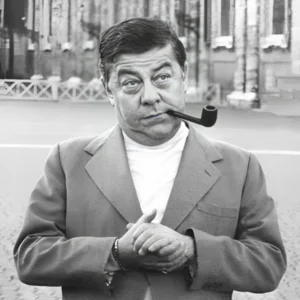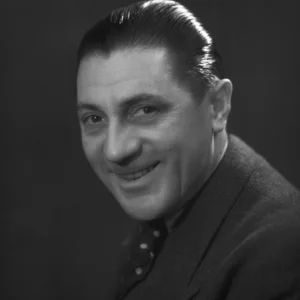

Georgius (1891-1970) was a French songwriter and comic singer, a leading figure of music hall during the interwar period. The author of more than 1,500 songs, he is considered a pioneer of zany, absurdist song.
Georgius(1891 — 1970)
Georgius
France
5 min read
Frequently asked questions
Key Facts
- Born in 1891 in Mantes-la-Jolie and died in 1970 in Paris
- A star of Parisian music hall in the 1920s and 1930s, notably at the Européen and Bobino
- The author of more than 1,500 songs, often zany or satirical
- Creator of hits such as “Au Lycée Papillon” and “La Plus Bath des javas”
- A forerunner of absurdist and nonsense song, influencing French musical humour
Works & Achievements
Comic song about a class of dunces, which became a classic covered for generations. A symbol of his absurd, schoolyard humour.
A lively java that celebrates the popular dance of Parisian dance halls. It illustrates Georgius's connection to the culture of the working-class suburbs.
A humorous song about the automobile, an object of fascination at the time. An example of his comedy turned toward modernity.
A zany song with a deliberately absurd theme, typical of his offbeat repertoire. It delighted audiences with its unabashed nonsense.
An account of his life as an artist and a testimony about the world of the music hall. A valuable source on the café-concert scene.
Georgius also wrote detective novels, extending onto the page his taste for intrigue and imagination. A little-known side of the songwriter.
Anecdotes
Real name Georges Guibourg, Georgius wrote more than 1,500 songs over the course of his career, a pace of creation that makes him one of the most prolific authors of French music hall. He was the author of both the lyrics and the staging of his wild song-and-dance acts.
His song *Au Lycée Papillon* (1936), featuring a teacher questioning dunces who give absurd answers, became a classic sung for decades in schoolyards. The refrain “À la queue leu leu” firmly established a comedy that poked fun at school.
Georgius pushed the art of costume and incongruity very far: he came on stage in extravagant disguises, playing zany characters, which earned him a reputation as a pioneer of absurdist song, long before the Frères Jacques or Boris Vian.
A passionate fan of detective novels, he did not stop at singing: he also wrote several crime novels and an autobiography titled *Un chançonnier*, blending his life as an artist with his taste for intrigue.
He ran the Théâtre de l'Européen in Paris, one of the great music-hall venues, proving that he was not only a stage performer but also an entrepreneur of popular entertainment in the interwar years.
Primary Sources
Pupils, take up your pens, we are going to do a dictation… In single file.
It's the swellest of javas, the neatest java there is, it's the swellest of javas that you dance with tiny steps.
In it Georgius recounts his life as a comic singer and the atmosphere of the Parisian café-concerts and music halls he frequented.
Key Places
Town in the Yvelines where Georges Guibourg, known as Georgius, was born in 1891.
Capital of the music hall and the café-concert, where Georgius spent his entire career and where he died in 1970.
Large Parisian music-hall venue that Georgius directed and where the stars of song performed.
Famous music hall on the Left Bank of Paris where Georgius staged his comic song acts.
Iconic Parisian venue of the café-concert and the revue, a leading stage for popular song in the interwar years.
Typical Objects

Over-the-top, colorful outfit that Georgius wore to embody his zany characters. The costume was an integral part of the comedy in his song act.

Printed sheet carrying lyrics and music, sold to the public and to orchestras. It allowed music-hall hits to spread throughout France.

Accessories typical of the café-concert singer, used as props for performance and staging. They emphasized comic facial expressions and gestures.

Shellac disc spinning at 78 revolutions per minute, the medium onto which the songs of the era were engraved. It brought music-hall hits into people's homes.

Large illustrated poster announcing Georgius's song act in the Parisian music halls. It drew in the crowds and cemented the star's image.

The working tool of Georgius the author, with which he wrote his hundreds of songs, his sketches, and his crime novels. The keyboard was the companion to his prodigious output.
School Curriculum
Vocabulary & Tags
Key Vocabulary
Daily Life
Morning
The songwriter's morning begins late, since shows end in the middle of the night. Georgius often devotes his mornings to writing: he composes lyrics and music, filling notebooks with ideas for songs.
Afternoon
The afternoon is a time for rehearsals with the orchestra and for polishing his acts. He tries on his costumes, fine-tunes his gags and stage business, and sometimes meets with publishers and venue managers.
Evening
In the evening, he takes to the stage of a Parisian music hall or café-concert. Before a working-class audience, he strings together comic songs, costume changes, and clowning late into the night.
Food
Like the artists of his day, he often grabs a quick bite between song numbers, in the cafés and brasseries near the venues. Late meals after the show, shared with his fellow performers, were part of the rhythm.
Clothing
In town, he wears the neat suit and tie of the Parisian artist of the interwar years. On stage, however, he dons extravagant, comic outfits, accessorized with hats and zany props.
Housing
He lives in Paris, at the heart of the entertainment world, close to the great music halls. His city dwelling is also a workplace, where scores, texts, and manuscripts pile up.