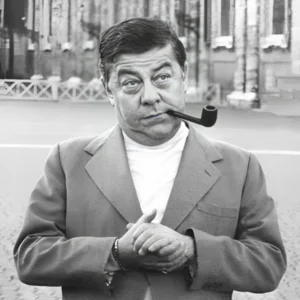

Francis Blanche (1921-1974) was a French comedian, actor, cabaret singer and writer. A partner of Pierre Dac, he was one of the masters of post-war comedy, a virtuoso of wordplay, radio hoaxes and nonsense.
Francis Blanche(1921 — 1974)
Francis Blanche
France
5 min read
Frequently asked questions
Famous Quotes
« Here lies Francis Blanche who, though no Rothschild, knew how to make a fortune: he wedded wit to laughter.»
Key Facts
- Born on 21 July 1921 in Paris, son of the actor Louis Blanche.
- Co-wrote with Pierre Dac the radio serial “Signé Furax” (1950s), a huge popular success.
- Author of the song “Le Complexe de la truite” and of many sketches, including “Le Sâr Rabindranath Duval” with Pierre Dac.
- Actor in numerous films (Les Tontons flingueurs, 1963; Babette s'en va-t-en guerre).
- Died on 6 July 1974 in Paris.
Works & Achievements
The duo's first great parodic radio serial, the seedbed of their zany universe.
A cult serial followed daily by millions of listeners, the pinnacle of French radio comedy.
A music-hall sketch that became a classic, a virtuoso display of gibberish and the fast-talking con artist.
A cult classic of French cinema in which Blanche plays a memorable supporting role, with dialogue by Audiard.
A comedy in which Blanche stars alongside Brigitte Bardot, showcasing his film career.
The author of many lyrics and aphorisms, he popularized the pun and French-style nonsense.
Anecdotes
With Pierre Dac, Francis Blanche created the parody radio serial “Signé Furax” (1951-1952, then 1956-1960), broadcast in daily episodes. Its success was such that millions of listeners followed the wild adventures of the “Babuchka” and the “Redskins” every day, turning the serial into a genuine social phenomenon.
Francis Blanche was a master of the telephone prank. On his show, he would call real shopkeepers to spout absurd remarks with unflappable seriousness — for instance, asking a locksmith to “lock up the sea” or placing impossible orders, foreshadowing hidden-camera shows and radio hoaxes.
The famous sketch “Le Sâr Rabindranath Duval,” performed with Pierre Dac, features a fake fakir (Blanche) and his showman (Dac). The line “I can smell the cannonball wind!” and the play on the supposed clairvoyant's gibberish became classics of the French music hall.
Francis Blanche wrote the French lyrics to the song “Ça tourne pas rond” and, above all, many texts built on wordplay. He is also credited with famous aphorisms such as “It is better to ponder change than to change the poultice,” a pun that captures his love of playing with words.
On the big screen, he played memorable supporting roles, notably the police superintendent in Georges Lautner's “Les Tontons flingueurs” (1963), with dialogue by Michel Audiard, where his cheeky presence rounded out a cast that became legendary in popular French cinema.
Primary Sources
Episode after episode, listeners follow the struggle against the Babus and the mysterious organization, in a torrent of puns and absurd plot twists.
— You don't say! — There's a whiff of danger in the air, my good sir…
Better to ponder the change than to change the pondage.
Key Places
Francis Blanche's birthplace and the heart of his career; it is here that he was born in 1921 and died in 1974.
The radio station where “Signé Furax” was a triumph in the late 1950s, a temple of the radio serial.
The Left Bank and the grands boulevards: here Blanche honed his sketches with Pierre Dac, in the golden age of the post-war cabaret.
On the French Riviera, Francis Blanche is buried in the cemetery of the village of Èze, where he loved to stay.
Typical Objects

The central tool of his career: it was in front of the microphone that Blanche brought his hoaxes and serials like “Signé Furax” to life.

Blanche used the telephone for his famous pranks, calling real people with comic self-assurance.

A prolific author of sketches, songs and dialogue, Blanche filled his pages with puns on the typewriter.

For the sketch of Sâr Rabindranath Duval, the fake fakir disguise added to the visual comedy of the music-hall act.

The sketches and songs of Blanche and Dac were released on records, extending the success of their radio acts.

A beloved supporting actor in popular cinema, Blanche performed before the lens in comedies that became cult classics.
School Curriculum
Vocabulary & Tags
Key Vocabulary
Daily Life
Morning
A tireless writer, Francis Blanche often devoted his mornings to writing: sketches, songs, dialogues and puns that he threw onto the page with boundless inventiveness. The phone rang, one project followed another.
Afternoon
His afternoons were paced by rehearsals with Pierre Dac, radio recordings or film shoots. Blanche juggled several trades — actor, cabaret singer, writer — in the bustling world of Parisian show business.
Evening
In the evening came the stage: cabarets, music halls and performances where he broke in his acts before an enthusiastic audience. Postwar Parisian nightlife was his playground.
Food
A man who loved good food and good company, Blanche enjoyed traditional French cuisine and long tables full of artists, washed down with wine, ripe for witty remarks and fits of laughter.
Clothing
In town, he wore the suit and tie expected of an artist of his day; on stage, he slipped into comic costumes, from the fake fakir to the zaniest of characters, all in the service of laughter.
Housing
Francis Blanche lived in Paris, as close as possible to the radio studios, theatres and film sets; he also happily stayed on the French Riviera, especially around Èze.
Historical Timeline
Period Vocabulary
Liens externes & ressources
Références
Œuvres
Malheur aux barbus (feuilleton radio, avec Pierre Dac)
1951-1952
Signé Furax (feuilleton radio, avec Pierre Dac)
1956-1960
Le Sâr Rabindranath Duval (sketch, avec Pierre Dac)
années 1950
Chansons et textes à jeux de mots
années 1950-1970