 flip
flipKash — Barley Beer with a Straw
Kash — Barley Beer with a Straw
Why this dish? In the epic, it is by drinking seven jars of beer that Enkidu becomes human and worthy of confronting and then loving Gilgamesh. Beer was the sacred and daily drink of Sumer, under the protection of the goddess Ninkasi. No royal banquet in Uruk without it.
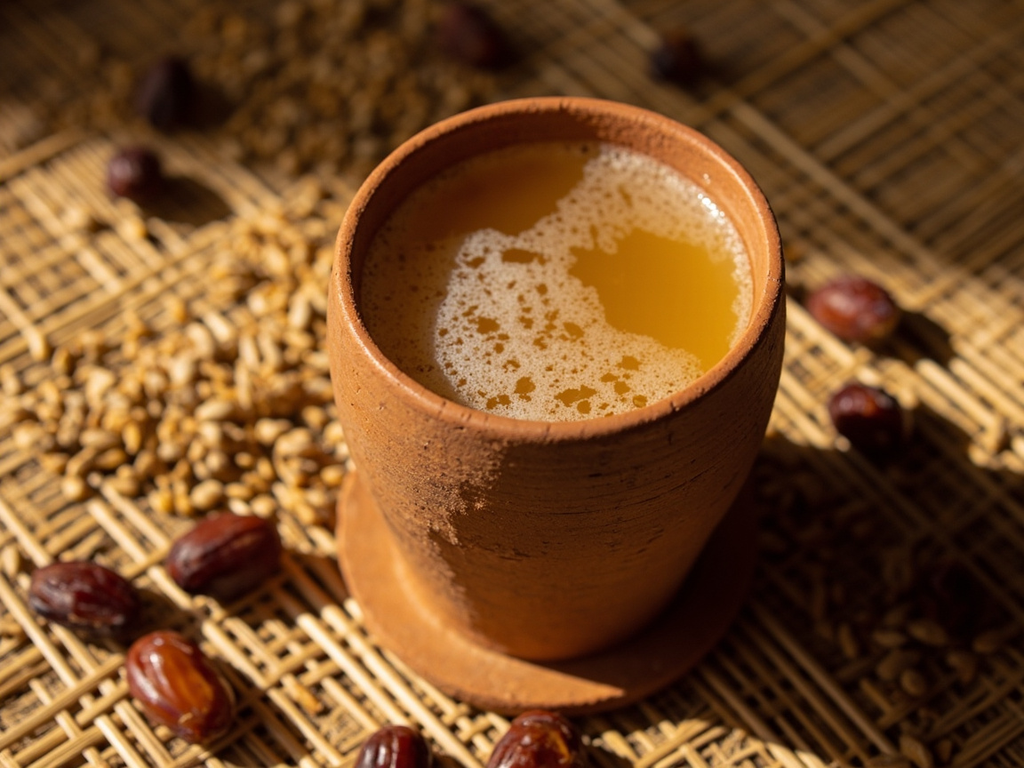
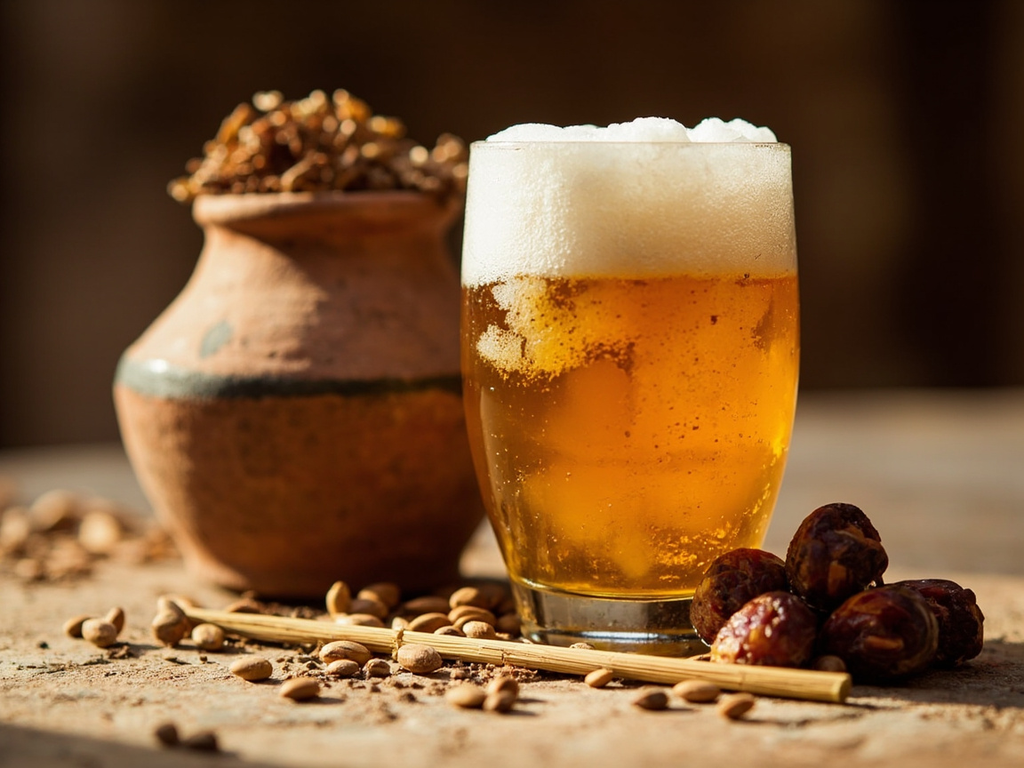
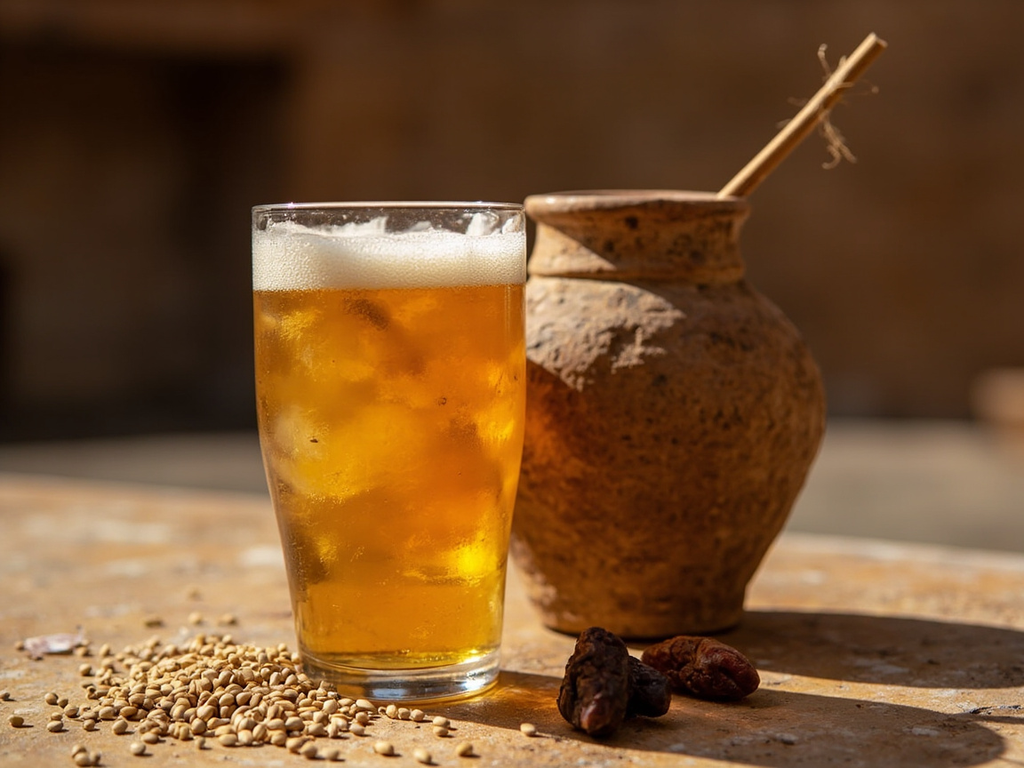
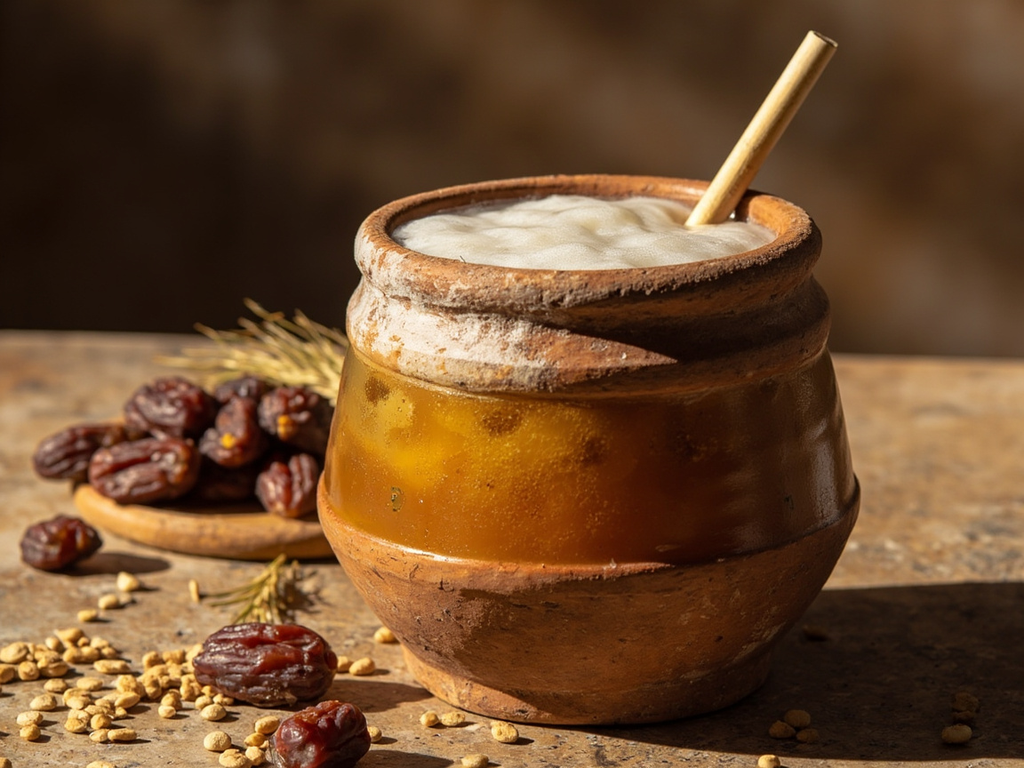
A cloudy, golden, low-alcohol beer brewed from crumbled barley loaves (bappir) and fermented, flavored with dates. It was drunk through a long straw to avoid the floating residues.
You want to know how the wild man became my equal? Seven jars of kash, and his heart opened, and he sang! The goddess Ninkasi taught us the art: you bake the bappir, that brown barley bread, you crumble it into fresh water with the honey of dates, and you let the spirit of the grain work in the jar. When the surface bubbles and sings, you plunge the reed straw — for a king does not drink the lees. Drink with me, stranger, to the health of walled Uruk.
- •Bappir (brown barley bread, twice-baked) — several loaves (source of sugars)
- •Barley malt — one part (fermentable)
- •Dates — a handful (sweetness and wild yeast)
- •Fresh water — a jar (medium)
Kash — Barley Beer with a Straw
A cloudy, golden, low-alcohol beer brewed from crumbled barley loaves (bappir) and fermented, flavored with dates. It was drunk through a long straw to avoid the floating residues.
Why this dish? In the epic, it is by drinking seven jars of beer that Enkidu becomes human and worthy of confronting and then loving Gilgamesh. Beer was the sacred and daily drink of Sumer, under the protection of the goddess Ninkasi. No royal banquet in Uruk without it.
You want to know how the wild man became my equal? Seven jars of kash, and his heart opened, and he sang! The goddess Ninkasi taught us the art: you bake the bappir, that brown barley bread, you crumble it into fresh water with the honey of dates, and you let the spirit of the grain work in the jar. When the surface bubbles and sings, you plunge the reed straw — for a king does not drink the lees. Drink with me, stranger, to the health of walled Uruk.
Ingredients (period version)
- Bappir (brown barley bread, twice-baked) — several loaves (source of sugars)
- Barley malt — one part (fermentable)
- Dates — a handful (sweetness and wild yeast)
- Fresh water — a jar (medium)
Ingredients
- Crushed barley malt — 500 g (fermentable)
- Toasted barley bread (from r1, dried) — 200 g, crumbled (source of sugars)
- Deglet Nour dates — 100 g, pitted (sweetness, aromas)
- Spring water — 3 liters (medium)
- Brewer's yeast (or natural sourdough) — 1 packet (controlled fermentation)
Method
- Heat water to 65°C, stir in the crushed malt and crumbled barley bread. Maintain this temperature for 1 hour (mashing) to convert starches into sugars.
- Filter the wort through a cheesecloth, press to recover the sweet liquid.
- Bring to a simmer for 20 minutes with the crushed dates, then let cool to room temperature.
- Transfer to a clean container, add the yeast, cover with a cloth, and let ferment for 4 to 6 days in a warm place.
- Serve cloudy and cool, with a straw to stay true to Sumerian custom. (Non-alcoholic version: skip fermentation and drink the cooled date wort.)
How it was made : The Hymn to Ninkasi (circa 1800 BCE) is both a religious poem and a brewing recipe: it describes bappir, malting, and fermentation in the vat. Sumerian beer, thick and full of residues, was drunk collectively from a jar using long reed straws, sometimes of precious metal for kings.
The contemporary twist : Serve in a shared jar with real reed straws, label 'recipe of the goddess Ninkasi, ~1800 BCE' — the oldest aperitif in the world.
Sources : Hymn to Ninkasi, Sumerian text circa 1800 BCE (translation M. Civil, 1964) · Jean Bottéro, The Oldest Cuisine in the World: Cooking in Mesopotamia, University of Chicago Press, 2004
Gilgamesh · Charactorium