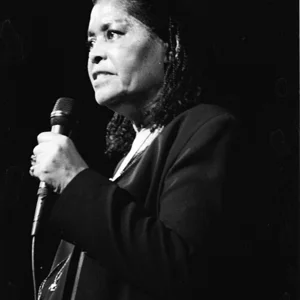

Helen Merrill (born Jelena Ana Milčetić, 1929-2025) was an American jazz singer of Croatian descent. Known for her intimate, hushed voice, she established herself from the 1950s onward as a leading interpreter of standards and vocal jazz.
Helen Merrill(1930 — ?)
Helen Merrill
États-Unis
5 min read
Frequently asked questions
Key Facts
- Born on July 21, 1929, in New York as Jelena Ana Milčetić, to Croatian immigrant parents.
- Recorded the 1954 album 'Helen Merrill with Clifford Brown', arranged by Quincy Jones and regarded as a classic of vocal jazz.
- Enjoyed immense popularity in Japan, where she settled in the late 1960s.
- Pursued a career spanning more than sixty years, recording numerous albums into the 2000s.
- Died in 2025, remembered as one of the major voices of 20th-century vocal jazz.
Works & Achievements
First album and a great classic of vocal jazz, featuring Clifford Brown on trumpet and arrangements by Quincy Jones.
Her version of the Cole Porter standard, which became her most famous performance and the one most emblematic of her intimate style.
A landmark album entirely arranged by Gil Evans, one of his first major orchestration works.
A hushed album confirming her talent as a delicate interpreter of ballads.
A studio reunion with Gil Evans, more than thirty years after “Dream of You.”
A tribute album to Clifford Brown, her early-career partner who died in 1956.
Anecdotes
Helen Merrill wasn't really her name: she was born Jelena Ana Milčetić in New York, into a family of Croatian immigrants. Like many artists of the time, she anglicized her name for the stage, but she always remained proud of her roots.
At just 24, she recorded her very first album with two future jazz giants: trumpeter Clifford Brown and a 21-year-old arranger, Quincy Jones (who would later produce Michael Jackson). Two years after this recording, Clifford Brown died in a car accident at 25, which makes this record even more precious in the eyes of jazz lovers.
In the 1960s, Helen Merrill moved to Japan, where she became a huge star — often more famous there than in the United States. She recorded there, produced records and took part in the country's musical life, building a bridge between American jazz and Japanese audiences.
Her soft, hushed and very intimate voice is her trademark: she sings right up against the microphone, almost as if confiding, rather than belting out her power. This muted style made her one of the great interpreters of the “standards,” those songs covered by dozens of jazz artists.
In 1956, it was the famous arranger Gil Evans — a future collaborator of Miles Davis — who set her album “Dream of You” to music. It was one of his first major works as an arranger, just before the masterpieces he would create with Miles Davis.
Primary Sources
Helen Merrill's first album, recorded in New York with Clifford Brown on trumpet and arrangements by Quincy Jones; it opens with the standard “Don't Explain” and contains her most famous recording, “You'd Be So Nice to Come Home To.”
“You'd be so nice to come home to / You'd be so nice by the fire” — Cole Porter's standard (1943) that Helen Merrill made famous in her intimate 1954 rendition.
A Helen Merrill album arranged entirely by Gil Evans, one of his first major works as an orchestrator, in which the singer's hushed voice converses with brass in strikingly new colors.
More than thirty years after “Dream of You,” Helen Merrill and arranger Gil Evans reunited in the studio to re-record a series of standards together, shortly before Evans's death.
Key Places
Helen Merrill's hometown and the cradle of her career, where she got her start in the clubs and recorded her first albums.
The famous New York jazz club street where the great bebop musicians performed and where young singers like her sang.
Helen Merrill settled in Japan in the late 1960s, where she enjoyed immense popularity and also became a record producer.
She spent time in Europe, and notably in Italy, in the late 1950s, a stage in her international career.
Typical Objects

Helen Merrill sings right up against the mic to achieve her hushed, intimate voice; the ribbon microphones in 1950s studios capture that close, breathy sound.

Her EmArcy albums come out on this long-playing vinyl format that spreads during the 1950s and allows several tracks to be recorded on each side.

The instrument of Clifford Brown, whose warm solos answer Helen Merrill's voice on her 1954 album.

Like the cabaret and jazz club singers of the era, she performs in an elegant evening gown.

Helen Merrill performs the “standards” of the Great American Songbook (Cole Porter, Gershwin), reworking their phrasing from the sheet music.

The illustrated cover of her records, like that of “Helen Merrill with Clifford Brown,” is part of her image as a refined performer.
School Curriculum
Vocabulary & Tags
Key Vocabulary
Tags
Daily Life
Morning
A musician of the nightlife, she wakes up late, often in the early afternoon, after concerts that end in the dead of night. The late morning is mainly devoted to resting her voice and listening to records.
Afternoon
The afternoon is devoted to rehearsals with the musicians and to working out arrangements in the studio. She refines the phrasing and the meaning of the lyrics of the standards she is going to perform.
Evening
In the evening, she performs in jazz clubs, sometimes playing several “sets” in the same night. The audience is close, the lighting dim and the atmosphere intimate—perfect for her confiding voice.
Food
Like many club performers, her meals are irregular, snatched between two appearances on stage or late at night. Before singing, she spares her throat by avoiding drinks and foods that irritate it.
Clothing
On stage, she wears elegant evening gowns suited to cabarets and jazz clubs. Off stage, her style follows the refined fashion of the 1950s.
Housing
She first lives in apartments in New York, then moves from country to country several times: a stay in Italy, then several years in Japan, before returning to settle in the United States.