
American jazz pianist, keyboardist, and composer born in 1940. He rose to prominence in Miles Davis's quintet during the 1960s, becoming one of the leading figures of modal jazz and later of jazz-funk fusion, while never ceasing to explore new electronic sounds.
Herbie Hancock(1940 — ?)
Herbie Hancock
États-Unis
6 min read
Frequently asked questions
Key Facts
- Born on April 12, 1940, in Chicago, a child prodigy of classical piano before turning to jazz
- Member of Miles Davis's second great quintet from 1963 to 1968
- 1965: records the landmark modal album “Maiden Voyage”
- 1973: “Head Hunters” becomes one of the pioneering and best-selling records of jazz-funk
- 2008: receives the Grammy for Album of the Year for “River: The Joni Letters”
Works & Achievements
The young pianist's first major hit, which went on to become a jazz standard covered by countless musicians.
A track with a mesmerizing groove, later sampled by hip-hop acts—a testament to Hancock's lasting influence.
A masterpiece of modal jazz, evoking the vastness of the ocean through suspended, soaring harmonies.
A pioneering jazz-funk fusion album, one of the best-selling in jazz history, carried by the track “Chameleon”.
An electro-funk hit that brought DJ scratching into mainstream music and revolutionized the music video.
The score for Bertrand Tavernier's film, which earned Hancock the Oscar for Best Original Score.
A tribute to Joni Mitchell, and the first jazz album to win the Grammy for Album of the Year since 1965.
Anecdotes
At just eleven years old, in 1952, the young Herbie Hancock, already a classical piano prodigy, performed a movement of a Mozart concerto accompanied by the Chicago Symphony Orchestra. This childhood divided between classical music and a passion for science would shape his insatiable curiosity for new sounds.
One evening, performing with the Miles Davis Quintet, Hancock accidentally struck a “wrong” chord right in the middle of one of the trumpeter's solos. Rather than stopping, Miles played a few notes that turned that “mistake” into something that sounded right. Hancock drew a lesson from it that he repeated all his life: in music, there are no truly wrong notes, only choices you have to own.
In 1962, Hancock's first record featured the track “Watermelon Man.” The following year, the Cuban percussionist Mongo Santamaría recorded a version of it that became a genuine hit in the United States. The royalties gave the young pianist a financial security that was rare for a beginning jazz musician.
In 1983, with the track “Rockit,” Hancock introduced the general public to turntable “scratching,” a technique born of the emerging hip-hop scene. Its music video, populated with strange robotic mannequins, won several awards at the MTV Video Music Awards and introduced millions of young people to electronic sounds.
In 2008, his album “River: The Joni Letters,” a tribute to singer Joni Mitchell, won the Grammy for Album of the Year. It was the first time since 1965 that a jazz record had claimed this supreme honor, usually reserved for pop stars.
Primary Sources
Herbie was the step after Bud Powell and Thelonious Monk, and I haven't heard anybody yet who has come after him.
Miles didn't hear it as a mistake. He heard it as an event, something that had simply happened. And he chose to make it into something right.
I never saw a contradiction between playing acoustic piano and exploring electronic instruments: it was always about searching for new sonic colors.
Key Places
Hancock's birthplace, where he revealed his talent as a classical pianist before turning to jazz.
The university where the young Hancock first studied electrical engineering before devoting himself to music; his scientific curiosity would fuel his love of technology.
The jazz capital where Hancock recorded his foundational albums and played in Miles Davis's quintet.
The city where Hancock settled and set up his studio filled with keyboards and machines, at the heart of his electronic adventure and his work for film.
Typical Objects

A lifelong instrument, from the classical prodigy to the jazzman; on it Hancock forged his refined harmonic language, inherited from Bill Evans and Thelonious Monk.

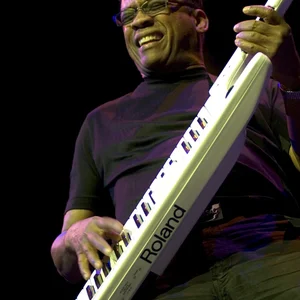
A keyboard with a warm, crystalline sound that Hancock brought to the fore in Miles Davis's electric quintet and then on his own modal and funk records.

A keyboard with a percussive, “funky” timbre that delivers the famous intro line of “Chameleon” on the album “Head Hunters.”

Machines for producing never-before-heard sounds that Hancock, an electronics enthusiast, brought into jazz as early as the start of the 1970s.

A device that “roboticizes” the voice by blending it with a keyboard; Hancock used it notably to sing on his fusion tracks.

An early adopter of music computing, Hancock used the first personal computers to compose and drive his synthesizers in the 1980s.

An object of his daily practice of Nichiren Buddhism, which he embraced in the early 1970s and which guides his life and his creative work.
School Curriculum
Vocabulary & Tags
Key Vocabulary
Tags
Daily Life
Morning
A practicing Buddhist, Hancock often begins his day by reciting his mantra before his altar, a moment of focus that calms the mind. Then comes work at the piano—scales and improvisations to maintain a technique forged in childhood.
Afternoon
The afternoon is devoted to composing and studio work. Curious about everything, he spends hours exploring his synthesizers, computers, and keyboards in search of a sound or effect never heard before.
Evening
A jazzman's life largely plays out in the evening, on stage: club concerts, festivals around the world, long sessions where improvisation stretches the night out alongside fellow musicians.
Food
Like any touring artist, Hancock divides his meals between food eaten on the road, dressing rooms, and restaurants in the cities he passes through. His stays and concerts in Japan, tied to his Buddhist practice, familiarize him with Asian cuisine.
Clothing
In the 1960s, on the Blue Note album covers, he wears the elegant suit of New York jazzmen. In the fusion era and the 1980s, his attire becomes more colorful and eccentric, mirroring his electronic sounds.
Housing
Settled in Los Angeles, Hancock lives surrounded by the technology that fascinates him: a true home studio cluttered with keyboards, synthesizers, and computers where his experiments come to life.