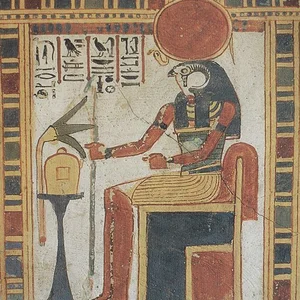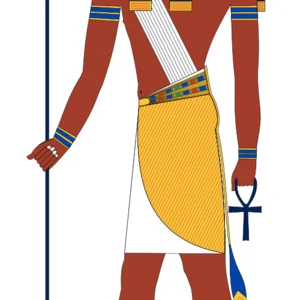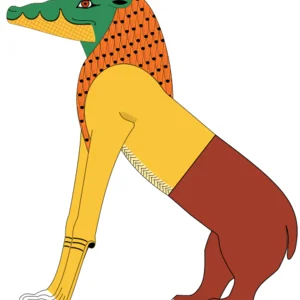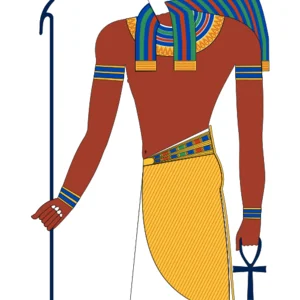

Horus is a major deity of ancient Egyptian mythology, depicted with the head of a falcon. Son of Osiris and Isis according to legend, he embodies the sky and the sun. He is one of the most important gods in the Egyptian pantheon, venerated since the Old Kingdom.
Horus
Horus
8 min read
Frequently asked questions
Key Facts
- Venerated since the Egyptian Old Kingdom as god of the sky and associated with the sun
- Depicted with a falcon's head, an animal symbolizing power and celestial vision
- Son of Osiris and Isis in the Osirian myth, he represents the heir and the continuation of divine power
- Divine embodiment of the pharaohs, who considered themselves earthly representatives of Horus
- Central figure in the myth of vengeance against Set, the uncle who usurped the throne of Egypt
Works & Achievements
A founding myth of Egyptian mythology in which Horus avenges his father Osiris against his uncle Set and becomes king of Egypt. This myth embodies the principles of justice, cosmic order, and legitimate succession to pharaonic power.
A sacred symbol representing the unharmed eye of the falcon god, which became one of the most powerful amulets in ancient Egypt. Used as a protective charm and symbol of wholeness and healing in both daily life and religious practice.
Horus embodies the daytime sky and is associated with the rising sun (Horus the Elder) and the sun at its zenith. This major cosmological role makes him a central deity in Egyptian cosmology and solar theology.
A divine judgment in which Horus claims the throne of Egypt against Set before an assembly of gods. This legal legend establishes the foundations of the pharaoh's legitimacy as heir of Horus and representative of divine order.
The systematic association between the living pharaoh and the god Horus, reinforcing the sovereign's divine authority. This religious and political practice made the king the earthly incarnation of the falcon god and guardian of cosmic order (Ma'at).
Images and statues of the falcon god found in Egyptian temples, tombs, and ritual objects. These representations served as religious and magical supports for venerating the celestial and solar power of Horus.
The gradual merging of Horus with the solar god Ra, creating a syncretic deity combining celestial and solar attributes. This theological development reinforced the god's role in Egyptian cosmology and solar religion.
Anecdotes
Horus was worshipped in several forms in ancient Egypt: Horus the Elder (Haroeris) and Horus the Younger (Harsiesis), son of Osiris and Isis. The Egyptians believed that every living pharaoh was the earthly incarnation of Horus, which justified his divine power and his right to rule. This belief persisted for over 3,000 years, from the early Old Kingdom through the end of the Ptolemaic period.
According to mythological texts inscribed in temples, Horus fought an epic battle against his uncle Set to avenge his father Osiris's death and reclaim the throne of Egypt. This myth, attested in the Pyramid Texts and temple inscriptions such as those at Edfu, symbolized the struggle between order (Horus) and chaos (Set) — two fundamental forces in Egyptian cosmology.
The Temple of Edfu, one of the best-preserved in ancient Egypt, was dedicated to Horus the Falcon and contains detailed reliefs depicting his mythological battles. Built between 237 and 57 BCE, the temple bears witness to the enduring importance of this god in Egyptian belief, from the earliest dynasties through the Greco-Roman period.
The Egyptians depicted Horus with the head of a falcon because this bird of prey symbolized piercing vision and mastery of the sky. In Egyptian mythology, his left eye represented the Moon and his right eye the Sun — which is why the amulet of the Eye of Horus (the Wadjet) became one of the most popular protective symbols throughout ancient Egypt.
Horus is one of the rare Egyptian gods whose cult endured well beyond pharaonic civilization: he was still venerated during the Ptolemaic period, and the Greeks identified him with the god Apollo. This religious continuity spanning more than three millennia shows just how central this falcon god was to Egyptian spirituality.
Primary Sources
Horus, son of Osiris, rises into the sky. He is the falcon with golden wings who soars above the land and the Nile. The deceased king becomes Horus, living manifestation of the god.
Horus is depicted as the living pharaoh, divine embodiment of royal power. Each king of Egypt receives the title of 'Living Horus' upon his accession to the throne.
Horus battles Set to avenge the death of his father Osiris. In this struggle for the throne of Egypt, Horus triumphs and becomes lord of the lands of the living.
You are Horus the Falcon, lord of the sky, son of Osiris and Isis. Your eyes are the sun and the moon, your power protects the sacred lands of Egypt.
Key Places
A legendary site in the Nile Delta where Isis is said to have hidden the young Horus after the death of Osiris. This sanctuary is the symbolic birthplace and refuge of the young god.
A major city in Upper Egypt home to the Temple of Horus, one of the best-preserved ancient Egyptian temples. This sanctuary, dedicated to the worship of Horus and his battles against Set, is a fundamental religious center.
A major religious center of ancient Egypt where Horus was venerated as a form of the sun god Ra. Heliopolis was the heart of Egyptian solar theology linked to Horus.
A sacred city where the mysteries of Osiris and his son Horus were commemorated. Texts and rituals describing the conflicts between Horus and Set were inscribed and performed here.
The ancient capital of Egypt where Horus was incorporated into the royal cult as a symbol of the living pharaoh and his divine legitimacy. The god was closely associated with Egyptian royal succession.
An important temple complex dedicated to Hathor where Horus is depicted as her divine consort. This sanctuary illustrates the familial and mythological bonds between Egyptian deities.
Typical Objects

A sacred eye-shaped amulet, one of the most important symbols associated with Horus. This emblem represented protection, healing, and wholeness, and was worn as a talisman by the ancient Egyptians.
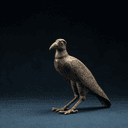
The iconic representation of the god Horus himself, often sculpted or painted with a falcon's head and a human body. This animal was venerated as the divine incarnation and appeared on temples and ritual objects.
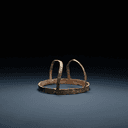
The royal headdress associated with Horus and with the pharaohs who considered themselves his living incarnations. It symbolized the union of Upper and Lower Egypt under the divine authority of the falcon god.
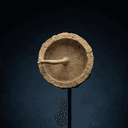
A symbol representing Horus as god of the sky and the sun, depicting a disk flanked by two falcon wings. This emblem adorned temple entrances and tombs to ensure divine protection.
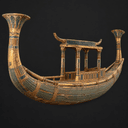
A mythological boat sailing through the daytime sky, associated with Horus's daily journey across the heavens as an incarnation of the sun. This object symbolized the cosmic cycle and regeneration.
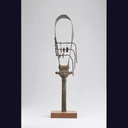
A ritual percussion instrument used in the cults of Horus and other Egyptian deities, shaken during religious ceremonies. It represented divine joy and cosmic harmony.
📷 CC0 · Wikimedia Commons ↗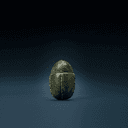
Funerary amulets engraved with magical spells and the image of Horus, placed in tombs to protect the soul in the afterlife. They represented resurrection and transformation.
School Curriculum
Vocabulary & Tags
Key Vocabulary
Tags
Mythologie
Daily Life
Morning
Horus has no daily life in the human sense — his "day" is represented through myths and religious rituals. At dawn, he is associated with the rising sun and the renewal of the world. Egyptian priests performed morning rituals in temples to honor the god and ensure the continuation of the cosmic cycle.
Afternoon
Horus reigns over the daytime sky as a form of the sun (Horakhty), traversing the firmament in his solar barque. The Egyptians imagined the god watching over the earth and its inhabitants, dispensing light and royal protection. Iconographic representations show him active and vigilant throughout the day.
Evening
At nightfall, Horus yields his place to the other nocturnal and solar deities. Evening rituals in the temples included prayers and offerings to ensure that the god would complete his nocturnal journey and reappear the following morning. His role as protector extended to the night as well as the day.
Food
As a deity, Horus does not consume ordinary food. However, in the temples, priests presented him with ritual offerings including bread, beer, meat, fruits, and flowers. These offerings symbolized the sustenance of the god and strengthened the bond between the earthly and divine worlds.
Clothing
Horus is traditionally depicted wearing the pschent (double crown of unified Egypt) or the khepresh (blue war crown). His divine body is often shown bearing the royal insignia: the crook and the flail. A falcon's head replaces his human head, embodying his celestial nature and sovereign power.
Housing
Horus does not dwell in any earthly abode but resides in the sky and in the sacred temples built in his honor. The greatest sanctuaries — most notably the Temple of Edfu — served as his earthly "home," where priests attended to him daily. These temples cosmically recreated his celestial domain.
Historical Timeline
Period Vocabulary
Visual Style
Un style visuel puisant dans l'art pariétal égyptien antique, caractérisé par des teintes dorées et bleues profondes, des hiéroglyphes stylisés, et une représentation solennelle et hiératique du dieu faucon. L'atmosphère évoque les temples et tombeaux pharaoniques avec une lumière divine dorée émanant de la figure centrale.
Sound Ambience
Une ambiance mystérieuse et majestueuse évoquant les temples égyptiens antiques, fusionnant les cris de faucons sacrés, les chants rituels des prêtres et les instruments traditionnels pour créer un environnement sonore divin et cosmique.
Liens externes & ressources
Références
Œuvres
Le Mythe d'Horus et Osiris
circa 2400-2300 av. J.-C.
L'Œil d'Horus (Oudjat)
circa 3000 av. J.-C.
La Domination du Ciel et du Soleil
Période dynastique
Le Procès contre Set
circa 1160 av. J.-C. (attesté dans les textes)
L'Identification avec le Pharaon
Ancien Empire (circa 2686-2181 av. J.-C.)
Les Représentations Iconographiques
Toutes périodes dynastiques
La Fusion avec Rê (Rê-Horus)
Moyen Empire (circa 2055-1650 av. J.-C.)