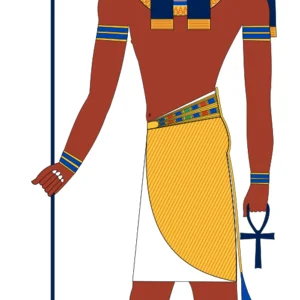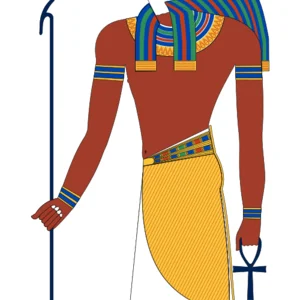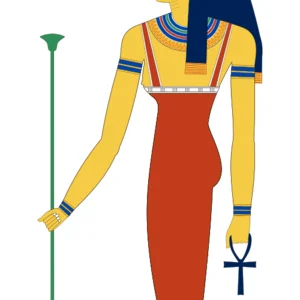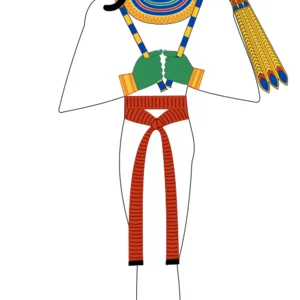

Ra is the principal solar deity of ancient Egypt, worshipped as the creator of the world and king of the gods. He embodies the life-giving power of the sun and its daily journey across the sky. His cult spanned more than three millennia of Egyptian civilization.
Ra
Re
9 min read
Frequently asked questions
Key Facts
- Worshipped since the Old Kingdom (c. 2686 BCE) as the god of the sun and creator of all things
- Merged with the god Amun to form Amun-Ra during the New Kingdom (c. 1550 BCE)
- Depicted with a falcon's head crowned by a solar disk in Egyptian iconography
- His daily voyage across the sky and through the underworld aboard the solar barque forms the backbone of Egyptian cosmology
- His main cult center was at Heliopolis, one of the most important sanctuaries in ancient Egypt
Works & Achievements
According to Egyptian mythology, Ra is the creator who brought forth the world and all the gods from himself. This cosmogony places Ra at the center of Egyptian theology as the primordial source of all existence.
Ra crosses the sky each day aboard a solar barque, symbolizing the eternal cycle of life, death, and resurrection. This mythology explains astronomical phenomena and structures the Egyptian understanding of time.
Every night, Ra fights the serpent of chaos Apophis in the Amduat (the underworld). This mythological battle represents the perpetual victory of order (Ma'at) over chaos, and justifies the necessity of the day-night cycle.
During the New Kingdom, Ra merged with Amun, the hidden god, forming Amun-Ra, the supreme deity of Egypt. This syncretism reinforced the religious authority of the pharaoh, who was regarded as the son of Ra.
The cult of Ra at Heliopolis (Iunu) became one of the most important in ancient Egypt, shaping pharaonic theology for three millennia. The pharaohs adopted the title of son of Ra to legitimize their divine power.
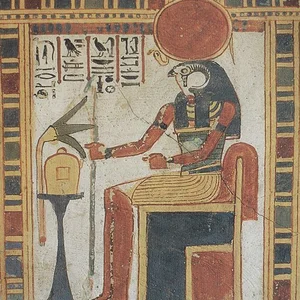
Ra is depicted with a falcon head crowned by the solar disk, symbolizing his power and dominion. This imagery became one of the most recognizable symbols of Egyptian mythology.
The cult of Ra shaped the Egyptian calendar, which was based on the annual solar cycle and organized the seasons (Akhet, Peret, Shemu) and religious festivals. This calendrical structure influenced agriculture and civic life.
Anecdotes
Ra was depicted with the head of a falcon crowned by the solar disk. Each day, the Egyptians believed that Ra crossed the sky in his solar barque, bringing light and life. This belief was so important that it structured the Egyptian calendar and religious rituals.
The name of Ra was considered so powerful that the Egyptians kept it secret. According to New Kingdom texts, knowing the true name of a god gave power over him. This practice shows the major importance granted to Ra in the Egyptian divine hierarchy.
Ra was merged with Amun to form Amun-Ra, an even more powerful deity. This fusion, especially popular during the New Kingdom, represented the union of the hidden creator god (Amun) and the visible solar god (Ra), showing how the Egyptians adapted their mythology.
The Egyptians believed that every night, Ra journeyed through the Duat (the Underworld) aboard his barque, battling the chaos serpent Apophis. This nocturnal voyage was just as important as his daytime journey, as it represented the eternal cycle of creation and renewal.
The temple of Heliopolis was the main center of Ra's cult in ancient Egypt. Pharaohs built obelisks pointing toward the sky to honor Ra and affirm their divine connection with him, a practice that lasted more than three thousand years.
Primary Sources
Glory to you, Ra, at your rising! Glory to you who rise as Khepri! You have accomplished your transformation and shine upon the horizon of the sky. Your eye is the sun that spreads its light across the earth.
Unas ascends to the sky with Ra. Unas travels in the solar barque of Ra. Unas is Khepri, the morning form of the sun god who renews his creation each day.
Adoration to you, Amun-Ra, king of all the gods! You are the creator of all things; you illuminate the earth with your golden rays and journey across the sky in your eternal barque.
Ra-Horakhty shines in his splendor upon the golden throne. His solar disc lights up the Two Lands, and his life-giving rays reach even into the dwellings of the dead.
Under the protection of Ra, king of the gods, Pharaoh Ramesses II concludes the eternal alliance. May Ra watch over this treaty for all eternity.
Key Places
The main religious center of Ra in ancient Egypt, located near Cairo. This temple was the heart of the solar cult and the seat of Ra's priesthood, where the god was venerated in his various forms.
A vast temple complex in Upper Egypt where Ra was venerated, particularly in his fusion with Amun (Amun-Ra). The pylons and chapels bear witness to the importance of the solar cult in this region.
A major religious center of ancient Egypt where Ra was worshipped alongside other gods. The Temple of Luxor hosted numerous ceremonies in honor of the sun god.
A great temple built by Ramesses II in Nubia, where Ra was venerated alongside other deities. The temple is famous for the illumination of its inner sanctuaries twice a year, symbolizing the journey of the sun.
During the Greco-Roman period, the cult of Ra persisted in Alexandria, where it was syncretized with other deities. The city became an important center for the blending of Egyptian tradition with Greco-Roman culture.
The ancient Egyptian capital where Ra was venerated as creator god and sovereign ruler. Memphis was a major center of religious and political power where the solar cult was celebrated.
Typical Objects

A representation of the sun, often depicted as a golden circle in Egyptian iconography. It is Ra's primary emblem, symbolizing his divine nature and dominion over the sky.

A sacred amulet associated with Ra and solar deities, serving as a symbol of protection and wholeness. It was worn by Egyptians as a token of divine favor.

The mythological boat in which Ra crosses the sky during the day and travels through the underworld at night. It is the god's iconic vehicle, representing his eternal daily journey.

A mythological creature confronted by Ra each night, representing chaos and darkness. It symbolizes the eternal struggle between divine order and the forces of evil.

A royal headdress made of two ostrich feathers flanking a solar disk, worn by Ra and the pharaohs. It embodies supreme power and the connection to the divine.

Ra's form at dawn, depicted as a scarab beetle rolling the sun across the sky. This insect symbolizes the rebirth and daily renewal of the god.

A royal and divine attribute representing power and dominion. Ra carries it as a symbol of his authority over the other gods and over the universe.

Ritual gifts burned in Egyptian temples to honor Ra, including myrrh and incense. These daily offerings were essential to the solar cult to ensure the god's safe and beneficial journey.
School Curriculum
Vocabulary & Tags
Key Vocabulary
Tags
Mythologie
Daily Life
Morning
Ra begins his day as the sun god by boarding his celestial barque (the Mandjet) at the eastern horizon. Accompanied by his divine crew and his son Shu (the air), he sets out on his daily journey across the sky, bringing light and warmth to the world of the living. Egyptian priests perform morning rituals in temples to honor his rising and ensure the renewal of the world.
Afternoon
At his zenith, Ra reaches the peak of his power in the sky, nurturing the growth of crops and sustaining all life. Meanwhile, devotees make offerings at shrines and temples to give thanks for his blessing. His journey continues relentlessly westward, maintaining the cosmic balance.
Evening
At day's end, Ra descends toward the western horizon and transfers to the funerary barque (the Mesektet) to cross the Duat (the underworld) through the night. During this perilous passage, he must battle the serpent of chaos, Apophis, to ensure the next day's rebirth and the renewal of the cosmos. This eternal cycle symbolizes the victory of order (Ma'at) over chaos.
Food
As a divine being, Ra is sustained by divine essence and the ritual offerings presented to him by priests and worshippers: bread, beer, sacrificed cattle, and incense. These offerings represent gratitude toward the god and the nourishment of his vital force. The god's spiritual sustenance is fundamentally different from that of human beings.
Clothing
Ra is depicted with the solar disk surrounding his head, a symbol of his divine essence and power. He typically wears a royal white kilt and sometimes a double crown, and his body is shown with golden or green skin depending on the period. His appearance combines human features with animal traits — most notably a falcon's head when represented as Ra-Horakhty.
Housing
Ra's celestial home is the sky itself, across which he travels in his divine barque through the firmament. His divine palace, located in the celestial realm, is beyond the reach of mortals. On earth, his principal place of worship was the temple at Heliopolis (Iunu), and later the temple of Karnak at Thebes, where priests maintained his daily cult.
Historical Timeline
Period Vocabulary
Visual Style
Un style inspiré de l'art égyptien antique combinant peintures murales de temples et enluminures de papyrus, caractérisé par des teintes dorées éclatantes, une symbolique hiéroglyphique et une atmosphère céleste majestueuse mettant en avant le rayonnement divin du dieu solaire.
Sound Ambience
Une ambiance sacrée et majestueuse évoquant les temples égyptiens du Nouvel Empire, mêlant chants rituels, sons naturels du Nil et instruments anciens pour créer une atmosphère divine et cosmique autour du dieu solaire Râ.
Liens externes & ressources
Références
Œuvres
La création du monde
mythologie ancienne
Le voyage quotidien du soleil
culte continu
La lutte contre Apophis
mythologie ancienne
La fusion avec Amon (Amon-Râ)
Nouvel Empire
L'institution du culte solaire héliopolitain
Ancien Empire et postérité
La représentation iconographique du dieu
culte continu
L'influence sur le calendrier égyptien
civilisation égyptienne