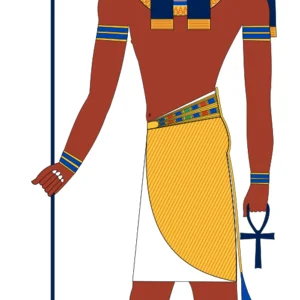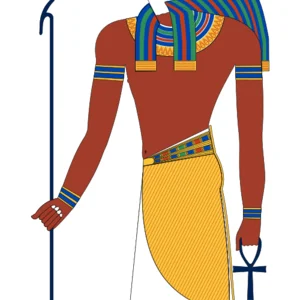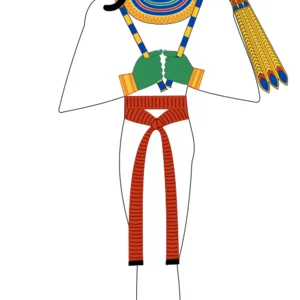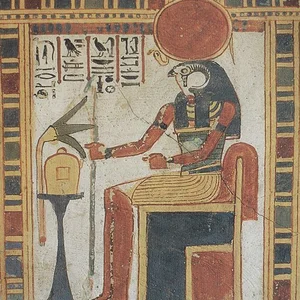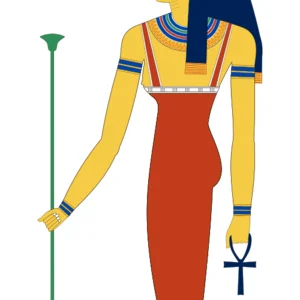

Isis is a major goddess of Egyptian mythology, associated with magic, motherhood, and protection. She is best known for having resurrected her husband Osiris after his murder by his brother Set, embodying the power of life and regeneration.
Isis
Isis
8 min read
Frequently asked questions
Key Facts
- Tutelary goddess of motherhood and fertility in the Egyptian pantheon
- Wife of Osiris and mother of Horus according to Egyptian mythology
- Depicted with a throne on her head or falcon wings
- Her cult spread throughout the Mediterranean world during the Greco-Roman period
- Associated with magic (heka) and the practices of resurrection and protection of the dead
Works & Achievements
Isis restores life to her husband Osiris, murdered by Set, by reassembling his body and performing magic. This founding act symbolizes the triumph of life over death and the transcendent power of conjugal love.
Isis conceives Horus, son of Osiris, through magical means following her husband's death. She raises the child in secret; he will grow up to avenge his father, embodying dynastic succession and maternal protection.
Isis becomes a major goddess whose cult spreads throughout the Mediterranean world. Her followers practice initiatory rituals and venerate her as a symbol of wisdom, magic, and universal regeneration.
Isis is presented as the inventor of magic (Heka) and the source of sacred knowledge passed on to priests and pharaohs. She is the mistress of magical spells for protection, healing, and transformation.
Isis acts as divine protector of the pharaohs and their heirs, guaranteeing the legitimacy of the throne and the continuity of the dynasty. She is frequently invoked in coronation and succession rituals.
Isis is venerated as the bestower of wisdom and occult knowledge in initiatory mysteries. She represents access to cosmic and spiritual secrets, particularly at the sanctuaries of Abydos and Philae.
Anecdotes
According to ancient Egyptian texts, Isis used her magic to resurrect her husband Osiris after his brother Set murdered and dismembered him. She gathered the scattered pieces of Osiris's body and, with the help of her sister Nephthys, recited magical spells to bring him back to life — at least temporarily. For the ancient Egyptians, this story symbolized the cycle of death and rebirth, a central theme of their religion.
Isis was revered as the perfect mother because she raised her son Horus alone after Osiris's death, hiding him in the marshes of the Nile Delta to protect him from harm. The Egyptians saw her as the ideal of protective motherhood, and her maternal love was celebrated in temples and religious rituals throughout Egypt.
The cult of Isis spread so widely across the ancient Mediterranean world that it extended far beyond Egypt's borders. Temples dedicated to Isis were built in Greece, Rome, and even Gaul, showing how this Egyptian goddess had become beloved throughout the Roman Empire — long after the end of pharaonic civilization.
In ancient papyri such as the Turin Papyrus, Isis is described as a sorceress of tremendous power, capable of unlocking the secrets of the gods and wielding fearsome magical spells. The ancient Egyptians believed her magic was so potent that it could challenge even the will of the supreme god Ra.
Isis wore a hieroglyph shaped like a throne on her head (called "yst" in Egyptian), a symbol meaning literally "throne" that underscored her status as queen of the heavens and a major goddess. This emblem was so significant that Egyptians also used it to write her name and identify her statues in temples.
Primary Sources
Isis came, she found her brother Osiris lying dead... She cried out like a falcon, she wept for her brother Osiris.
I am Isis, the great enchantress, my magic is mighty. I have restored to life him whose heart was still, I have brought air to the nostrils of him whose heart had ceased to beat.
Hail to you, Isis, divine mother, who restored life to Osiris and who protects your son Horus among the papyrus reeds.
And then the goddess Isis herself, whose divine majesty surpasses that of all the gods, appeared to me... I am she who is called by a thousand names throughout the world.
Key Places
A major temple dedicated to Isis, located on an island in the Nile in Upper Egypt. It was the primary center of Isis worship, drawing pilgrims from across the Egyptian and Greco-Roman empire to honor the goddess.
A sacred city associated with Osiris, where Isis is said to have searched for the scattered pieces of her husband's body after his murder. The temples of Abydos celebrate this founding myth of resurrection.
The ancient capital of Egypt, where Isis was venerated in royal temples and sanctuaries. The goddess was closely associated there with the cult of Osiris and the protection of pharaonic kingship.
A region in northern Egypt where Isis is said to have given birth to Horus following the resurrection of Osiris. The delta was a symbolic place of fertility and regeneration tied to the myth of Isis.
A temple dedicated to Hathor where Isis was also honored as a protective goddess and sorceress. Its reliefs and inscriptions attest to the importance of the Isiac cult within this sanctuary.
A major center of Isis worship during the Greco-Roman period, from which her veneration spread throughout the Mediterranean. The Serapeum of Alexandria linked Isis to the syncretic Greco-Egyptian cult.
Liens externes & ressources
Références
Œuvres
Résurrection d'Osiris
Mythe antérieur au Nouvel Empire (~1550 av. J.-C.)
Naissance miraculeuse d'Horus
Mythe du Nouvel Empire
Culte et rituels magiques
Période gréco-romaine (~332 av. J.-C. - IVe siècle ap. J.-C.)
Enseignements de magie divine
Antiquité égyptienne (3000-332 av. J.-C.)
Protection de la famille royale
Période pharaonique
Sagesse et initiation
Période tardive (664-332 av. J.-C.) et gréco-romaine