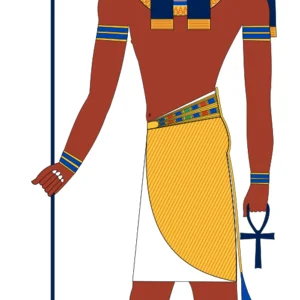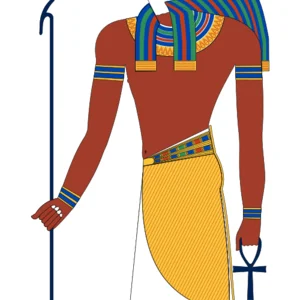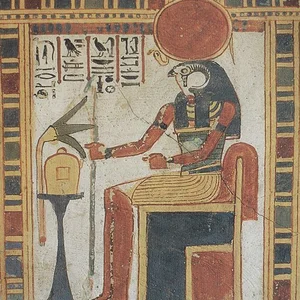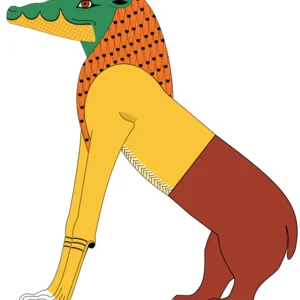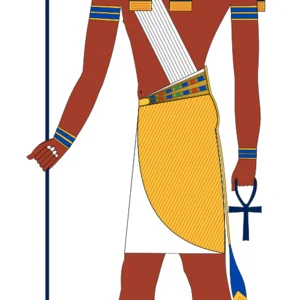

Thoth is a deity of ancient Egyptian mythology, associated with wisdom, writing, and knowledge. Depicted with the head of an ibis or a baboon, he was venerated as the inventor of hieroglyphic writing and as the scribe of the gods.
Thoth
Thoth
8 min read
Frequently asked questions
Key Facts
- Thoth was considered the inventor of hieroglyphic writing and all forms of writing in ancient Egypt
- He was depicted with the head of an ibis or a baboon, sacred animals associated with wisdom
- Thoth served as the divine scribe, responsible for recording the deeds of souls in the afterlife (the Judgment of Osiris)
- He was associated with the Moon and the measurement of time in Egyptian cosmology
- His main cult was centered in Khmunu (Hermopolis), a major religious hub of ancient Egypt
Works & Achievements
Thoth is credited as the inventor of hieroglyphic writing, the sacred writing system of pharaonic Egypt. This invention represents the foundation of knowledge and the transmission of learning in Egyptian civilization.
Thoth is associated with the composition and preservation of the Book of the Dead, a collection of magical spells and funerary rituals believed to guide souls through the afterlife. He is presented as its divine author and guardian.
Beyond hieroglyphic writing, Thoth is regarded as the inventor of all systems of notation, including numerals and mathematical calculation. These inventions were essential to administrative and scientific organization.
Thoth served as the divine scribe who recorded the deeds of all beings and presided over the Weighing of the Heart, the judgment of souls after death. This role placed him as the arbiter of cosmic and divine justice.
Thoth is associated with the creation of medical and magical texts, most notably the Ebers Papyrus. These treatises gathered the medical knowledge and magical formulas of ancient Egypt.
Thoth intervened as mediator and counselor in conflicts between the gods — most notably between Horus and Set. His role as wise arbiter made him a guardian of cosmic order (Ma'at).
Anecdotes
Thoth was considered the inventor of hieroglyphic writing according to the ancient Egyptians. Egyptian scribes, who formed an important and respected class, invoked him as their patron and protector. They celebrated an annual festival in his honor, acknowledging his fundamental role in the transmission of knowledge.
In Egyptian mythology, Thoth served as the divine scribe during the judgment of souls after death. According to the Book of the Dead, he recorded the results of the weighing of the heart and noted whether a soul was worthy of the afterlife, making him a central figure in ancient Egyptian funerary beliefs.
Thoth was associated with the moon and its cycles in Egyptian cosmology. The Egyptians sometimes called him 'the lord of the moon,' and temples were dedicated to him at Khmunu (Hermopolis), where astronomer-priests observed the lunar phases tied to his worship.
Depicted sometimes with the head of an ibis and sometimes with the head of a baboon, Thoth symbolized wisdom and intellect. Both sacred animals were mummified and buried in his honor — thousands of ibis and baboon mummies have been discovered in Egyptian necropolises.
The Greeks, through their contact with Egypt, identified Thoth with Hermes, their god of messages and writing. This fusion gave rise to 'Hermes Trismegistus' (thrice-great), a legendary figure said to have authored sacred texts, illustrating how the wisdom of Thoth went on to influence ancient Mediterranean thought.
Primary Sources
Thoth, the great ibis with golden wings, presides over the judgment of souls. He weighs the heart of the deceased on the scales of Ma'at and records the verdict with his scribe's reed.
Thoth, who wrote the names of the gods and established the divine decrees, he who gave form to the sacred hieroglyphs.
Thoth, the heart and tongue of the god Ptah, through whom the words of creation were spoken and all things recorded.
Praise to you, Thoth, lord of wisdom, who invented writing and preserved the secrets of the gods in your divine words.
Key Places
The main cult city of Thoth in ancient Egypt, located in Upper Egypt. It was the religious center where the god was venerated as creator and divine scribe, home to an important temple dedicated to his worship.
A major administrative and religious center of ancient Egypt where Thoth was recognized as scribe of the royal court and keeper of the sacred archives. A key site of Egyptian divine worship.
Capital of the New Kingdom where Thoth was venerated in temples as god of wisdom and writing, particularly at the temples of Karnak and Luxor.
Though built after the Pharaonic era, it symbolically embodies the legacy of Thoth as god of writing and guardian of humanity's accumulated knowledge.
A region of Upper Egypt where Thoth was venerated in local temples as protector of knowledge and scribes throughout ancient Egyptian antiquity.
Typical Objects
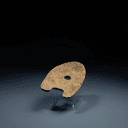
A small rectangular object made of wood or stone with cavities for holding pigments (black and red). An essential attribute of Thoth as god of writing and scribes.
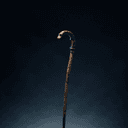
A cut reed stem used as a stylus to trace hieroglyphs on papyrus. The scribe's tool of the trade, intimately associated with Thoth.
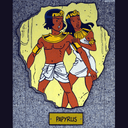
A sheet made from the papyrus plant, used as a writing surface. The primary material for recording the knowledge that Thoth embodied.
📷 CC BY-SA 4.0 · Wikimedia Commons ↗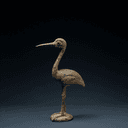
A bronze or stone representation of the ibis, the animal form in which Thoth was most often depicted. A direct symbol of the deity.
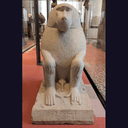
A figurine depicting a baboon, another animal form associated with Thoth in Egyptian mythology, particularly linked to wisdom and the moon.
📷 CC0 · Wikimedia Commons ↗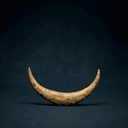
A symbol of the moon, as Thoth was also associated with lunar divinity and the measurement of time. A defining iconographic element of the god.
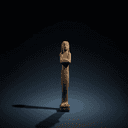
Depictions of scribes in a crouching position, palette and reed pen in hand. Thoth was the divine patron of all scribes in ancient Egypt.
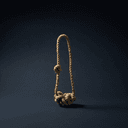
A measuring instrument used in ancient Egypt to mark out land boundaries. Thoth also governed the measurement of time and mathematical knowledge.
School Curriculum
Vocabulary & Tags
Key Vocabulary
Tags
Mythologie
Daily Life
Morning
Thoth begins his day in the halls of the temple or divine palace, where he fulfills his duties as scribe of the gods. He prepares his papyrus tablets and writing instruments to record divine decisions and maintain the cosmic archives. Before any other activity, he takes part in the religious rituals of worship devoted to the supreme god Ra.
Afternoon
In the afternoon, Thoth continues his work of documentation, recording the important events of the pharaonic reign and sacred transactions. He also acts as mediator in divine conflicts, particularly during the judgment of souls in the afterlife, where he weighs the hearts of the dead. His intellectual role gives him access to all domains of knowledge and governance.
Evening
As evening falls, Thoth withdraws to the libraries and halls of learning within the temples, where he meditates on the mysteries of the universe and infinite knowledge. He devotes time to perfecting hieroglyphic writing and preserving the magic and secrets of ritual practice. At night, he joins the nocturnal processions alongside the other deities.
Food
As a deity, Thoth is nourished by ritual offerings presented at the temple: bread, beer, meat from sacrificed animals, and fruit. These offerings come from the abundant harvests of the Nile and from livestock. His symbolic diet mirrors that of the Egyptian priestly elite who venerate him and receive the consecrated remains.
Clothing
Thoth wears the insignia of his divine office: a crown combining the lunar crescent and the solar disk, symbolizing his mastery over time and knowledge. He is dressed in the garments of a priest or high-ranking courtier, often the white kilt worn by the pharaoh and liturgical staff. His iconographic depictions frequently show him holding a reed pen and a writing palette.
Housing
Thoth resides in the major Egyptian temples, particularly at Hermopolis (Khmunu), where his cult is dominant. His divine dwelling is imagined as a hall in the celestial palace filled with papyri, tablets, and sacred books. These spaces of knowledge and worship are the only fitting places to house a deity of such intellectual importance.
Historical Timeline
Period Vocabulary
Visual Style
Un style inspiré de l'art égyptien antique mêlant hiéroglyphes, iconographie pharaonique et symbolisme divin. Les compositions privilégient les perspectives plates et les profils, enrichies de motifs géométriques sacrés, de rouleaux de papyrus et d'une atmosphère mystique dorée, rappelant les fresques de temples et l'art des papyrus.
Sound Ambience
Une ambiance mystique et studieuse évoquant les temples égyptiens antiques, mêlant les sons de l'écriture sacrée, des instruments rituels délicats et des bruits de la nature du Nil, créant une atmosphère de sagesse ancienne et de savoir divin.
Liens externes & ressources
Références
Œuvres
Invention de l'écriture hiéroglyphique
Mythologie égyptienne antique
Le Livre des Morts (Livre de la Sortie au Jour)
Nouvel Empire (vers 1550-1070 av. J.-C.)
Invention de l'alphabet et des nombres
Mythologie égyptienne antique
Fonction de scribe des dieux et juge des morts
Nouvel Empire et périodes ultérieures
Traités de médecine et de magie
Nouvel Empire
Médiation dans les conflits divins
Mythologie égyptienne antique