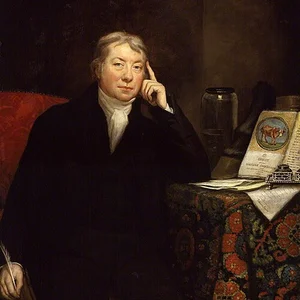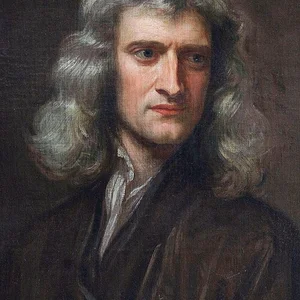

English mathematician, physicist and astronomer (1643–1727), Isaac Newton is one of the greatest scientists in history. He revolutionized science by formulating the laws of motion and universal gravitation, and by developing calculus.
Isaac Newton(1643 — 1727)
Isaac Newton
royaume de Grande-Bretagne, royaume d'Angleterre
7 min read
Frequently asked questions
Famous Quotes
« If I have seen further, it is by standing on the shoulders of giants.»
« Gravity explains the motions of the planets, but it cannot explain who set the planets in motion.»
Key Facts
- 1666–1667: Period at Woolsthorpe during the Great Plague, during which he developed the foundations of calculus and the laws of motion
- 1687: Publication of 'Philosophiæ Naturalis Principia Mathematica' (Mathematical Principles of Natural Philosophy), the founding work of classical mechanics
- 1704: Publication of 'Opticks', presenting his theories on light and colour based on his prism experiments
- 1696–1727: Warden then Master of the Royal Mint, where he applied his skills to monetary affairs
- 1705: Knighted by Queen Anne for his scientific contributions
Works & Achievements
Newton's most important work, in which he formulates the three laws of motion and the law of universal gravitation. Considered the foundation of classical mechanics, it durably revolutionized physics and astronomy.
Newton presents his research on the nature of light, the decomposition of colors through a prism, and the corpuscular theory of light. Written in English, this work reached a wide audience and profoundly influenced modern optics.
A foundational manuscript in which Newton sets out his method of fluxions, a precursor to differential and integral calculus. This discovery, contemporaneous with that of Leibniz, gave rise to a famous priority dispute between the two scholars.
Newton designed and built the first functional mirror-based telescope, overcoming the defects of lens-based telescopes. This instrument revolutionized observational astronomy and its principle is still used in the largest modern telescopes.
A compilation of his mathematics lectures at Cambridge, covering algebra and equations. This work contributed to the dissemination and teaching of modern mathematics across Europe.
Anecdotes
The apple legend is partially true: Newton himself recounted on several occasions that watching an apple fall in the orchard at Woolsthorpe had led him to reflect on gravity. It was not an apple falling on his head, but an observation that triggered a deep meditation on the forces governing the motion of celestial bodies.
Newton was a passionate and secretive alchemist: it is estimated that he devoted more than one million handwritten words to alchemy, seeking to transmute metals and find the philosopher's stone. These works, long kept hidden, show that the father of modern physics also believed in the hermetic knowledge of his era.
During the Great Plague of 1665–1666, the University of Cambridge closed its doors and Newton returned to his childhood home at Woolsthorpe. It was during these two years of forced isolation that he developed infinitesimal calculus, his theory of colours, and the foundations of gravitation — a period historians call his 'annus mirabilis'.
Newton was the first scientist to be knighted for his scientific work: Queen Anne granted him the honour in 1705. He also took charge of the Royal Mint in 1696 and zealously pursued counterfeiters, even having several of them sentenced to death.
Primary Sources
Every particle of matter in the universe attracts every other particle with a force directly proportional to the product of their masses and inversely proportional to the square of the distance between them.
I procured a triangular glass prism to try therewith the celebrated phenomena of colours. And having darkened my room and made a small hole in my window-shutters to let in a convenient quantity of the sun's light, I placed my prism at its entrance so that the light might be refracted to the opposite wall.
If I have seen further than others, it is by standing upon the shoulders of giants.
I consider mathematical quantities not as consisting of very small parts, but as described by a continuous motion. Lines are described and generated not by apposition of parts, but by the continuous motion of points.
Key Places
Newton's birthplace, where he took refuge during the Great Plague (1665–1666). It was in this orchard that he observed an apple falling and developed the foundations of his major theories.
Newton studied there from 1661 and became Professor of Mathematics in 1669. He wrote the bulk of his major scientific works there and taught for over thirty years.
Newton presented his discoveries on light there in 1672 and became its president in 1703. The Royal Society was Europe's leading scientific forum, where Newton published and debated his theories.
Newton headed the Royal Mint from 1696, overseeing the recoinage of English currency and pursuing counterfeiters. The position gave him considerable political and social influence.
Newton was interred there in 1727 with full national honours, alongside the greatest figures in English history. His tomb remains a site of scientific pilgrimage visited to this day.
Typical Objects
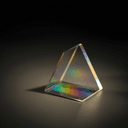
Newton used a prism to decompose white light into a spectrum of colors, demonstrating that white light is composed of all the colors of the rainbow. This experiment revolutionized the understanding of the nature of light.
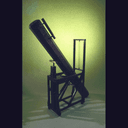
Dissatisfied with the chromatic aberrations of refracting telescopes, Newton designed and built by hand in 1668 the first functional mirror telescope. This type of instrument is today known as the 'Newtonian telescope' and remains in use.
📷 CC BY 4.0 · Wikimedia Commons ↗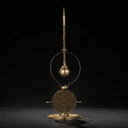
Pendulum clocks, refined in the 17th century, were indispensable to Newton's experiments on motion and the measurement of time. They allowed him to empirically verify his laws of motion.
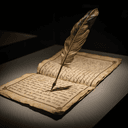
Newton wrote millions of handwritten words throughout his life, on mathematics, physics, alchemy, and theology. His notebooks are a precious source for understanding the evolution of his thought.
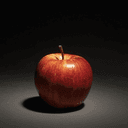
Having become the universal icon of Newton, the apple represents the simple observation of nature that leads to a great discovery. It symbolizes the scientific method based on observation and experimentation.
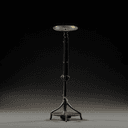
As director of the Royal Mint, Newton used high-precision scales to control the purity and weight of coins. His scientific skills allowed him to modernize the minting of English coinage.
School Curriculum
Vocabulary & Tags
Key Vocabulary
Tags
Époque
Daily Life
Morning
Newton rose early and devoted his first hours to reading scientific and philosophical texts, often the writings of Descartes, Kepler, or Galileo. He took little care of himself, sometimes forgetting to eat or change his clothes, absorbed in his mathematical reflections.
Afternoon
He spent the afternoon writing mathematical proofs, conducting optical experiments with his prisms, or observing the sky from the garden. At Cambridge, he rarely lectured: his rooms were often empty, as his teachings were considered too difficult.
Evening
Newton frequently worked until very late at night, by candlelight, immersed in his manuscripts on alchemy or theology. He led an essentially solitary, celibate, and ascetic life, with little social activity.
Food
Newton had very irregular eating habits, often noted by his contemporaries: he would forget to eat and subsisted frugally on bread, cheese, and a few vegetables. He drank little alcohol, preferring water or tea, which was then becoming widespread in England.
Clothing
Newton wore the typical dress of an English gentleman of the 17th century: breeches, silk stockings, a ruffled shirt, and a long dark wool coat. He often neglected his appearance, sometimes appearing in public with dishevelled hair or crumpled clothes.
Housing
At Cambridge, Newton had spacious rooms in Trinity College, with a library and a private chemistry laboratory. In London, from 1696 onwards, he lived in a comfortable house on Jermyn Street, then in Kensington, surrounded by his books and instruments.
Historical Timeline
Period Vocabulary
Visual Style
Style portrait baroque anglais du XVIIe siècle, avec un clair-obscur dramatique, des instruments scientifiques et la lumière prismatique décomposée en arc-en-ciel comme élément visuel central.
Sound Ambience
Un mélange de silence studieux et de sons naturels de la campagne anglaise du XVIIe siècle, ponctué par le grattement de la plume et le tic-tac d'une horloge de précision.
Liens externes & ressources
Références
Œuvres
Philosophiæ Naturalis Principia Mathematica
1687
De Methodis Serierum et Fluxionum
1671 (publié en 1736)
Telescope à réflexion (invention)
1668
Arithmetica Universalis
1707