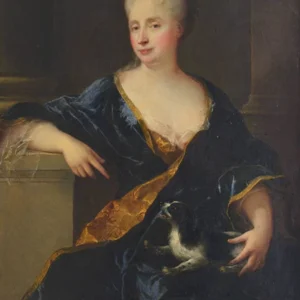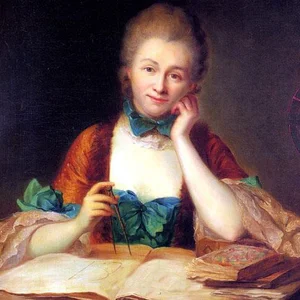

Émilie du Châtelet (1706-1749) was a French physicist and mathematician of the Enlightenment. She translated and annotated Newton's Principia Mathematica, a work that remained the standard French reference until the 19th century. Voltaire's companion, she demonstrated that kinetic energy is proportional to the square of velocity.
Émilie du Châtelet(1706 — 1749)
Émilie du Châtelet
France
8 min read
Frequently asked questions
Famous Quotes
« One must choose: to love women or to know them; there is no middle ground.»
« I am in truth a most uncommon woman.»
Key Facts
- 1706: born in Paris into an aristocratic family that encouraged her scientific education
- 1733: beginning of her intellectual and romantic relationship with Voltaire at Cirey
- 1740: publication of the Institutions de physique, a synthesis of Newton and Leibniz
- 1745–1749: annotated translation of Newton's Principia Mathematica, published posthumously in 1759
- 1749: died in childbirth at age 42 at the court of Lunéville
Works & Achievements
An ambitious synthesis seeking to reconcile Newtonian physics with Leibniz's metaphysics. This pedagogical work, intended for her son's education, demonstrates her mastery of the two great scientific systems of her era.
A memoir submitted to the Académie des sciences competition in 1738, in which she puts forward the hypothesis that light and fire are of a different nature. Published by the Académie, it stands as one of the rare female scientific works officially recognized in the 18th century.
A complete translation from Latin accompanied by an algebraic commentary in her own hand, which remains to this day the only complete French translation of Newton's Principia. Voltaire had it published seven years after her death.
A philosophical essay in which she defends a materialist and hedonist conception of happiness grounded in passion, study, and reason. A remarkable text for its candor and modernity, published thirty years after her death.
A theoretical and experimental work in which she argues that the energy of a moving body is proportional to the square of its velocity (mv²), vindicating Leibniz against Newton's supporters. This contribution anticipates the modern concept of kinetic energy.
A critical and philosophical text examining the contradictions of the Holy Scriptures, reflecting her rationalism and the libertine spirit of the Enlightenment. Kept in manuscript form during her lifetime, it illustrates the philosophical dimension of her thought.
Anecdotes
Émilie du Châtelet was so passionate about mathematics that, having been refused entry to the Parisian cafés reserved for men where scholars gathered, she disguised herself as a man to gain access and take part in scientific discussions. This episode illustrates the extraordinary obstacles women had to overcome to access knowledge at that time.
To experimentally verify Leibniz's theory of vis viva, Émilie du Châtelet personally funded experiments involving dropping lead balls into clay from different heights. She thereby demonstrated that kinetic energy is proportional to the square of velocity — a fundamental discovery for modern physics.
Near the end of her life, convinced she would die in childbirth, Émilie du Châtelet worked frenetically to complete her translation of Newton's Principia Mathematica, sometimes writing for twelve hours at a stretch. She finished her manuscript shortly before her death in September 1749, at only 42 years old. Her translation remains to this day the only complete French version of this foundational work.
Émilie du Châtelet and Voltaire transformed the Château de Cirey-sur-Blaise into a genuine private scientific laboratory, one of the best-equipped in Europe. They installed optical instruments, a library of over 21,000 volumes, and together conducted experiments on the nature of fire as part of a competition held by the Académie des sciences — an institution that nonetheless refused to admit women.
Émilie du Châtelet anonymously submitted a memoir on the nature of fire to the Académie des sciences competition in 1738, at the same time as Voltaire and without telling him. Although neither won the prize, the Académie, impressed by the quality of her work, nevertheless published both memoirs — an exceptional honour granted to a woman for the first time.
Primary Sources
The ideas we have of extension are so clear and so distinct that it is impossible to confuse them with any other; extension is that which has parts outside of parts, and which can be divided into parts.
Fire is not a particular and elementary substance, but a movement of the insensible parts of bodies, excited and sustained by different causes.
Mr. Newton has demonstrated that if the accelerating force of the Moon toward the Earth is in the inverse ratio of the square of its distance from the center of the Earth, this force is equal to Gravity at the surface of the Earth.
One must begin by telling oneself firmly: I have a mind capable of learning, and I intend to use it. One must not be discouraged by the first difficulties.
I am persuaded that many women are unaware of their own talents due to the failings of their education, and that if they were raised as men are, they would succeed equally in the arts and sciences.
Key Places
Main residence of Émilie du Châtelet and Voltaire from 1735 to 1748, transformed into an intellectual hub and private scientific laboratory. It was here that she wrote her Institutions de Physique and conducted her experiments on fire.
Her childhood home on the rue de Bourbon (now rue de Lille), where her father, contrary to the customs of the time, had her given an advanced education in Latin, mathematics, and sciences. This exceptional environment shaped her intellectual vocation.
Residence of the court of King Stanislas of Poland, where du Châtelet stayed in 1748–1749. It was here that she died on 10 September 1749, a few days after giving birth to her fourth child.
Institution from which she was excluded as a woman, despite the recognized quality of her work. She nonetheless submitted her papers there and had her Dissertation sur le feu published there in 1744, an extremely rare honor for a woman.
Famous Parisian café frequented by philosophers and scholars of the Enlightenment. Tradition holds that Émilie disguised herself as a man in order to take part in the scientific discussions that were normally forbidden to her.
Typical Objects

Essential instruments of the Cirey laboratory, they allowed du Châtelet to experiment on the nature of light and refraction. She used them for her work on fire and Newtonian optics.

Daily tools of her prodigious writing activity: translations, scientific memoirs, letters to Voltaire and European scholars. She sometimes wrote at night by candlelight to advance her work.

The Latin copy she annotated and translated was her scientific bedside book. Her French translation, enriched with her own algebraic commentaries, remains the reference in the French language.

Materials for her experiments on vis viva: by measuring the impression left by balls dropped from different heights, she empirically validated the equation E = mv², anticipating Leibniz's concept of kinetic energy.

A high-ranking noblewoman, du Châtelet wore the attire required by her social standing to attend Versailles and Parisian salons. Her polished appearance contrasted with her scientific pursuits, which were highly unconventional for a woman.

Reference instruments for her studies of astronomy and celestial mechanics. She used them to understand and illustrate Newton's laws of universal gravitation in her lessons at Cirey.
School Curriculum
Vocabulary & Tags
Key Vocabulary
Tags
Daily Life
Morning
Émilie du Châtelet rose early and devoted the first hours of the morning to correspondence with European scholars — Maupertuis, Bernoulli, Clairaut. She would then briefly oversee the activities of the château before retiring to her study for her mathematical readings.
Afternoon
The afternoon was reserved for intensive scientific work: writing her memoirs, conducting experiments in the Cirey laboratory, or taking private lessons with mathematicians she had brought to the château. She could remain focused for several hours at a stretch, to the point of forgetting to eat.
Evening
Evenings at Cirey were lively and brilliant: theatrical performances in the château's small theatre, suppers with guests — philosophers, enlightened nobles — followed by intellectual discussions. Voltaire and she would often read their works aloud before each retiring to their own apartment to work late into the night.
Food
Like most eighteenth-century aristocrats, du Châtelet ate little and irregularly, absorbed in her work. Meals at Cirey brought guests together around refined dishes — roasted meats, entremets, fine wines — in an atmosphere blending gastronomy with philosophical conversation.
Clothing
She wore the pannier gowns and corsets dictated by Rococo fashion, in silk and brocade, often in pastel or deep colours. Her working attire was simpler but always neat; she favoured diamond jewellery and pearls for social occasions, aware that her appearance contributed to her social standing.
Housing
She divided her life between the family's Parisian townhouse, the Château de Cirey — redesigned at her own expense with a library, laboratory, and theatre — and various court residences. Her private apartment at Cirey was filled with books, manuscripts, and scientific instruments, while the reception rooms reflected the grandeur expected of her rank.
Historical Timeline
Period Vocabulary
Visual Style
Esthétique rococo française des Lumières, mêlant luxe aristocratique et rigueur scientifique dans la lumière chaude des chandelles du château de Cirey.
Sound Ambience
Ambiance d'un cabinet de travail aristocratique du XVIIIe siècle, mêlant le silence studieux de la nuit aux sons discrets du laboratoire scientifique privé de Cirey.
Liens externes & ressources
Références
Œuvres
Institutions de Physique
1740
Dissertation sur la nature et la propagation du feu
1744
Principes mathématiques de la philosophie naturelle (traduction des Principia de Newton)
1756 (posthume)
Discours sur le bonheur
1779 (posthume)
Mémoire sur la nature des forces vives (inédit)
1747
Examen de la Bible
XVIIIe siècle (posthume)