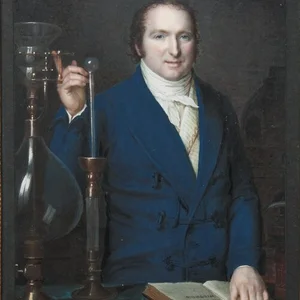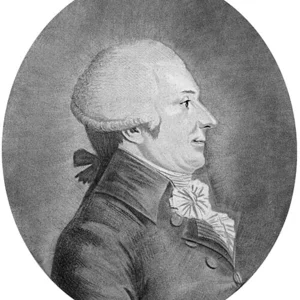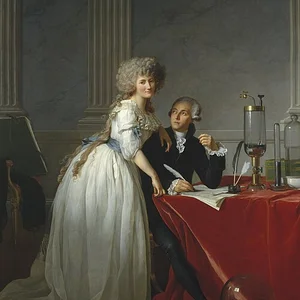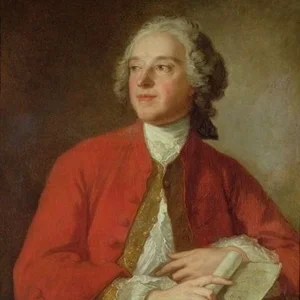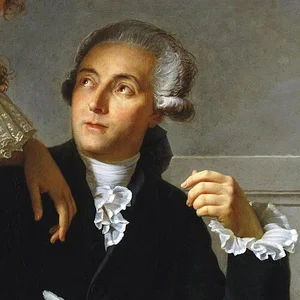

An 18th-century French chemist, Lavoisier is the founder of modern chemistry. He established the law of conservation of mass and identified oxygen, revolutionizing the understanding of chemical phenomena.
Antoine de Lavoisier(1743 — 1794)
Antoine Lavoisier
France
7 min read
Frequently asked questions
Famous Quotes
« Nothing is lost, nothing is created, everything is transformed»
Key Facts
- 1772: discovers the role of oxygen in combustion by refuting the phlogiston theory
- 1774: isolates and identifies oxygen (alongside Priestley in England)
- 1785: demonstrates that water is composed of hydrogen and oxygen
- 1787: publishes the Méthode de nomenclature chimique, creating the modern system of chemical nomenclature
- 1794: executed during the Reign of Terror of the French Revolution
Works & Achievements
A founding work of modern chemistry, presenting a new nomenclature, the list of known elements, and the law of conservation of mass. It is considered the first chemistry textbook in the modern sense.
Written with Guyton de Morveau, Berthollet, and Fourcroy, this text establishes a rational system of chemical names. Many terms coined at the time (oxygen, hydrogen, nitrogen) are still in use today.
A decisive memoir in which Lavoisier demonstrates that combustion is a combination with oxygen, overturning the phlogiston theory that had dominated chemistry for a century.
Pioneering work showing that animal respiration is a form of slow combustion, consuming oxygen and producing carbon dioxide and heat.
An economic and statistical study on French agriculture, reflecting Lavoisier's interest in agronomy and economic reform.
A demonstration that water is a compound of hydrogen and oxygen and not an element, definitively refuting the Aristotelian theory of the four elements.
Anecdotes
Lavoisier demonstrated that water was not a simple element by decomposing it into hydrogen and oxygen, then recomposing it from those two gases. This spectacular experiment, performed before the Académie des sciences in 1785, definitively refuted the ancient theory of the four elements.
To finance his very costly scientific research, Lavoisier was a tax farmer (fermier général), meaning a tax collector for the king. This position, which allowed him to purchase the finest instruments of the era, ultimately cost him his life during the Reign of Terror: he was guillotined on May 8, 1794, along with 27 other tax farmers.
Lavoisier possessed a balance of exceptional precision for the time, capable of weighing to the nearest grain (approximately 0.05 grams). It was thanks to this obsession with exact measurement that he was able to establish the law of conservation of mass: 'Nothing is lost, nothing is created, everything is transformed.'
His wife Marie-Anne Paulze, whom he married when she was only 13, became his most valuable collaborator. She learned Latin and English to translate foreign scientific works, produced the illustrations for his books, and kept detailed notes of his laboratory experiments.
The mathematician Lagrange reportedly declared after Lavoisier's execution: 'It took only an instant to cut off that head, and a hundred years may not be enough to produce another like it.' This phrase illustrates the immense loss his death represented for science.
Primary Sources
We may lay it down as an incontestable axiom that, in all the operations of art and nature, nothing is created; an equal quantity of matter exists both before and after the experiment; the quality and quantity of the elements remain precisely the same, and nothing takes place beyond changes and modifications.
The calcination and combustion of metals are due solely to pure air, and the increase in weight acquired by metallic calxes is exactly equal to the quantity of air absorbed.
It is time to bring chemistry back to a more rigorous way of reasoning, to strip away from the facts with which this science enriches itself daily what reasoning and prejudice add to them.
Languages are not merely intended to express ideas and images by means of signs: they are moreover genuine analytical methods by which we proceed from the known to the unknown.
Key Places
Established in the Royal Arsenal in 1775, this was Lavoisier's main laboratory where he conducted his most celebrated experiments on combustion and the composition of water.
Institution where Lavoisier was elected in 1768 and presented most of his papers. He played a central role there until its dissolution in 1793.
Headquarters of the Ferme générale where Lavoisier carried out his duties as a tax collector, an activity that funded his research but ultimately led to his downfall.
Rural property where Lavoisier conducted scientific agronomy experiments, testing new farming and livestock-rearing methods.
The site where Lavoisier was guillotined on 8 May 1794, alongside 27 other former tax farmers condemned by the Revolutionary Tribunal.
Typical Objects

Central instrument of Lavoisier's laboratory, of remarkable accuracy. It was through his meticulous weighings that he established the law of conservation of mass.

Large apparatus designed by Lavoisier to precisely measure the volumes of gas produced or consumed during chemical reactions.

Instrument invented with Laplace to measure the heat released by chemical reactions and the respiration of living beings.

Vessel with a curved neck used for heating and distilling substances, ubiquitous in his laboratory at the Arsenal.

Glass bell inverted over a mercury trough, allowing gases to be collected and measured without contamination from outside air.

Registers meticulously kept by Lavoisier and his wife, recording each experiment with exact measurements and operating conditions.
School Curriculum
Vocabulary & Tags
Key Vocabulary
Tags
Daily Life
Morning
Lavoisier rose very early, around 5 or 6 in the morning, and devoted his first hours to scientific research, before his administrative duties took over. He worked in his laboratory at the Arsenal, checking the results of ongoing experiments and planning the next ones with methodical rigor.
Afternoon
The afternoon was generally occupied by his official duties: meetings of the Ferme générale, sessions at the Académie des sciences, or work for the various royal commissions of which he was a member (gunpowder and saltpeter, agriculture, weights and measures). He also dictated his scientific correspondence.
Evening
In the evening, Lavoisier returned to his laboratory for a second scientific work session. His wife Marie-Anne assisted him by taking notes and drawing the experimental apparatus. They also regularly received scholars and philosophers in their salon at the Arsenal.
Food
Lavoisier ate according to the customs of the Parisian upper bourgeoisie: white bread, roasted or sauced meats, fish, seasonal vegetables, cheeses, and fruit. His own work on nutrition had made him aware of the importance of diet, and he took an interest in the quality of foodstuffs.
Clothing
As a member of the upper bourgeoisie and a tax farmer, Lavoisier wore the French-style suit: a fine woolen coat, embroidered waistcoat, fitted breeches, silk stockings, and a powdered wig. In the laboratory, he protected his clothes with a linen apron during chemical procedures.
Housing
Lavoisier resided in a vast apartment at the Paris Arsenal, where he had a laboratory considered the best-equipped in Europe. The rooms contained hundreds of precision instruments, furnaces, mercury tanks, and a remarkable scientific library.
Historical Timeline
Period Vocabulary
Visual Style
Style néoclassique français de la fin du XVIIIe siècle, éclairage chaleureux de laboratoire mêlant lumière naturelle et lueur des fourneaux, instruments de laiton poli et verrerie scientifique.
Sound Ambience
L'atmosphère sonore du laboratoire de Lavoisier à l'Arsenal : crépitement des fourneaux, bouillonnement des gaz dans le mercure, tintement des poids de balance, sur fond de rumeur parisienne du XVIIIe siècle.
Liens externes & ressources
Références
Œuvres
Traité élémentaire de chimie
1789
Méthode de nomenclature chimique
1787
Mémoire sur la combustion en général
1777
Mémoire sur la respiration des animaux
1789
De la richesse territoriale du royaume de France
1791
Expériences sur la décomposition et la recomposition de l'eau
1785