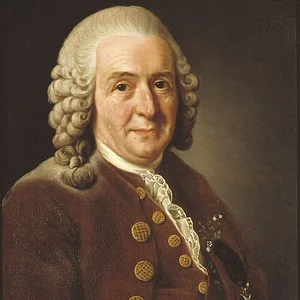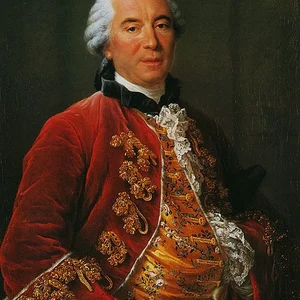

French naturalist and mathematician of the 18th century, Buffon is one of the founders of modern natural history. As director of the Jardin du Roi in Paris, he proposed a groundbreaking theory on the age of the Earth and the evolution of species.
Buffon(1707 — 1788)
Georges-Louis Leclerc de Buffon
France
7 min read
Frequently asked questions
Famous Quotes
« The style is the man himself»
« Nature has no categories»
Key Facts
- 1739: Becomes director of the Jardin du Roi (future Muséum national d'Histoire naturelle) in Paris
- 1749–1788: Publishes Histoire naturelle, générale et particulière, a monumental encyclopedia in 36 volumes
- 1778: Proposes that the Earth is approximately 75,000 years old (a revolutionary theory for the time)
- Develops a transformist theory foreshadowing evolution, based on the adaptation of species to their environment
- Establishes a naturalist approach grounded in systematic observation and experimentation
Works & Achievements
A monumental work in 36 volumes covering minerals, animals, and the theory of the Earth. It constitutes the first attempt to encompass the entirety of the natural world in a coherent work.
An inaugural address to the Académie française, which became a classic of reflection on writing. The phrase "the style is the man himself" remains its most celebrated formulation.
A revolutionary work proposing a history of the Earth in seven epochs. Buffon estimates the age of the Earth at 75,000 years, challenging the biblical chronology.
A treatise on probabilities and their application to human decisions. Buffon introduces the famous Buffon's needle problem, a founding contribution to geometric probability.
One of Buffon's earliest texts on the rational management of natural resources, foreshadowing modern ecological concerns.
Nine volumes devoted to birds with detailed descriptions and illuminated plates. This work remains a reference in historical ornithology.
Anecdotes
Buffon was elected to the Académie française in 1753, where he delivered a famous Discourse on Style containing the now-proverbial formula: "The style is the man himself." This discourse remains one of the most quoted texts in French literature on the art of writing.
To estimate the age of the Earth, Buffon heated iron cannonballs of various sizes and measured their cooling time. He concluded that the Earth must be at least 75,000 years old — a revolutionary estimate that earned him a reprimand from the theology faculty of the Sorbonne in 1751.
Buffon transformed the modest Jardin du Roi into a true scientific center of European renown. Under his direction from 1739, the garden doubled in area and was enriched with thousands of specimens from around the world, becoming the forerunner of the Muséum national d'histoire naturelle.
Buffon was a tireless worker who rose every morning at five o'clock and worked until nine in the evening. He instructed his servant Joseph to drag him out of bed by force if he failed to get up, even offering a reward for each successful wake-up.
Buffon owned ironworks in Montbard, in Burgundy, where he conducted his experiments on the cooling of metals. He was both a scientist and an industrialist, drawing substantial income from his metallurgical activities while putting them in the service of his scientific research.
Primary Sources
Nature is the outer throne of divine magnificence; the man who contemplates it, who studies it, rises by degrees to the inner throne of omnipotence.
Well-written works will be the only ones to pass on to posterity. The quantity of knowledge, the singularity of facts, the very novelty of discoveries, are not sure guarantors of immortality.
The entire face of the Earth today bears the imprint of the power of man. Time, space, and matter are his means; the universe is his domain.
The most noble conquest that man has ever made is that of this proud and spirited animal, who shares with him the hardships of war and the glory of combat.
Key Places
Buffon directed the Jardin du Roi for nearly 50 years, transforming it into a major scientific center. He established extensive collections there and expanded the gardens.
Buffon's main residence, where he spent a large part of the year. He conducted his experiments on metals there and wrote most of his Natural History in his working tower.
Buffon was elected to seat no. 1 of the Académie française in 1753. It was there that he delivered his famous Discourse on Style.
Buffon was admitted in 1734 for his work in mathematics. He regularly presented his research in natural history there.
The young Buffon studied law and then mathematics there in the 1720s, before turning to the natural sciences.
Typical Objects

Buffon collected minerals, fossils, and animal specimens from around the world. His cabinet at the Jardin du Roi was one of the richest in Europe.

Buffon constructed a large mirror made of 168 flat glass panes to concentrate the sun's rays. He succeeded in igniting wood at a distance, reproducing what he believed to be the feat of Archimedes.

He used white-hot iron cannonballs in his experiments on the cooling of bodies. This work allowed him to estimate the age of the Earth.

The *Histoire naturelle* was illustrated with hundreds of detailed engraved plates. The draughtsman Jacques de Sève produced most of these illustrations under Buffon's direction.

Buffon composed his texts with extreme care, rewriting certain passages as many as eleven times. He regarded style as inseparable from scientific thought.

His forges at Montbard served him both as an industrial enterprise and as an experimental laboratory for studying the properties of metals and heat.
School Curriculum
Vocabulary & Tags
Key Vocabulary
Daily Life
Morning
Buffon rose at five in the morning, often forcibly awakened by his servant Joseph. He immediately set to work in his tower at Montbard, drafting and correcting his manuscripts in the early morning silence. He worked for several hours at a stretch before taking a light meal.
Afternoon
The afternoon was devoted to his duties as superintendent: inspecting the collections of the Jardin du Roi, corresponding with scholars and travelers from around the world, and overseeing the Montbard forges. He regularly received distinguished visitors who came to admire his collections and discuss natural sciences.
Evening
In the evening, Buffon would retire to re-read and correct his texts, sometimes until nine o'clock. He supped late and occasionally entertained guests at his table. He went to bed relatively early to ensure his early morning rise, convinced that regularity was the key to intellectual productivity.
Food
Buffon ate in moderation, favoring simple food despite his wealth. He enjoyed the produce of his Burgundian estate: poultry, game, garden vegetables, and Burgundy wines. He generally had two meals a day, a light one in the morning and a more substantial supper.
Clothing
As a count and superintendent of the Jardin du Roi, Buffon wore the French court dress: embroidered justaucorps, waistcoat, breeches, silk stockings, and powdered wig on official occasions. In the privacy of his study at Montbard, he adopted simpler attire — a dressing gown and nightcap.
Housing
Buffon divided his time between his private mansion at the Jardin du Roi in Paris and his château at Montbard in Burgundy. At Montbard, he had converted a medieval tower into an isolated study, surrounded by terraced gardens he had designed himself. His Parisian residence adjoined the collections of the Jardin du Roi.
Historical Timeline
Period Vocabulary
Visual Style
Un style visuel inspiré des gravures d'histoire naturelle du XVIIIe siècle, mêlant la lumière dorée des cabinets de curiosités aux verts profonds des jardins botaniques royaux et aux tons chauds de la Bourgogne.
Sound Ambience
L'atmosphère sonore mêle les bruits d'un jardin botanique royal — chants d'oiseaux exotiques, fontaines, pas sur le gravier — aux sons industriels des forges de Montbard et au grattement d'une plume dans un cabinet de travail.
Liens externes & ressources
Références
Œuvres
Histoire naturelle, générale et particulière
1749-1789
Discours sur le style
1753
Les Époques de la nature
1778
Essai d'arithmétique morale
1777
Mémoire sur la conservation et le rétablissement des forêts
1739
Histoire naturelle des oiseaux
1770-1783