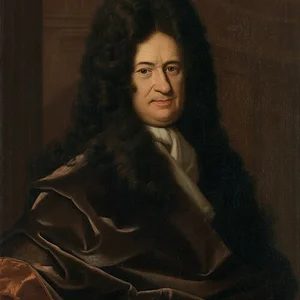

A German philosopher and mathematician of the 17th century, Leibniz contributed to the scientific revolution by developing infinitesimal calculus and proposing an original philosophy grounded in monadology. He shaped modern thought through his theory of pre-established harmony and his metaphysical optimism.
Leibniz(1646 — 1716)
Gottfried Wilhelm Leibniz
électorat de Saxe
7 min read
Frequently asked questions
Famous Quotes
« There is nothing in the intellect that was not first in the senses, except the intellect itself.»
« God has created the best of all possible worlds.»
Key Facts
- 1646: Born in Leipzig (Saxony)
- 1675–1676: Development of differential and integral calculus, the foundation of modern mathematical analysis
- 1684: Publication of his theory of infinitesimal calculus in the journal Acta Eruditorum
- 1686: Exposition of his Monadology and his theory of pre-established harmony
- 1716: Death in Hanover
Works & Achievements
First published article on differential calculus, appearing in the Acta Eruditorum. It introduces the notation dx and dy, which became standard throughout continental Europe.
Founding text of Leibnizian philosophy, laying out his conception of God, individual substances, and the relationship between soul and body. Never published during his lifetime.
Article publicly presenting for the first time the pre-established harmony, the theory according to which the soul and body each follow their own laws without direct interaction.
The only major philosophical work published during his lifetime. Leibniz justifies the goodness of God despite the existence of evil, asserting that our world is 'the best of all possible worlds'.
A synthesis of 90 paragraphs on Leibnizian metaphysics, describing the universe as composed of monads — simple, indivisible substances each reflecting the entire universe.
A companion text to the Monadology, accessible to a broad educated audience, setting out the fundamental principles of Leibniz's natural and theological philosophy.
A point-by-point response to Locke's Essay Concerning Human Understanding. Leibniz defends innatism against empiricism and argues that the intellect itself is innate knowledge.
Anecdotes
Leibniz and Newton independently discovered calculus at roughly the same time. This coincidence triggered a fierce priority dispute between English and Continental scholars that lasted decades and poisoned the scientific relationship between the two men until their deaths.
Leibniz had a prodigious memory and encyclopedic curiosity: he worked on dozens of subjects simultaneously, from jurisprudence to theology, geology, and linguistics. It is said he slept little, often dozing in his armchair, and jotted down his ideas on loose sheets of paper that he piled up around him.
Leibniz designed one of the first mechanical calculators capable of performing all four arithmetic operations, which he presented to the Académie des sciences in Paris in 1675. He hoped to free scholars from tedious calculations so they could focus on creative thinking.
Despite a life devoted to serving the princes of Hanover, Leibniz died alone and unhonored in 1716. Not a single official representative of the court attended his funeral, so thoroughly had he fallen out of favor. Voltaire, though critical of his optimism, remarked on the ingratitude of the powerful toward this genius.
Leibniz dreamed of a universal logical language, the 'characteristica universalis', which would allow all philosophical and scientific disagreements to be resolved through calculation. His idea remarkably foreshadows modern mathematical logic and computer science.
Primary Sources
God having chosen the most perfect world, he has brought it about that everything which happens in this world is connected to everything else according to the laws of nature.
Monads are the true Atoms of Nature and, in a word, the Elements of things. There are no windows through which anything could enter or leave.
Nothing is in the intellect that was not first in the senses, except the intellect itself.
This world is the best of all possible worlds, not because there is no evil in it, but because God chose the one in which good outweighs evil the most.
Sit axis AX, et curvae plures, ut VV, WW, YY, ZZ, quarum ordinatae, ad axem normales, VX, WX, YX, ZX, vocentur respective v, w, y, z.
Key Places
Leibniz's birthplace, where he was born in 1646 and received his early education. It was in this Protestant intellectual hub that he developed his passion for philosophy and languages.
Leibniz stayed here from 1672 to 1676 on a diplomatic mission. He met the greatest European scholars of the time, discovered Pascal's work, and developed his own methods of calculus.
The city where Leibniz spent most of his adult life as librarian and advisor to the Dukes of Brunswick-Lüneburg. He died there in 1716 and his archives are still preserved there.
Leibniz founded the Prussian Academy of Sciences here in 1700, of which he was the first president. This project reflects his vision of organizing knowledge in the service of states.
Leibniz met Spinoza here in 1676 during his return journey to Hanover. These philosophical conversations profoundly shaped his thinking on God and nature.
Typical Objects

Mechanical calculator designed by Leibniz around 1673, capable of addition, subtraction, multiplication and division. It embodies his ambition to mechanize mathematical reasoning.

Leibniz's everyday tool, with which he maintained an enormous correspondence — over 15,000 letters — with scholars across Europe. His sheets covered in notes bear witness to a mind in perpetual motion.

Leibniz published very little during his lifetime; the bulk of his thought remains in thousands of handwritten sheets preserved in Hanover. These drafts reveal a genius who thought by writing.

As a princely adviser, Leibniz took a keen interest in geopolitics and universal history. Maps and globes adorned the studies of scholars of his era.

A symbol of the learned seventeenth century, the watch illustrates the Leibnizian metaphor of the universe as a perfectly regulated clock set by God according to pre-established harmony.

Leibniz was a voracious reader from childhood; he had access to his father's library and read Aristotle, Descartes, Pascal and Hobbes even before university.
School Curriculum
Vocabulary & Tags
Key Vocabulary
Daily Life
Morning
Leibniz rose early, often after having worked a good part of the night in his armchair. He began the day by rereading his notes from the previous evening and dictating or drafting correspondence, as his exchange of letters with scholars across Europe was immense. A servant would bring him a frugal meal which he ate without leaving his desk.
Afternoon
The afternoon was devoted to audiences, working meetings with secretaries, and legal consultations for the Duke of Hanover. Leibniz juggled his roles as advisor, librarian, and diplomat, while continuing to jot down his philosophical reflections on loose sheets slipped between his administrative files.
Evening
In the evening, freed from his court obligations, Leibniz dedicated himself to his own research: mathematics, philosophy, and projects for a universal language. He worked by candlelight until late hours, sleeping little and making use of the nocturnal quiet for his most audacious speculations.
Food
Leibniz had a simple and rather careless diet for a man of the court; he was known for eating quickly and without much appetite, preferring to spend his time on research rather than meals. He nonetheless appreciated dinner parties where he could converse with educated interlocutors.
Clothing
Leibniz wore the court dress fashionable at the time: a long curled wig (a full-bottomed wig), a skirted coat, lace cuffs, and silk stockings. In private, he dressed more soberly in a dark working robe, in keeping with the image of the scholar.
Housing
Leibniz resided primarily in Hanover in a house placed at his disposal by the Dukes of Brunswick. There he arranged a substantial working library. His frequent travels between princely courts led him to lodge in inns or at the homes of patrons, always surrounded by books and papers.
Historical Timeline
Period Vocabulary
Visual Style
Esthétique baroque allemande de la fin du XVIIe siècle : chiaroscuro dramatique, intérieur d'érudit chargé d'instruments scientifiques et de volumes reliés, dominantes bordeaux et ambre doré.
Sound Ambience
L'univers sonore de Leibniz est celui d'un cabinet d'érudit baroque : grattement de plume, tic-tac d'horloge, cloches de cathédrale et musique de cour en sourdine.
Liens externes & ressources
Références
Œuvres
Nova Methodus pro Maximis et Minimis
1684
Discours de métaphysique
1686
Système nouveau de la nature
1695
Essais de Théodicée
1710
Principes de la nature et de la grâce
1714
Nouveaux Essais sur l'entendement humain
1704 (publié 1765)