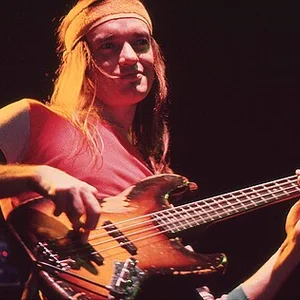

Jaco Pastorius was an American bassist regarded as one of the greatest electric bass virtuosos in history. A member of the jazz fusion band Weather Report, he revolutionized fretless bass playing and the instrument's melodic role within jazz.
Jaco Pastorius(1951 — 1987)
Jaco Pastorius
États-Unis
6 min read
Frequently asked questions
Famous Quotes
« I'm the greatest bass player in the world.»
Key Facts
- Born on December 1, 1951, in Norristown, Pennsylvania, he grew up in Florida.
- In 1976 he released his self-titled debut solo album, “Jaco Pastorius,” to critical acclaim.
- He joined the jazz fusion band Weather Report in 1976, contributing notably to the album “Heavy Weather” (1977) and the track “Birdland.”
- He popularized the use of the fretless bass (without frets) and a groundbreaking melodic and harmonic style of playing.
- Suffering from bipolar disorder and addiction problems, he died on September 21, 1987, in Fort Lauderdale at the age of 35, following an assault.
Works & Achievements
His first solo album, a true manifesto of modern bass playing, which revealed him to the whole world.
A piece played entirely in harmonics, dedicated to his wife, which became a study reference for bass players.
A solo cover of a bebop theme by Charlie Parker, proving that the bass could match a wind instrument in virtuosity.
Guitarist Pat Metheny's first album, where the trio showcases the dialogue between guitar and bass.
The band's most famous album; on it Jaco wrote “Teen Town” and contributed to the worldwide hit “Birdland”.
A dazzling composition on which he plays both bass and drums, which became a standard and a formidable technical test.
An ambitious solo project with a large orchestra, blending fusion, rich harmonies and complex arrangements.
A filmed lesson in which he passes on his technique, which became a major teaching document for bass players.
Anecdotes
Jaco Pastorius built his famous “fretless” bass himself: he pulled the metal frets out of his 1962 Fender Jazz Bass, filled the slots with wood putty, then coated the neck with marine epoxy resin. This bass, nicknamed the “Bass of Doom,” gave him the gliding, singing tone that became his signature.
When he met producer Bobby Colomby, Jaco introduced himself with a confidence that became legendary: “I'm John Francis Pastorius III, and I'm the best bass player in the world.” Many musicians found the line arrogant — but his talent would more than prove it true.
Before becoming a bassist, Jaco played the drums. A wrist injury during a game of American football kept him from continuing; he then turned to the electric bass, whose role he would change forever.
On his first album, Jaco played “Donna Lee,” an ultra-fast bebop tune by Charlie Parker, as a bass solo. No one believed such a feat of virtuosity, reserved for the saxophone or the trumpet, was possible on an electric bass.
With the piece “Portrait of Tracy,” Jaco showed that you could play entire melodies using only harmonics — those crystalline tones produced by lightly touching the strings. The technique was so new that generations of bassists still study it today.
Primary Sources
My name is John Francis Pastorius III, and I'm the greatest bass player in the world.
His first record under his own name, featuring “Donna Lee,” “Come On, Come Over,” “Continuum,” and “Portrait of Tracy”: a complete showcase of his melodic playing and his harmonics.
The band's best-selling album, featuring the hit “Birdland” and his own composition “Teen Town,” on which Jaco plays both bass and drums.
A filmed lesson in which Jaco explains and demonstrates his technique: harmonics, fretless playing, scales, and phrasing, joined by bassist Jerry Jemmott.
Key Places
Birthplace of Jaco Pastorius in 1951, before his family moved to Florida.
The region where he grew up, learned music and got his start in local bands; he would return there throughout his life.
The center of jazz where he recorded with Weather Report, Joni Mitchell and Pat Metheny and built his international reputation.
It was near a club in this town that he was severely assaulted in September 1987, before dying at a Fort Lauderdale hospital.
Typical Objects

His favorite bass, from which he had removed the frets himself to achieve a unique gliding sound. It is inseparable from his legend.

Jaco used bright strings with a metallic sound that brought out the harmonics and the texture of his fretless playing.

He coated the neck of his bass with it to protect the bare wood after removing the frets, giving the instrument a more singing tone.

The amplifier with a powerful, round tone that helped him establish the bass as a solo instrument on stage.

Jaco used electronic effects to layer his lines and create washes of sound, especially during solo performances.

His first instrument, before a wrist injury pushed him toward the bass; his drummer's sense of rhythm shaped his entire playing.
School Curriculum
Vocabulary & Tags
Key Vocabulary
Tags
Daily Life
Morning
When he wasn't on tour, Jaco often began the day with long hours of practice: scales, harmonics, and improvisations. Music filled his mind from morning to night.
Afternoon
Afternoons were spent in the recording studio or rehearsing with the musicians of Weather Report or his big band. He also composed, writing out arrangements for several instruments.
Evening
Evenings were devoted to concerts, in jazz clubs or large venues. On stage, Jaco was spectacular—dancing, jumping, and leading the audience with energy.
Food
Like many touring musicians of the 1970s and 1980s, he ate irregularly, between fast-food restaurants, hotel meals, and food grabbed backstage, all at the pace of constant travel.
Clothing
Jaco wore the casual outfits typical of the era: jeans, a T-shirt or shirt, sometimes a bandana. On stage, he favored loose clothing so he could move freely.
Housing
He lived between a house in Florida and the wandering life of touring, moving from one hotel room and bus to the next. His final years, marked by illness, brought him hardship and instability.