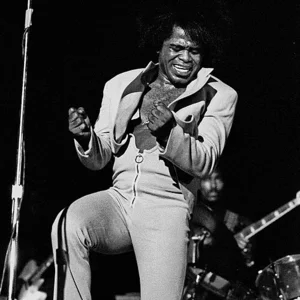

James Brown (1933-2006) was an American singer, songwriter, and producer, nicknamed the "Godfather of Funk." A pioneer of soul and then funk, he profoundly shaped African American popular music and influenced hip-hop, disco, and pop worldwide.
James Brown(1933 — 2006)
James Brown
États-Unis
6 min read
Frequently asked questions
Famous Quotes
« Say it loud, I'm black and I'm proud.»
Key Facts
- Born in 1933 in South Carolina, died in 2006 in Georgia (United States).
- Known as the "Godfather of Soul" and the "Godfather of Funk."
- Released "Papa's Got a Brand New Bag" in 1965, a founding track of funk.
- Released "Say It Loud – I'm Black and I'm Proud" in 1968, an anthem of African American pride.
- A major influence on hip-hop, one of the most sampled artists in history.
Works & Achievements
First hit with the Famous Flames, which launched his career in soul music.
Album recorded live that became a huge success and revealed his stage energy.
A founding track of funk, where rhythm takes precedence over melody; Brown's first Grammy Award.
One of his most famous hits worldwide, a symbol of joy and energy.
Often cited as one of the first true funk tracks, centered on the groove.
An anthem of African American pride that became a symbol of the civil rights movement.
An iconic funk track that has had a lasting influence on dance and hip-hop.
Its drum break became one of the most sampled pieces in the history of hip-hop.
Anecdotes
Born into poverty in South Carolina and then Georgia, James Brown earned a few coins dancing barefoot in the street for soldiers and passersby. He taught himself piano, guitar, and drums, and even sang in a gospel church, where he forged the shouts and calls that would become his trademark.
He was nicknamed “the hardest working man in show business”: his concerts lasted for hours and he lost pounds every night from all his dancing. At the end, a member of the troupe would drape a cape over his shoulders as if he were exhausted, then Brown would throw it off to go back and sing again, a theatrical routine that became famous.
On the night Martin Luther King was assassinated, April 5, 1968, James Brown kept his concert in Boston going, broadcast on television to calm the city. By calling for peace from the stage, he helped prevent riots while many American cities were going up in flames.
In 1968, his song “Say It Loud – I'm Black and I'm Proud” became an anthem of African American pride during the civil rights movement. On the recording, it is children who chant the famous slogan in response.
James Brown is considered one of the most sampled artists in history: hundreds of hip-hop tracks reuse his drum beats and his shouts, especially the drum break from “Funky Drummer,” played by Clyde Stubblefield.
Primary Sources
Say it loud: I'm black and I'm proud.
Brown urges the audience and television viewers to stay calm and respectful, the day after the assassination of Martin Luther King.
I feel good, I knew that I would now.
In it, Brown recounts his childhood in poverty, his musical apprenticeship, and the building of his band, where every musician had to play his instrument “like a drum.”
Key Places
Town where James Brown was born in 1933, into a very poor family in the segregated South.
City where Brown grew up; he danced in the streets there and took his first steps as a musician. A statue is dedicated to him there.
Legendary venue of African American culture where Brown recorded his 1962 live album that made him famous.
Site of his televised concert on April 5, 1968, the day after Martin Luther King's death, which helped calm the city.
City where James Brown died on December 25, 2006.
Brown performed here in 1974 at the festival preceding the “Rumble in the Jungle” boxing match, reconnecting with the African roots of his music.
Typical Objects

An essential tool of his concerts, which he would spin, drop and catch again in spectacular choreography. The mic was the extension of his powerful voice.

A red or gold cape draped over his shoulders at the end of the concert, in a theatrical routine where he feigned exhaustion before returning to sing. It became a symbol of his show.

Brown's funk sound rests on an orchestra where the organ, saxophones and trumpets play short, choppy rhythms. Each instrument is treated like a percussion instrument.

The format on which his hits were released, sold as singles in the 1960s and 1970s. The 45 made it possible to broadcast a track on the radio and in jukeboxes.

Brown took great care with his appearance, with tailored, shiny suits and shoes perfect for gliding across the stage. His impeccable style was part of the pride he wanted to convey.

Recorded live in concert in 1962, this album captures the energy of the venue and the communion with the audience. It showcased Brown's power on stage to a wide audience.
School Curriculum
Vocabulary & Tags
Key Vocabulary
Tags
Daily Life
Morning
When he was on tour, James Brown often woke up late, since the concerts ended in the middle of the night. The morning was spent traveling by bus between two cities and handling the business of his organization.
Afternoon
The afternoon was devoted to demanding rehearsals: Brown led his orchestra like an army commander, fining musicians who played a wrong note or wore poorly polished shoes.
Evening
In the evening came the show: concerts lasting several hours where he sang, danced, and slid across the stage until he was exhausted, which earned him the title of “the hardest-working man in show business”.
Food
Coming from a childhood of deprivation where food was scarce, Brown kept a strict discipline; he burned enormous amounts of energy in concert and lost several kilos each night from moving so much.
Clothing
Always impeccably dressed, he wore fitted, glittering suits and patent leather shoes, and took great care of his hairstyle, making his elegance a symbol of pride and success.
Housing
Having become rich and famous, Brown owned large properties in Georgia and South Carolina, far removed from the modest shack and his aunt's house where he had grown up in poverty.