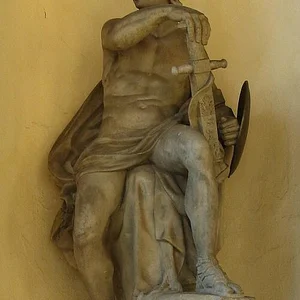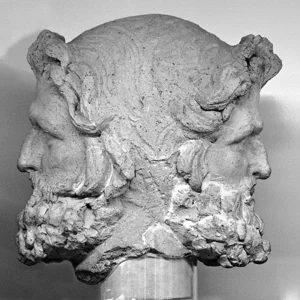

Janus is an ancient Roman deity depicted with two faces looking simultaneously toward the past and the future. God of beginnings, transitions, and doorways, he symbolizes thresholds and passages between two states. He was especially venerated at the New Year and at the start of any important undertaking.
Janus
Janus
7 min read
Frequently asked questions
Key Facts
- Janus is one of the oldest Roman deities, with no direct equivalent in Greek mythology
- Depicted with two faces (bifrons) symbolizing the duality of past and future, and the concepts of opening and closing
- The month of January takes its name from him (Januarius), as it is the month of new beginnings
- His main temple in Rome, the Janus Geminus, remained closed in times of peace and open in times of war
- Romans invoked him at the start of any important act: marriage, journey, construction, battle
Works & Achievements
Janus was venerated as the protective god of doors (janua), passageways, and transitions. His cult symbolized the protection of entrances and the facilitation of passage between two states or spaces.
The month of January takes its name from Janus, and the Romans offered him sacrifices and prayers at the start of the year. This practice reflects his role as god of beginnings and new endeavors.
Janus is depicted with two faces simultaneously looking toward the past and the future, symbolizing knowledge of time's cycles and the ability to perceive transitions. This iconography makes him unique among Roman deities.
Janus presided over all important beginnings: wars, constructions, marriages, and journeys. The Romans invoked him first in their prayers to ensure the success of any undertaking.
A temple dedicated to Janus stood in the Roman Forum, whose gates were opened in times of war and closed in times of peace, reflecting his symbolic role as god of transitions.
Anecdotes
Janus was so important to the Romans that he was the only god invoked first during religious ceremonies, before all others, including Jupiter. The month of January bears his name because the Romans considered this moment the threshold of the new year, the passage between two periods.
The Temple of Janus in the Roman Forum was a unique building with bronze doors that remained open in times of war and closed in times of peace. During the three centuries of the Roman Republic, these doors were closed only three times, marking the rare periods of complete peace in the empire.
The Romans depicted Janus with two opposing faces (bifrons) to symbolize that he could see the past on one side and the future on the other. This unique feature made him a very special god: he was the only Roman god to have this dual physical nature.
During the Roman New Year ritual, citizens exchanged gifts called 'strenae' to ensure a good year, asking Janus to bless the passage into new days. This tradition showed how deeply the Romans saw Janus as a guardian of temporal thresholds.
Primary Sources
Two-faced Janus is the guardian of the gates of heaven. He alone sees both what has been and what is yet to come. The first month of the year is dedicated to him, for he presides over beginnings and the thresholds of every undertaking.
The Romans venerated Janus as the god of doorways and passages, foremost among the gods, the one who opens and closes, a symbol of transitions and new beginnings.
Honor Janus on the first day of the month: he presides over gates and thresholds, looking on one side toward the past and on the other toward the future, guiding the Romans in all their new endeavors.
Janus is depicted with two faces, the embodiment of the most ancient deity among the Romans. He presides over the beginnings of all things and over the passages between two distinct states.
Key Places
Capital of the Roman Empire where Janus was primarily worshipped. The cult of Janus was central to Roman religion, particularly during official ceremonies and the beginnings of new ventures.
A temple dedicated to Janus located in the Roman Forum, whose doors were closed in times of peace and opened in times of war. This sanctuary was the heart of the Janus cult in Rome.
A four-sided arch located in the Forum Boarium, also known as the Arch of Janus. This structure evoked the god's two faces and symbolically marked passages and transitions within the city.
The region of Latium where the origins of Janus trace back to ancient Italic religious traditions. Janus was venerated in the early rituals of Latin peoples before Rome rose to dominance.
A hill in Rome whose name derives from Janus, pointing to the importance of his cult in this area. It is believed to have been associated with the earliest sanctuaries dedicated to Janus.
Typical Objects
Architectural structure symbolizing passage and thresholds, the domains most sacred to Janus. The gates of Roman temples and homes were placed under his protection.
📷 CC BY-SA 4.0 · Wikimedia Commons ↗
A bronze or iron object representing authority over thresholds and passageways. Janus, guardian of gates, was closely associated with keys and the right of access to sacred and private spaces.
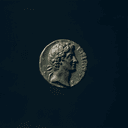
A coin struck with the two-faced profile of Janus, regularly minted throughout the Roman Empire. His image adorned many bronze coins known as 'asses'.
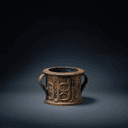
A small household shrine where Romans paid homage to Janus at the start of the year and at each major transition. These structures received offerings and prayers.
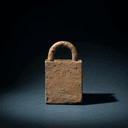
A system for measuring time in which the month of January (Januarius) was dedicated to Janus. The first day of each month was consecrated to him as a marker of the new cycle.
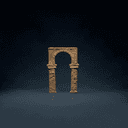
Roman religious architecture featuring two opposing entrances, symbolizing Janus's bidirectional gaze toward past and future, and allowing passage between two distinct spaces.
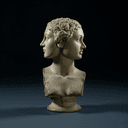
A sculpture depicting Janus with his two faces looking in opposite directions, illustrating his unique divine nature. These busts adorned Roman temples, shrines, and private homes.
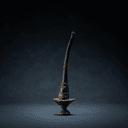
Aromatic substances burned during ceremonies dedicated to Janus, particularly at the Roman New Year and at the outset of wars. Accompanied by ritual words to ensure auspicious beginnings.
School Curriculum
Vocabulary & Tags
Key Vocabulary
Daily Life
Morning
Janus has no daily life in the human sense, as he is a Roman deity rather than a living being. However, in Roman mythology, he is invoked at sunrise as the guardian of transitions. Romans offered their prayers to Janus at dawn, particularly on January 1st (the Kalends of January), a day entirely dedicated to him.
Afternoon
Janus is depicted as omnipresent in spaces of passage: doorways, thresholds, and passages between two worlds. He performs no everyday actions but remains a divine symbol watching over transitions and beginnings. Romans invoked his protection when crossing through doorways or at the start of a new phase of life.
Evening
As the god of doors and passages, Janus also symbolizes the closing of the day and the crossing into night. Romans paid him tribute at the end of the day, regarding him as the guardian between the completed day and the coming night. His altars and two-faced statues served as focal points for evening rituals.
Food
As a deity rather than a human figure, Janus does not eat. Nevertheless, during his festivals, Romans offered him ritual sacrifices: honey cakes, wine, incense, and symbolic foods marking beginnings and transitions.
Clothing
Janus is depicted with two faces looking simultaneously backward and forward, symbolizing the past and the future. He typically wears a majestic Roman toga and holds divine attributes: a key symbolizing his power over thresholds, and sometimes a staff or divine scepter. His appearance is that of a timeless, majestic god.
Housing
As a Roman deity, Janus has no fixed dwelling but is honored through places of worship: the Ianus Geminus (the sacred double gate) in the Roman Forum, which was dedicated to him. He reigns symbolically over every threshold and passage in Rome, present wherever two worlds or two moments meet.
Historical Timeline
Period Vocabulary
Visual Style
Un style entre sculpture grecque antique et fresque romaine, mêlant marbre patiné, or et bronze, avec une atmosphère mystérieuse jouant sur les contrastes de lumière dorée et d'ombres profondes pour symboliser le passage entre deux mondes.
Sound Ambience
Une ambiance sonore majestueuse mêlant les échos d'un temple romain antique, les vibrations de cloches de bronze, des voix en latin susurrées et le son de portes franchies, symbolisant la dualité temporelle et les passages entre le passé et l'avenir.
Liens externes & ressources
Références
Œuvres
Culte des portes et des seuils
Antiquité romaine
Festivités du Nouvel An (Ianuarius)
1er janvier
Représentation iconographique bifrons
Antiquité romaine
Présidence des rituels de commencement
Antiquité romaine
Temple de Janus au Forum
Antiquité romaine