
Roman Emperor from 211 to 217 AD, Caracalla is best known for the Edict of Caracalla (212 AD), which granted Roman citizenship to all free inhabitants of the Empire. Despite his reforms, his reign was marked by political instability and his assassination in 217 AD.
Caracalla(188 — 217)
Caracalla
Rome antique
6 min read
Frequently asked questions
Key Facts
- 211 AD: rise to power following the death of Septimius Severus, initially as co-regent with his brother Geta
- 212 AD: promulgation of the Edict of Caracalla (Constitutio Antoniniana), granting Roman citizenship to all free inhabitants of the Empire
- 213–217 AD: military campaigns against the Parthians and Germanic peoples along the frontiers
- 217 AD: assassination of Caracalla, ending his six-year reign
Works & Achievements
Imperial edict granting Roman citizenship to all free inhabitants of the Empire. A revolutionary measure that legally unified the Empire and profoundly transformed Roman law.
Gigantic thermal complex in Rome, the second largest of Antiquity. Their monumental architecture and mosaics make them a major testament to Roman art.
Creation of a new silver coin to finance military expenditures. This monetary devaluation marked the beginning of a long inflationary crisis in the Empire.
Triumphal arch erected in honor of Caracalla in the Roman city of Volubilis (present-day Morocco), attesting to the reach of the Edict into the westernmost provinces.
Reinforcement works on the Germanic limes and construction of military roads during the campaign against the Alamanni, consolidating the Empire's frontier defenses.
Anecdotes
The nickname "Caracalla" comes from a long hooded Gaulish cloak that the emperor was fond of and wore on every occasion. This garment, the caracallus, was of common origin and clashed with imperial dignity, but it was popular with the soldiers.
In 215 AD, Caracalla ordered a massacre in the city of Alexandria after its inhabitants had composed mocking satires against him. Thousands of young Alexandrians were killed by legionaries in what is known as the Massacre of Alexandria.
Caracalla harbored boundless admiration for Alexander the Great. During his stay in Alexandria, he visited the tomb of the Macedonian conqueror and laid his own breastplate and jewels there as an offering. He even organized his troops into Macedonian phalanxes in imitation of his hero.
After the death of their father Septimius Severus in 211, Caracalla and his brother Geta were co-emperors for less than a year. Caracalla had Geta murdered in the arms of their mother Julia Domna, then ordered a damnatio memoriae: Geta's name and likeness were erased from all monuments and official documents.
Caracalla was assassinated on April 8, 217, near Carrhae in Mesopotamia, while on his way to a temple. It was a common soldier of his guard, manipulated by the Praetorian prefect Macrinus, who stabbed him while he had stepped aside to relieve himself.
Primary Sources
This imperial edict of 212 AD, partially preserved on the Papyrus of Giessen, grants Roman citizenship to all free inhabitants of the Empire, with the probable exception of the dediticii.
Cassius Dio, a senator and contemporary witness, describes Caracalla as a cruel and unpredictable man: "He was the common enemy of all mankind", recounting the murder of Geta and the persecutions that followed.
This late biographical collection reports that Caracalla, from childhood, was sullen and violent, and that he rarely smiled. The author emphasizes his passion for military life and his contempt for civilian activities.
Herodian, a contemporary of the events, recounts the fratricide of Geta and the terror that ensued in Rome, describing how twenty thousand supposed supporters of Geta were massacred on Caracalla's orders.
Key Places
Immense bathing complex inaugurated in 216, capable of accommodating around 1,600 bathers simultaneously. A masterpiece of architecture, it included libraries, gymnasiums, and gardens.
Birthplace of Caracalla, capital of the Gauls and one of the most important cities of the Western Roman Empire.
City in Roman Britain where Septimius Severus died in 211. It was there that Caracalla and Geta were proclaimed co-emperors.
Great metropolis of the Roman East where Caracalla ordered a massacre in 215 after being mocked by its inhabitants. He also visited the tomb of Alexander the Great.
City in Roman Mesopotamia where Caracalla was assassinated on April 8, 217, while preparing a campaign against the Parthians.
Hill of Rome housing the imperial palace where Caracalla resided and where Geta was assassinated in the apartments of their mother Julia Domna.
Typical Objects

Long Gallic hooded cloak that gave the emperor his nickname. He wore it constantly and had it distributed to the Roman people.

New silver coin introduced by Caracalla, theoretically worth two denarii but containing less precious metal. It reflects the financial difficulties of the Empire.

Emblematic weapon of the legionaries that Caracalla carried at all times, cultivating his image as a soldier-emperor close to his troops.

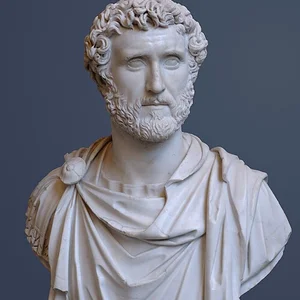
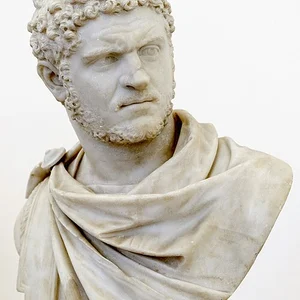
Sculpted portraits of Caracalla are recognizable by his severe expression and sideward gaze, a realistic style that breaks with the idealization of previous emperors.

Papyrus fragment discovered in Egypt that preserves a partial copy of the Edict of Caracalla of 212, a foundational document of Roman law.

Bronze scraper used at the baths to clean the skin after physical exercise. The Baths of Caracalla required thousands of them for their daily users.
School Curriculum
Vocabulary & Tags
Key Vocabulary
Tags
Concept
Daily Life
Morning
Caracalla rose at dawn in the imperial palace on the Palatine Hill. He began his day with a salutatio, receiving courtiers and military officers. Unlike many emperors, he ate a frugal breakfast of bread and cheese, cultivating an image of military sobriety.
Afternoon
The afternoon was devoted to the affairs of the Empire: audiences, correspondence with provincial governors, and judicial decisions. Caracalla favored military exercises with his soldiers, however, sharing their training and meals to maintain their loyalty.
Evening
In the evening, the emperor readily visited the baths, frequenting them like an ordinary citizen. The evening meal (cena) was taken in the company of his close circle and officers, often in relative simplicity compared to the banquets of previous emperors.
Food
Caracalla affected the simple diet of a soldier: wheat bread, grilled meat, vegetables, cheese, and wine mixed with water. On campaign, he shared the food of his legionaries, eating lard, lentils, and hardtack to reinforce his image as a soldier-emperor.
Clothing
The emperor wore his famous caracallus, a long hooded cloak of Gallic origin, rather than the senatorial toga. In official contexts, he donned the imperial purple and the paludamentum (military cloak). He wore caligae (military sandals) rather than patrician shoes.
Housing
Caracalla resided in the imperial palace on the Palatine Hill in Rome, a vast complex of audience halls, gardens, private baths, and luxurious apartments. On military campaign, he slept under a tent with his soldiers, refusing the comfortable quarters reserved for generals.
Historical Timeline
Period Vocabulary
Visual Style
Esthétique impériale romaine de la dynastie des Sévères : architecture monumentale en marbre et brique, portraits au réalisme psychologique intense, tons chauds méditerranéens et pourpre impériale.
Sound Ambience
Ambiance sonore de la Rome impériale du IIIe siècle : échos des thermes monumentaux, rumeur des rues animées, marche rythmée des légionnaires et sonneries militaires.
Liens externes & ressources
Références
Œuvres
Édit de Caracalla (Constitutio Antoniniana)
212 apr. J.-C.
Thermes de Caracalla
212-216 apr. J.-C.
Antoninianus (réforme monétaire)
215 apr. J.-C.
Arc de Caracalla à Volubilis
vers 217 apr. J.-C.
Via Nova (route militaire en Germanie)
213 apr. J.-C.