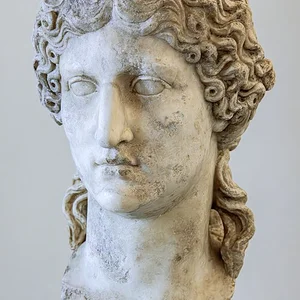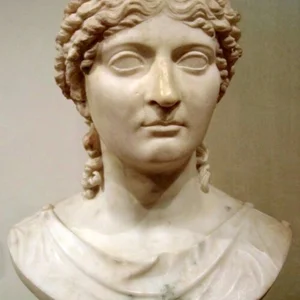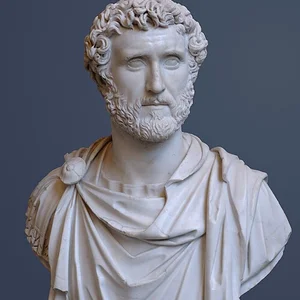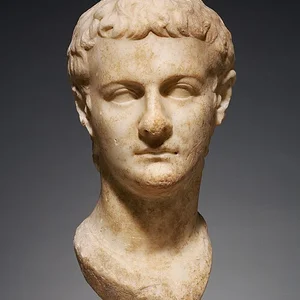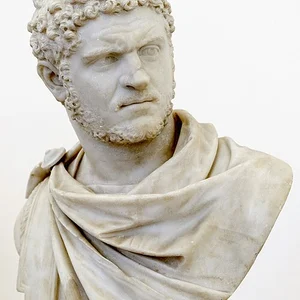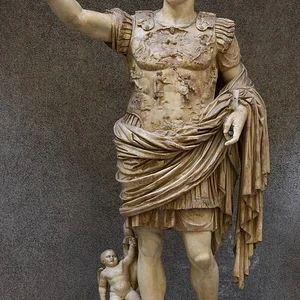

Augustus was the first Roman emperor, ruling from 27 BC to 14 AD. Grand-nephew and adopted son of Julius Caesar, he established a lasting political regime and brought peace after decades of civil wars. His reign marks the beginning of the Roman Empire and a period of cultural prosperity.
Augustus(62 av. J.-C. — 14)
Augustus
Rome antique
7 min read
Frequently asked questions
Famous Quotes
« I found Rome a city of bricks and left it a city of marble.»
« I found Rome a city of brick and left it a city of marble.»
Key Facts
- Adopted by Julius Caesar in 45 BC
- Victory at the Battle of Actium in 31 BC, marking the end of the civil wars
- Granted the title of Augustus and supreme power in 27 BC, officially founding the Roman Empire
- Administrative and military reforms: creation of a standing army, organization of provincial administration
- Died in 14 AD after 41 years of rule, leaving behind a stable and prosperous empire
Works & Achievements
Augustus's political testament engraved on bronze tablets in front of his mausoleum, recounting his great deeds. It is a unique document of ancient imperial propaganda.
Monumental complex inaugurated after forty years of construction, dedicated to Mars the Avenger. It celebrated military victories and affirmed the greatness of the Julian dynasty.
Marble altar erected on the Campus Martius to celebrate the Pax Romana established by Augustus. Its sculpted reliefs are masterpieces of Roman art.
Division of the Empire into senatorial and imperial provinces, creating an efficient system of government that endured for centuries.
A set of laws aimed at restoring traditional Roman moral values, encouraging marriage and childbirth among Roman citizens.
First Pantheon built by Agrippa, Augustus's son-in-law, on the Campus Martius. Destroyed by fire, it was rebuilt under Hadrian in the form known today.
Anecdotes
Augustus was a frail and often sickly child. Despite his precarious health, he managed to assert himself through his political intelligence and his ability to surround himself with capable advisors such as Agrippa and Maecenas, proving that cunning could prevail over brute force.
According to Suetonius, Augustus liked to repeat that he had "found Rome in brick and left it in marble". This phrase summed up his immense building program which transformed the capital of the Empire with temples, forums, and aqueducts.
On his deathbed in 14 AD, Augustus reportedly asked those around him whether he had played his part well in the comedy of life, adding in Greek: "If the play has pleased you, applaud!" This anecdote, reported by Suetonius, illustrates his awareness of his public role.
Augustus was superstitious: he was very afraid of lightning and always carried a seal skin to protect himself from it. He would hide in an underground place whenever a storm broke out, traumatized by a lightning bolt that had nearly killed him during a military campaign.
When he learned of the loss of three legions in the disaster of Teutoburg Forest in 9 AD, Augustus reportedly beat his head against the walls crying: "Varus, give me back my legions!" This defeat at the hands of the Germanic tribes haunted him for the rest of his life.
Primary Sources
At the age of nineteen, I raised an army at my own expense and on my own initiative, and by means of it I restored liberty to the Republic, which had been oppressed by the tyranny of a faction.
He was remarkably handsome, a quality he retained throughout his life. His eyes were bright and piercing. He would grow annoyed when people tried to hold his gaze, as if facing the glare of the sun.
Augustus completely reorganized the administration of the state, dividing the provinces between those of the Senate and those of the emperor, and establishing a system that ensured peace for decades.
Here is the man, here is he whom you are so often promised, Augustus Caesar, son of the Divine, who shall found a golden age anew in Latium.
Key Places
New forum built by Augustus at the heart of Rome, dominated by the Temple of Mars Ultor, to celebrate his vengeance against Caesar's assassins.
Immense circular tomb erected on the Campus Martius as early as 28 BC to house the burial of Augustus and his family.
Relatively modest residence of Augustus on the Palatine Hill, decorated with remarkable frescoes still visible today.
Site of the decisive naval battle of 31 BC where Octavian defeated Mark Antony and Cleopatra, sealing his destiny as the most powerful man in Rome.
Town in southern Italy where Augustus died on 19 August 14 AD, in the same room where his father Octavius had passed away.
Typical Objects

Symbol of military victory and imperial power. Augustus is almost always depicted wearing this crown in statues and on coins.
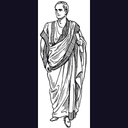
Purple-bordered toga worn by Augustus in his official functions. This garment symbolized the dignity and authority of the supreme magistrate.
📷 Domaine public · Wikimedia Commons ↗
Gold coin struck with his portrait, distributed throughout the Empire. Currency served both as an economic tool and as imperial propaganda.

Augustus used a ring engraved with a sphinx, then with his own portrait, to seal official documents and orders sent to provincial governors.

Augustus had an immense sundial (Horologium Augusti) erected on the Campus Martius, whose obelisk brought from Egypt served as the gnomon.

Golden shield offered by the Senate to Augustus in 27 BC, engraved with his four virtues: courage, clemency, justice, and piety.
School Curriculum
Vocabulary & Tags
Key Vocabulary
Daily Life
Morning
Augustus rose early, often at dawn, and began by consulting the augurs and performing his private devotions to the household lares. He ate a frugal breakfast of soaked bread, cheese, and a few olives. He then received the salutatio, the morning ceremony in which clients and petitioners came to pay their respects.
Afternoon
The afternoon was devoted to affairs of state: meetings of the imperial council, receiving foreign ambassadors, and reviewing reports from provincial governors. Augustus dictated his extensive correspondence to his secretaries. Despite his immense power, he affected a republican simplicity in his manners and decisions.
Evening
In the evening, Augustus dined simply, preferring modest meals to lavish banquets. He enjoyed coarse bread, fresh fish, and fruit. According to Suetonius, he often fell asleep during dinners, so tired was he. Before sleeping, he had works of history or literature read aloud to him.
Food
Augustus ate very sparingly for a man of his rank. He preferred coarse bread, fresh cheese, small fish, and green figs. He drank little wine, always watered down. Suetonius notes that he snacked between meals to compensate for his erratic appetite.
Clothing
On a daily basis, Augustus wore the traditional white toga of a Roman citizen, refusing luxurious garments. His wife Livia herself spun the wool for his household togas. For official ceremonies, he donned the toga praetexta bordered with purple and wore the laurel wreath.
Housing
Augustus lived in a relatively modest house on the Palatine Hill, refusing ostentatious palaces. His rooms were decorated with frescoes featuring vegetal and mythological motifs, still visible today. The house included a study, a triclinium for dining, and a lararium for domestic worship.
Historical Timeline
Period Vocabulary
Visual Style
Un style visuel inspiré de l'art augustéen classique, mêlant la blancheur du marbre, les dorures impériales et la lumière méditerranéenne dans des compositions symétriques évoquant l'ordre et la majesté de Rome.
Sound Ambience
L'ambiance sonore de la Rome impériale sous Auguste, entre le tumulte du Forum, les rituels religieux et les bruits de construction des grands monuments de marbre.
Liens externes & ressources
Références
Œuvres
Res Gestae Divi Augusti
14 apr. J.-C.
Forum d'Auguste et Temple de Mars Ultor
2 av. J.-C.
Ara Pacis Augustae (Autel de la Paix)
9 av. J.-C.
Réforme administrative des provinces
27 av. J.-C.
Lois juliennes sur les mœurs
18 av. J.-C.
Construction du Panthéon originel
27-25 av. J.-C.