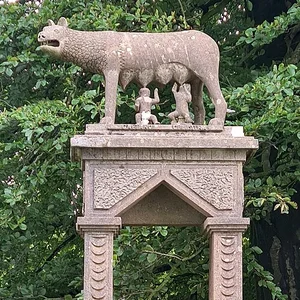

Twin brothers of Roman mythology, legendarily raised by a she-wolf after being abandoned at birth. Romulus is presented as the founder and first king of Rome in 753 BC, while Remus is said to have perished during the founding of the city.
Romulus and Remus
Romulus and Remus
8 min read
Frequently asked questions
Key Facts
- According to legend, born around 771 BC to Rhea Silvia and Ares (or Mars)
- Abandoned at birth on the orders of Amulius, rescued and nursed by a she-wolf (lupa)
- Mythical founding of Rome by Romulus in 753 BC (traditional date)
- Death of Remus during the founding, killed by Romulus for crossing the pomerium
- Romulus established the institutions of Rome and became its first king
Works & Achievements
Romulus is said to have founded the city of Rome on the Palatine Hill, establishing what would become one of the greatest powers of the ancient world. This event marks the starting point of the traditional Roman calendar.
Romulus organized the abduction of young Sabine women to populate Rome and ensure the survival of the new city. This event illustrates Rome's difficult beginnings and the tense relations with neighboring peoples.
Romulus is said to have created the Senate by forming a council of one hundred or three hundred elders (patres), laying the foundations of the Roman political system. This institution would become a central pillar of Roman government.
Romulus divided Rome's earliest inhabitants into three distinct tribes, establishing a social and administrative structure for the new city. This organization served as the basis for archaic Roman administration.
According to legend, Romulus kept a shield that had fallen from the sky and had copies made of it to conceal the original. These shields became sacred objects of Roman worship, believed to protect the city.
Romulus fortified the Palatine Hill, creating the alba Longa (white fortress), Rome's first defensive enclosure. This construction is presented as the original heart of the city.
Anecdotes
The legend of Romulus and Remus is a Roman mythological creation, not a historically documented event. Modern historians agree that Rome developed gradually from the 8th century BCE, with no single founder. Yet the Romans themselves believed it firmly and celebrated April 21st as the anniversary of Rome's founding by Romulus.
The famous story of the she-wolf (Lupa) who supposedly nursed the two abandoned brothers is pure legend, likely invented to explain the mysterious origins of Rome. This image became so iconic that it appeared on Roman coins and remains the symbol of Rome to this day.
The killing of Remus by Romulus at the founding of the city is recounted by the writer Livy: Remus reportedly jumped over the wall Romulus was building, and Romulus killed him, saying 'So perish whoever else shall leap over my walls.' This story illustrates the supposed brutality of Rome's founding and the absolute power of its first king.
The Romans themselves had doubts about certain details of the legend: several versions existed regarding Remus's death and the true identity of the children's parents. These variations show that even in antiquity, Roman historians acknowledged the legendary nature of these accounts.
The cult of Romulus evolved over time: after his supposed death, he was said to have been deified under the name Quirinus and worshipped as a protective god of Rome. This evolution reveals how the Romans blended history, legend, and religion to forge their national identity.
Primary Sources
Romulus and Remus, twins born of Mars and a Vestal Virgin, were exposed at birth. A she-wolf nursed them with her milk in a cave. Shepherds found them and raised them. When grown, Romulus founded the city of Rome in 753 BC.
Romulus, having traced the pomerium of the new city, killed his brother Remus, who had violated the sacred boundaries of the fortified enclosure.
After the she-wolf had nursed them, shepherds found the children and raised them. Romulus, having come of age, founded Rome and established its laws, while Remus perished for having scorned the sanctity of the new city walls.
The she-wolf Lupa, once a fierce creature, became gentle and offered her teats to the abandoned twins, Romulus and Remus, the future founders of Rome.
Romulus laid the foundations of Rome according to sacred rites and became its first king, establishing the institutions of the new city.
Key Places
The city legendarily founded by Romulus in 753 BC on the Palatine Hill. Rome is the heart of the Romulus and Remus myth, a symbol of their destiny and the empire that grew from it.
One of the seven hills of Rome where the city was said to have been founded and where the kings' palace stood. It was on this hill that Romulus is said to have established the pomerium, the sacred boundary of the city.
The river into which the twins were said to have been cast at birth according to legend. It was near its banks that they were found and nursed by the she-wolf.
An ancient sanctuary beneath the Palatine Hill where the she-wolf is said to have nursed Romulus and Remus. This site was venerated in ancient Rome as the cradle of the city.
An ancient city of Latium from which the twins were said to originate. It was here that Rhea Silvia, their mother, was born, and from which Rome's founding dynasty descended.
A museum and modern archaeological exhibition space preserving the remains of ancient Rome and artistic depictions of the legend of Romulus and Remus.
Typical Objects

A mythological animal symbolizing the nursing and protection of the abandoned twins Romulus and Remus. This animal became the emblem of Rome and its legendary founding.

A military cloak worn by Roman generals and kings. Romulus, as the founder and first king of Rome, is said to have worn this garment emblematic of ancient Roman power.

A symbol of royal power that Romulus wore as the first king of Rome. It represents his authority and his role as founder of the city-state.

An imaginary boundary traced by Romulus around Rome at its founding in 753 BC. It is a religious and political concept made tangible by an inaugural furrow plowed into the earth.

The tool used to trace the founding furrow of Rome according to legend. Romulus is said to have used this plow to mark out the sacred boundary of the new city.

A bronze sculpture depicting the she-wolf nursing the twins. This artwork became the official emblem of Rome and symbolizes the mythical origins of the city.

The short sword characteristic of early Roman armament. Romulus, as a warrior and founder, is said to have wielded this weapon to protect and conquer Rome.

A coin from ancient Rome often bearing the image of the she-wolf or founding symbols. It embodies the economic and political authority of Rome.
School Curriculum
Vocabulary & Tags
Key Vocabulary
Daily Life
Morning
According to legend, Romulus begins his day in the hills of Latium, occupied with pastoral and warlike tasks. In the 8th century BC, Latin chieftains spent their mornings watching over their flocks and training with weapons, laying the groundwork for their future dominance. Historical sources indicate that the earliest Romans led a semi-nomadic life combining livestock herding and farming.
Afternoon
The afternoon is devoted to military activities and the early administration of the community. Romulus, as a legendary military leader, would organize raids and consolidate his authority over the villages of the Palatine. Archaeological excavations show that 8th-century Latium was fragmented into small rival communities each seeking to establish supremacy.
Evening
Evenings unfold around communal meals and gatherings with the elders and warriors of his tribe. Ancient sources describe religious rites and banquets where alliances and battle strategies are discussed. The social life of Latin chieftains revolves around shared meals and collective decision-making.
Food
The diet is based on local produce: goat and sheep milk and cheese, grain grown across Latium, wild fruits, and hunted game. Pork and mutton are important sources of protein during feasts and sacrifices. Wine and olive oil are only just beginning to arrive through Mediterranean trade at this time.
Clothing
Romulus wears woven wool and linen garments typical of early Latium warriors: a simple tunic and a cloak fastened with a fibula. As a chieftain, he may have displayed symbols of power and bronze ornaments reflecting his status. His overall appearance is that of a rugged, muscular warrior suited to pastoral life and combat.
Housing
Romulus would have lived in a wattle-and-daub hut with a thatched roof — structures characteristic of the archaic Palatine village as revealed by archaeology. The dwelling is simple and functional, also serving as a communal space and storage for food supplies. The Palatine stronghold, where legend places his residence, was a basic fortified oppidum with rudimentary dwellings.
Historical Timeline
Period Vocabulary
Visual Style
Style inspiré de la Renaissance italienne fusionnant l'art romain antique avec le dramatisme baroque. Une esthétique majestueuse mêlant réalisme historique et grandeur mythologique, aux teintes chaudes de terracotta et bronze illuminées par une lumière dorée, évoquant la fondation légendaire de Rome.
Sound Ambience
Ambiance épique et mystique évoquant la légende romaine des origines : mélange de bruits naturels (loups, rivière, vent), de sons rituels et militaires (cornes antiques, chants latins) et d'instruments de bronze anciens, créant une atmosphère légendaire et grandiose du VIIIe siècle av. J.-C.
Liens externes & ressources
Références
Œuvres
Fondation de Rome
753 av. J.-C. (selon la tradition)
L'enlèvement des Sabines
Période légendaire
Établissement du Sénat romain
Période légendaire
Organisation des trois tribus primitives
Période légendaire
Institution des anciles (boucliers sacrés)
Période légendaire
Fortification du Palatin
Période légendaire