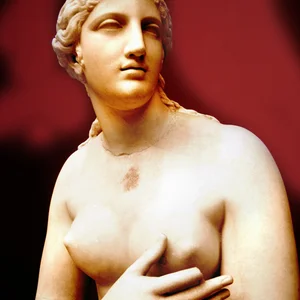

Greek goddess of love, beauty, and fertility in ancient mythology. Venerated throughout Greece and the Roman Empire under the name Venus. A central figure in mythological narratives and ancient art.
Aphrodite
Aphrodite
8 min read
Frequently asked questions
Key Facts
- Major goddess of the Greek pantheon, member of the Olympians according to Homer and Hesiod
- Associated with the creation of Pandora and several wars (Troy, the Judgment of Paris)
- Cult attested from the 8th century BCE in Greece, particularly at Paphos (Cyprus)
- Identified with Venus by the Romans, who incorporated her into their own pantheon
- Depicted in ancient art through numerous statues and frescoes (Venus de Milo, The Birth of Venus)
Works & Achievements
A central mythological episode in which Aphrodite is chosen as the most beautiful goddess by the Trojan prince Paris, in exchange for the love of Helen. This event triggers the Trojan War, a founding moment of Greek literature.
A cosmogonic myth in which Aphrodite is born from the sea foam following the castration of Uranus, symbolizing the emergence of beauty and love in the world. This primordial event is celebrated in Hesiod's Theogony.
The establishment of religious rituals and the construction of major temples (notably in Cyprus, Paphos, and Cythera), where she was worshipped as the protective deity of fertility, beauty, and both conjugal and carnal love.
Mythological tales illustrating the goddess's passions and conflicts — particularly her liaison with Ares as recounted by Homer in the Odyssey, and her marriage to Hephaestus — major themes in ancient literature.
Aphrodite inspired countless artistic representations (sculpture, painting, mosaics) and became a symbol of aesthetic ideals, most famously through the Venus de Milo and Botticelli's Birth of Venus during the Renaissance.
Aphrodite actively protected Aeneas during the Trojan conflict and watched over his descendants after the war, intervening directly in battle and ensuring the survival of the Trojan lineage — a pivotal episode in ancient epic poetry.
Anecdotes
The cult of Aphrodite dates back at least to the 8th century BCE in Greece. One of her most famous sanctuaries was the temple of Paphos in Cyprus, where the Greeks believed she was born from the sea foam. This temple drew pilgrims from across the Mediterranean who came to honor the goddess.
According to ancient texts, notably those of Homer, Aphrodite possessed a magical girdle called the 'kestos' that made whoever wore it irresistible. This girdle was so powerful that even Hera, queen of the gods, would sometimes borrow it to seduce her husband Zeus.
The Romans identified Aphrodite with their goddess Venus, and the emperor Augustus claimed direct descent from Venus through his ancestor Aeneas, the Trojan hero. This supposed lineage reinforced the prestige of Roman imperial power.
In the famous ancient sculpture known as the 'Venus de Milo', created around the 2nd century BCE, the goddess is depicted without arms, making it one of the most mysterious and admired statues in the history of ancient art. This work was kept on the Greek island of Milos before being brought to the Louvre.
The myrtle and the dove were the sacred attributes of Aphrodite, present in all her temples and artistic representations. The ancients saw these symbols as embodiments of the beauty, love, and fertility that the goddess represented.
Primary Sources
Aphrodite, born from the sea foam, descended from Olympus to protect her son Aeneas in battle. She shines among the goddesses for her incomparable beauty and her power over the hearts of mortals and immortals alike.
From the white foam a goddess emerged: Aphrodite of the beautiful crown. She was first carried to the island of Cyprus, then to Cythera. The beautifully crowned Horae received her and dressed her in immortal garments.
I shall sing of golden Aphrodite, who holds sway over the fertile lands of Cyprus. She it is who inspires sweet smiles and desire in the hearts of all beings.
Venus, mother of Aeneas, shields her son from every danger. Her beauty and her dominion over love make gods and mortals tremble alike. She is the source of all generation and all life.
Aphrodite and Ares converse on the mysteries of love and war. The goddess wields her irresistible charm even over the gods, demonstrating her universal power.
Key Places
Mediterranean island where Aphrodite was born according to Greek mythology, particularly at Paphos. It was the goddess's main cult site, home to the Sanctuary of Aphrodite at Paphos, venerated since the 8th century BCE.
Greek island in the Aegean Sea associated with Aphrodite's birth. Several alternative myths place the goddess's emergence near this island, which hosted an important sanctuary dedicated to her.
Greek capital where Aphrodite was worshipped through several temples and sanctuaries. The goddess played an important role in Athenian religious festivals and the public life of the city.
Major Greek port city that boasted a celebrated temple dedicated to Aphrodite. The goddess's cult was particularly significant there owing to the city's commercial and maritime importance.
Roman capital where Aphrodite was worshipped under the name Venus. The Romans honored her as the ancestor of the Julian family and as the protective goddess of the city.
Typical Objects

A prized grooming object in antiquity, symbolizing beauty and vanity. Aphrodite is often depicted gazing at her own reflection, embodying the physical perfection she represents.

The sacred bird of Aphrodite, frequently depicted alongside the goddess in Greek and Roman art. A symbol of love, femininity, and gentleness associated with the goddess.

An iconic symbol of Aphrodite, immortalized in Botticelli's famous painting. It represents her legendary birth rising from the sea foam and is an enduring symbol of femininity.

A wreath or garland of myrtle worn by Aphrodite — the myrtle plant was sacred to the goddess in ancient Greece. A symbol of victory and the celebration of love and marriage.

Aphrodite's divine mode of transport, frequently depicted in ancient iconography. A symbol of her power and divinity, often engraved on Greek vases.

Noble materials associated with wealth and beauty in antiquity. Aphrodite is regularly shown wearing bracelets, necklaces, and precious adornments in sculptures and paintings.

Sanctuaries dedicated to Aphrodite built from white marble on Greek islands such as Cyprus and Paphos. Important centers of worship reflecting the veneration of the goddess in antiquity.

The legendary fruit at the heart of the Judgment of Paris in Greek mythology. The object of contention between Aphrodite, Athena, and Hera, it symbolizes coveted beauty and fate.
School Curriculum
Vocabulary & Tags
Key Vocabulary
Daily Life
Morning
Aphrodite begins her day on Mount Olympus, her divine realm where she dwells alongside the other gods. She prepares herself with great care, bathing in sacred waters and adorning herself with divine ornaments. She receives the prayers and offerings of the faithful who invoke her at dawn in earthly sanctuaries.
Afternoon
The goddess spends her afternoons watching over the affairs of mortals, particularly those involving love, beauty, and desire. She intervenes in romantic destinies, inspires poets and artists, and grants or withholds her favor as she sees fit. She also takes part in the councils of the Olympian gods.
Evening
Aphrodite presides over the celestial banquets where the gods gather. She is surrounded by her divine attributes: doves, roses, and mirrors. She listens to hymns sung in her honor and accepts the homage of mortals who dedicate festivals and nocturnal ceremonies to her.
Food
As a deity, Aphrodite is nourished by nectar and ambrosia, the foods of immortality unavailable to mortals. On earth, her devotees offer her animal sacrifices (doves, rams) and precious foods: fruits, honey, and wine. She does not consume food as humans do.
Clothing
Aphrodite is depicted wearing light, diaphanous robes, often golden or white, symbols of purity and divinity. She wears precious jewels, diadems, and ornate girdles, and is sometimes partially unclothed to symbolize natural beauty. Her attributes include a crown, a necklace, and a mirror.
Housing
The goddess resides on Mount Olympus in a divine palace, the majestic home of the Greek gods. Her domain is adorned with luxurious features: flowering gardens, fountains, and shrines. On earth, she is venerated in temples such as the one at Paphos in Cyprus, considered her mythological place of origin.
Historical Timeline
Period Vocabulary
Visual Style
Style classique gréco-romain mêlant la délicatesse des vases antiques à la grâce des sculptures en marbre, avec une atmosphère lumineuse et dorée évoquant les mythes méditerranéens et la beauté idéalisée de l'Antiquité.
Sound Ambience
Une ambiance sonore envoûtante évoquant un sanctuaire antique dédié à Aphrodite, mêlant les sons naturels de la Méditerranée, les instruments de musique sacrée et les whispers d'une présence divine féminissime et magnétique.
Liens externes & ressources
Références
Œuvres
Le Jugement de Pâris
mythe intemporel
La naissance d'Aphrodite
mythe intemporel
Culte et sanctuaires d'Aphrodite
VIIIe siècle av. J.-C. - IVe siècle ap. J.-C.
Les amours d'Aphrodite avec Arès et Héphaistos
mythe intemporel
L'influence sur la culture artistique gréco-romaine
VIIe siècle av. J.-C. - IVe siècle ap. J.-C.
Rôle dans la Guerre de Troie
mythe intemporel