 flip
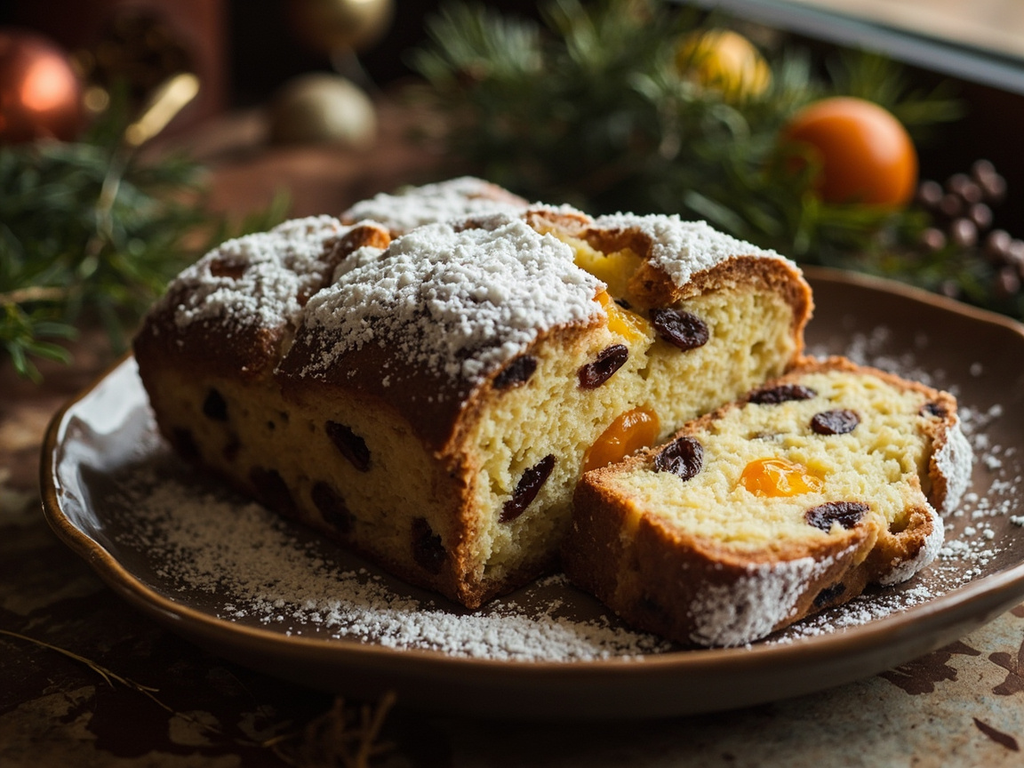
flipDresdner Stollen — Saxon Christmas Bread
Dresdner Stollen — Saxon Christmas Bread
Why this dish? Bach lived twenty-seven years in Leipzig, in Saxony, the land of Dresden Stollen. This rich bread of butter, almonds, and candied fruit, emblem of Saxon Advent, crowned the Christmases of his large family — he who composed so many oratorios for this season.
A dense, buttery brioche-like bread, scented with lemon zest, almonds, and candied fruit, rolled in sugar and cinnamon. Its shape evokes the swaddled Christ Child; it is prepared for Advent and enjoyed until Christmas.
For the Feast of the Nativity, when I gave my Oratorio at church, the whole house smelled of melted butter and lemon. Anna Magdalena kneaded this heavy dough — it takes butter without measure, almonds, raisins, and candied citron —, and we folded it like the Child in His swaddling clothes. We let it age a few days, for this bread improves like a good counterpoint. Cut me a thick slice, and let us give thanks: Jauchzet, frohlocket!
- •Wheat flour — a lot (base)
- •Butter — generously (richness)
- •Brewer's yeast / yeast — as needed (leavening)
- •Raisins and candied citron — by the handful (fruits)
- •Almonds — a good handful (crunch)
- •Lemon zest, mace, cardamom — to taste (flavor)
- •Sugar — for rolling the bread (coating)
Dresdner Stollen — Saxon Christmas Bread
A dense, buttery brioche-like bread, scented with lemon zest, almonds, and candied fruit, rolled in sugar and cinnamon. Its shape evokes the swaddled Christ Child; it is prepared for Advent and enjoyed until Christmas.
Why this dish? Bach lived twenty-seven years in Leipzig, in Saxony, the land of Dresden Stollen. This rich bread of butter, almonds, and candied fruit, emblem of Saxon Advent, crowned the Christmases of his large family — he who composed so many oratorios for this season.
For the Feast of the Nativity, when I gave my Oratorio at church, the whole house smelled of melted butter and lemon. Anna Magdalena kneaded this heavy dough — it takes butter without measure, almonds, raisins, and candied citron —, and we folded it like the Child in His swaddling clothes. We let it age a few days, for this bread improves like a good counterpoint. Cut me a thick slice, and let us give thanks: Jauchzet, frohlocket!
Ingredients (period version)
- Wheat flour — a lot (base)
- Butter — generously (richness)
- Brewer's yeast / yeast — as needed (leavening)
- Raisins and candied citron — by the handful (fruits)
- Almonds — a good handful (crunch)
- Lemon zest, mace, cardamom — to taste (flavor)
- Sugar — for rolling the bread (coating)
Ingredients
- All-purpose flour (T45) — 500 g (base)
- Butter — 200 g (richness)
- Fresh baker's yeast — 20 g (leavening)
- Warm milk — 15 cl (hydration)
- Raisins — 150 g (fruits)
- Candied citrus peel (citron) — 100 g (fruits)
- Blanched chopped almonds — 80 g (crunch)
- Zest of 1 lemon, mace and cardamom — to taste (flavor)
- Sugar + melted butter — for coating (finish)
Method
- Dissolve the yeast in warm milk, mix with a little flour, and let foam.
- Knead the flour, softened butter, spices, zest, and starter into a smooth dough; let rise for 1 hour.
- Fold in raisins, candied fruit, and almonds; knead briefly.
- Shape by folding the dough over itself (characteristic Stollen form); let rise for another 45 minutes.
- Bake at 180°C for about 50 minutes until a beautiful golden color.
- Upon removal, brush with melted butter and roll in sugar; let rest for a few days before eating.
How it was made : Dresden Stollen is attested as early as the 15th century; originally a lean Lenten bread (without butter, which was forbidden), it became richer after the Church allowed butter. In Bach's time, butter, almonds, and imported candied fruit made it a luxury reserved for festivities. (No trace of chocolate or vanilla, New World ingredients absent from the period recipe.)
The contemporary twist : Serve in thin slices with Zimmermann coffee, and insert a core of almond paste (marzipan) in the center, as in modern Dresden Stollen.
Johann Sebastian Bach · Charactorium