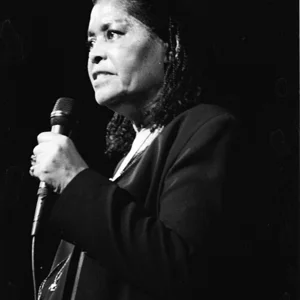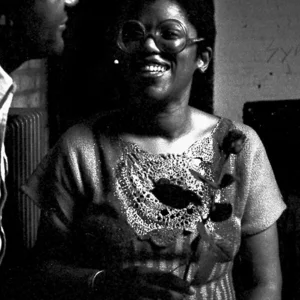

Jeanne Lee (1939-2000) was an American avant-garde jazz singer, poet, and composer. A pioneer of free vocal improvisation, she explored extended vocal techniques and the fusion of voice, poetry, and free jazz.
Jeanne Lee(1939 — 2000)
Jeanne Lee
États-Unis
6 min read
Frequently asked questions
Key Facts
- Born on January 29, 1939, in New York, into a family of musicians.
- In 1961 she recorded the album 'The Newest Sound Around' in a duo with pianist Ran Blake, which brought her to prominence.
- A pioneer of vocal improvisation and extended vocal techniques in free jazz.
- Collaborated with many figures of the avant-garde (Gunter Hampel, Marion Brown, Archie Shepp, Andrew Cyrille).
- Died on October 25, 2000, in Tijuana (Mexico).
Works & Achievements
A voice-piano duo that reinvents jazz standards; a pioneering record belatedly recognized as visionary.
A landmark recording in which her voice becomes an improvising instrument alongside winds and vibraphone.
A contribution to a monumental jazz opera blending jazz, rock, and contemporary music.
An album released under her own name, showcasing her personal approach to free vocal expression and poetry.
An intimate voice-piano duo that distills the full maturity of her art across jazz, improvisation, and poetry.
An independent record label co-founded to freely release their avant-garde music.
Anecdotes
A student at Bard College in New York State in the late 1950s, Jeanne Lee met pianist Ran Blake there. Together they formed a boldly inventive voice-and-piano duo and released “The Newest Sound Around” in 1961, an album that reinvented the jazz standards and that critics would long consider ahead of its time.
Jeanne Lee married the German musician Gunter Hampel, a vibraphonist and clarinetist of the European avant-garde. For nearly thirty years she sang in his Galaxie Dream Band, and the couple founded their own label, Birth Records, so they could release their music freely without depending on the major record companies.
In 1971 she took part in “Escalator Over the Hill,” the vast “jazz opera” by composer Carla Bley, set to texts by Paul Haines. This boundary-breaking project, blending jazz, rock, and contemporary music, brought together dozens of musicians, and Jeanne Lee's voice embodied several characters in it.
Jeanne Lee did not merely sing lyrics: she treated her voice as a free jazz instrument, using whispers, cries, breaths, and invented syllables. This practice of “extended vocal techniques” made her a true improviser, every bit as much as a saxophonist or a pianist.
A poet as much as a singer, she was fascinated by the link between voice, word, and the movement of the body, and she taught her vision of the voice as an instrument. She wanted to show that to sing was also to think, dance, and improvise all at the same time.
Primary Sources
A voice-and-piano duo album in which standards like “Summertime” are taken apart and reinvented, with no drums or double bass, leaving plenty of room for improvisation and silence.
A work billed as a “chronotransduction,” a sweeping fresco blending jazz, rock and the avant-garde, in which Jeanne Lee appears among the solo voices alongside many other musicians.
A recording released on the label founded by Hampel and Lee, where Jeanne Lee's voice converses freely with the winds and the vibraphone, treated as an instrument of improvisation.
A duo album with pianist Mal Waldron, a testament to the maturity of her vocal art, which weaves together jazz phrasing, poetry and improvisation.
Key Places
Jeanne Lee's hometown and the heart of the avant-garde jazz scene where she grew up and got her start.
The college where she studied in the late 1950s and met pianist Ran Blake, her first duo partner.
A stop on her European tours: Europe often welcomed her experimental jazz more warmly than the United States did in the 1960s.
Home country of her partner Gunter Hampel and the base for many collaborations with the European avant-garde scene.
The city where she died in 2000 while undergoing medical treatment there.
Typical Objects

An essential tool for the singer, which she used to bring out the finest nuances of her voice, from breath to whisper.

Her true instrument: she used it like a saxophone or a piano, through cries, whispers, invented syllables, and extended vocal techniques.

The instrument of her companion Gunter Hampel, whose crystalline tones often accompanied her vocal improvisations.

A poet as much as a singer, she wrote texts that she wove into her performances, at the crossroads of word and sound.

The medium for her recordings, often released on independent labels such as Birth Records to preserve her artistic freedom.

In free jazz, musicians sometimes used free notations or instructions instead of conventional scores, leaving room for collective improvisation.

A device used to record concerts and rehearsals, essential for preserving unique improvisations that were never reproduced exactly the same way.
School Curriculum
Vocabulary & Tags
Key Vocabulary
Tags
Daily Life
Morning
Like many musicians who lived by night, Jeanne Lee often started her days late. The morning might be devoted to writing poems or to vocal exercises to keep her voice supple and build its stamina.
Afternoon
The afternoon was a time for rehearsals and sonic experimentation, alone or with Gunter Hampel and other improvisers. They explored new vocal textures, combinations of words and rhythms rather than ready-made songs.
Evening
Evenings were for concerts, in clubs, at festivals, or in New York artists' “lofts.” Each performance was largely improvised and never quite resembled the one before.
Food
Her life as a touring musician meant irregular meals, often eaten late after concerts. What she ate depended heavily on the cities she passed through, between the United States and Europe.
Clothing
On stage, avant-garde jazz artists adopted a free, personal look, sometimes inspired by the African American cultural movements of the 1960s and 1970s, far from classic evening wear.
Housing
Her life was split between New York and Europe according to her collaborations, notably with Gunter Hampel. Touring kept her living a nomadic life, between temporary lodgings and concert venues.