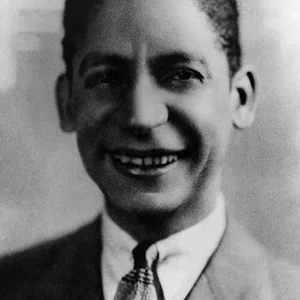

American pianist, composer, and bandleader, a major figure in the early days of jazz in New Orleans. He proclaimed himself “the inventor of jazz” and was one of the first to set his compositions down in writing, bridging ragtime and orchestrated jazz.
Jelly Roll Morton(1890 — 1941)
Jelly Roll Morton
États-Unis
6 min read
Frequently asked questions
Famous Quotes
« Jazz is a style, not a composition.»
Key Facts
- Born around 1890 in New Orleans (Louisiana), into the Creole of color community
- Composed “Jelly Roll Blues” (1915), often cited as one of the first published jazz pieces
- Recorded with his Red Hot Peppers starting in 1926, laying the foundations of orchestrated jazz
- Made a series of recordings and interviews for the Library of Congress in 1938 (Alan Lomax)
- Died in 1941 in Los Angeles in relative poverty, before the renewed interest in his work
Works & Achievements
Published in Chicago, it is one of the very first jazz compositions issued as printed sheet music.
An iconic piece that would become, in the 1930s, an anthem of the swing era covered by the big bands.
A Red Hot Peppers recording regarded as a model of New Orleans jazz orchestration.
A musical evocation of a New Orleans funeral procession, blending the solemnity and liveliness characteristic of the city.
A virtuosic piano composition, one of his best-known and most frequently covered pieces.
A refined piano piece, illustrating the shift from ragtime to fully composed jazz.
A long series of performances and spoken accounts recorded with Alan Lomax, a major archive on the origins of jazz.
A body of recordings that captured on disc the balance between written composition and collective improvisation.
Anecdotes
Ferdinand LaMothe, known as Jelly Roll Morton, sported a diamond set into one of his front teeth. This flashy detail was his calling card: he would flash it in a smile to remind everyone that he was one of the best-paid jazz musicians of his day.
Morton unabashedly proclaimed himself “the inventor of jazz,” which he dated precisely to 1902. In 1938, furious at hearing a radio program credit that title to W.C. Handy, he sent a long letter to Down Beat magazine claiming authorship of the genre, sparking one of the most famous controversies in the history of jazz.
As a teenager, Morton earned his living playing piano in the brothels of the Storyville district in New Orleans. When his Creole family, deeply concerned with respectability, discovered this work they deemed shameful, his grandmother threw him out of the house.
In 1938, the Library of Congress invited him to tell the story of his life in front of a microphone. For hours, Morton played the piano and recounted his memories to the folklorist Alan Lomax: these recordings form one of the first great oral histories of jazz, told by one of its pioneers.
For his 1926 sessions with his Red Hot Peppers, Morton rehearsed his musicians with a rigor rare for the time. He precisely balanced what was written out against what was left to improvisation, making these records models of New Orleans jazz orchestration.
Primary Sources
In them, Morton claims to have “invented jazz in 1902” and recounts, at the piano, the early days of the music in New Orleans, its pianists, and its Storyville houses.
Morton publicly disputes that W.C. Handy is “the inventor of jazz and the blues” and claims for himself the creation of jazz in 1902.
A composition published in Chicago, presented as one of the first jazz scores to be printed and distributed commercially.
On it he billed himself as the “Originator of Jazz and Stomp,” proudly proclaiming his claim to have founded the genre.
Key Places
Morton's birthplace and the cradle of jazz, where he grew up in Creole culture and cut his teeth on the piano.
Red-light district where the teenage Morton played in the brothels, a decisive cradle of early jazz.
Hub of jazz in the 1920s where Morton recorded his masterpieces with the Red Hot Peppers for Victor.
He lived here in the 1930s and made his historic recordings with Alan Lomax at the Library of Congress.
City where Morton died in 1941, on the margins of the music scene that had once celebrated him.
Typical Objects

His favorite instrument, on which he composed and demonstrated his vision of orchestrated jazz, blending ragtime, blues, and improvisation.

Morton had a diamond set into one of his front teeth, an ostentatious sign of success for one of the highest-paid jazz musicians of his era.

He was one of the first to put his jazz compositions down on paper, bridging the gap between the oral tradition and written music.

The medium for the Red Hot Peppers recordings (1926-1930) that spread his style across the country.

Before and during his musical career, Morton also made a living from gambling and billiards, earning money as a skilled traveling player.

Always impeccably dressed, he took great care of his dandy appearance, reflecting the prestige he associated with his music.
School Curriculum
Vocabulary & Tags
Key Vocabulary
Tags
Daily Life
Morning
A night-owl musician, Morton often rose late after the previous evening's concerts. His mornings were for resting, keeping up his polished appearance, and, on recording days, preparing his scores and arrangements.
Afternoon
The afternoon was spent at the piano, composing or meticulously rehearsing his musicians. As much a businessman as an artist, he also negotiated contracts, royalties, and engagements with clubs and record companies.
Evening
When evening came, he played in cabarets, vaudeville theaters, or dance halls until late into the night. The stage was his domain, where he led the band while dazzling the audience with his piano.
Food
His diet was that of a New Orleans Creole turned traveling musician: spicy Southern cooking, dishes served in the restaurants and clubs of the cities where he performed, and meals taken at irregular hours to the rhythm of his tours.
Clothing
Always elegant, Morton wore tailor-made suits, sharp shirts, and hats, placing great importance on appearances — right down to the diamond set in his tooth.
Housing
His life as a traveling musician had him lodging in furnished rooms, hotels, and apartments from one city to the next — New Orleans, Chicago, New York, Washington, and then Los Angeles.