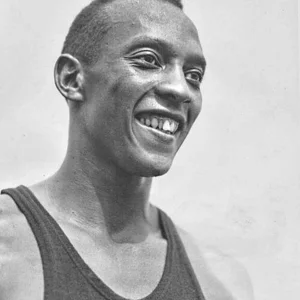

Jesse Owens was an American athlete who specialized in sprinting and the long jump. He became a legend of track and field by winning four gold medals at the 1936 Berlin Olympic Games, publicly defying the racist Nazi ideology.
Jesse Owens(1913 — 1980)
Jesse Owens
États-Unis
7 min read
Frequently asked questions
Key Facts
- Born on September 12, 1913, in Oakville, Alabama, United States
- On May 25, 1935, in Ann Arbor, broke or tied four world records in 45 minutes
- Won four gold medals at the 1936 Berlin Olympics (100 m, 200 m, long jump, 4×100 m relay)
- His victories contradicted Nazi propaganda about the superiority of the “Aryan race”
- Died on March 31, 1980, in Tucson, Arizona, United States
Works & Achievements
A legendary performance at the Big Ten Championships, often cited as the greatest single-day feat in the history of track and field.
Owens's first Olympic title, won in 10.3 seconds, defying racist propaganda on the very soil of Nazi Germany.
A winning leap of 8.06 m, marked by the sportsmanship and friendship of his German rival Luz Long.
His third title, set in 20.7 seconds, a new Olympic record for the distance.
A fourth gold medal, with the American team breaking the world record in 39.8 seconds; Owens ran the first leg.
An account of his life and a reflection on the African American condition, helping to make him a memorial figure of the civil rights movement.
Anecdotes
At the 1936 Berlin Games, Jesse Owens struck up a friendship with his German rival Luz Long, the long jump champion. Long even gave him a piece of technical advice during the qualifying rounds, helping him to qualify. After Owens's victory, the two athletes took a lap of honor together, arm in arm, under the gaze of Adolf Hitler.
Owens grew up in a very poor family in Alabama. As a child, he had to work in the cotton fields and suffered from health problems linked to malnutrition. It was a middle-school physical education teacher who spotted his talent and allowed him to train in the mornings before school, because Jesse had to work in the afternoons.
On 25 May 1935, at a college meet in Ann Arbor, Owens broke or tied four world records in just 45 minutes, despite a back injury. Many sports historians consider this performance the most extraordinary ever achieved by an athlete in a single day.
Returning to the United States as a hero, Owens discovered that segregation had not disappeared: at a reception held in his honor in New York, he had to take the freight elevator reserved for goods to reach the hall. He would later say bitterly that President Roosevelt never congratulated him or received him at the White House.
Stripped of financial means after his Olympic glory, Owens took on unusual challenges to earn a living: he ran races against racehorses. He explained that he had to eat, and that you couldn't eat gold medals.
Primary Sources
“Hitler didn't snub me — it was me who snubbed Hitler. I didn't have time to bother with him; I had races to run.”
“You could melt down all the medals and cups I've won, and they wouldn't form a plating on the twenty-four-carat friendship I felt for Luz Long at that moment.”
Recorded results: Owens won the 100 m (10.3 s), the 200 m (20.7 s, Olympic record), the long jump (8.06 m, Olympic record) and the 4×100 m relay (39.8 s, world record).
Within the span of forty-five minutes, Owens set new world records in the 220 yards, the 220-yard hurdles and the long jump, and tied the one in the 100 yards.
Key Places
Rural village in the American South where Jesse Owens was born in 1913 into a family of African American sharecroppers.
Industrial city in the North where the Owens family migrated during the Great Migration. Jesse grew up here and revealed his talent in junior high school.
University where Owens trained and broke four world records during a single competition in 1935. He also faced segregation there, having to lodge off campus.
Setting of the 1936 Games where Owens won his four gold medals in front of Hitler. The stadium was designed as a showcase for the power of the Nazi regime.
City where Jesse Owens spent his final years and died of lung cancer in 1980.
Typical Objects

Lightweight running shoes fitted with metal spikes, designed for grip on the cinder tracks of the era. Owens wore a pair supplied by the German manufacturer Adi Dassler at the 1936 Games.

Award presented to the winners of Olympic events. Owens won four in Berlin, symbols that became emblematic of the moral defeat of Nazi propaganda.

A running surface made of packed clinker and ashes, standard in the stadiums of the interwar period. Much slower and more uneven than modern synthetic tracks.

A mechanical time-measuring instrument used by judges to time the races. At the time, times were recorded manually, to the tenth of a second.

A tank top emblazoned with the USA insignia worn by American athletes in Berlin. For Owens, wearing it embodied both national pride and the paradox of a country still under segregation.

A cylindrical rod passed between teammates during the 4×100 metres relay event. Owens was the lead-off runner for the victorious American team in Berlin.
School Curriculum
Vocabulary & Tags
Key Vocabulary
Tags
Daily Life
Morning
As a teenager in Cleveland, Jesse trained early in the morning before class, his work schedule keeping him busy in the afternoon. A student-athlete, his mornings were paced by warm-ups, starting drills, and technical work on the cinder track.
Afternoon
The afternoon was devoted to intensive training sessions: sprints, strides, and repeated jumps under the watchful eye of his coach. At university, he also had to juggle competitions and odd jobs to support himself.
Evening
In the evening, Owens recovered, studied, and spent time with his family. After his athletic career, his evenings were often filled with lectures and public appearances to earn a living.
Food
A poor child of the South, he suffered from malnutrition. As an athlete, his diet was built on meals rich in protein and starch, typical of sportsmen of the era, far from the scientific regimens of modern athletes.
Clothing
On the track, he wore the team's tank top and shorts along with his leather spikes. In town, like every man of his time, he dressed in plain suits, with a shirt, tie, and hat.
Housing
Born in a modest sharecroppers' cabin in Alabama, he later knew the working-class housing of Cleveland. Because of segregation, even when famous he was often forced to stay in separate hotels reserved for African Americans.
Historical Timeline
Period Vocabulary
Liens externes & ressources
Références
Œuvres
Quatre records du monde en 45 minutes (Ann Arbor)
25 mai 1935
Médaille d'or du 100 mètres (Berlin)
1936
Médaille d'or du saut en longueur (Berlin)
1936
Médaille d'or du 200 mètres (Berlin)
1936
Médaille d'or du relais 4×100 mètres (Berlin)
1936
Autobiographie « The Jesse Owens Story »
1970