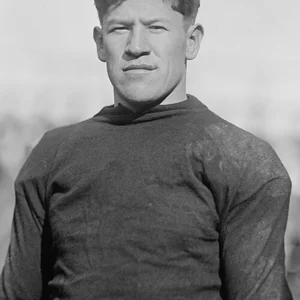

Native American athlete from the United States (Sac and Fox Nation), regarded as one of the most versatile sportsmen in history. A double Olympic champion in 1912, he was also a professional American football and baseball player.
Jim Thorpe
Jim Thorpe
États-Unis
7 min read
Frequently asked questions
Key Facts
- Born in 1887 in Indian Territory (present-day Oklahoma), within the Sac and Fox Nation
- Won the gold medals in the pentathlon and the decathlon at the 1912 Stockholm Olympic Games
- Stripped of his Olympic titles in 1913 for having played semi-professional baseball (a violation of the amateurism rules)
- Professional career in American football (co-founder and first president of the APFA, forerunner of the NFL, in 1920) and in baseball
- Died in 1953; his Olympic medals were officially returned by the IOC in 1982, and his status as sole winner was reinstated in 2022
Works & Achievements
A crushing victory in Stockholm where he dominated four of the five events, proving his exceptional versatility.
A points record for the era in this premier track-and-field event combining ten disciplines over two days.
A star player for the Carlisle school, he led his team to resounding victories against the major universities.
The first president of the organization that would become the NFL, helping to structure American professional football.
A player for the New York Giants and later other clubs, demonstrating his ability to excel in a third high-level sport.
A star who filled stadiums and carried his team to be among the best of its time.
Voted by American sportswriters the greatest athlete of the first half of the 20th century, ahead of legends from every sport.
Anecdotes
At the 1912 Stockholm Olympic Games, Jim Thorpe won both the pentathlon AND the decathlon, an unprecedented feat. King Gustaf V of Sweden is said to have told him as he handed over the medals: “Sir, you are the greatest athlete in the world.” Thorpe reportedly replied simply: “Thanks, King.”
On the morning of an Olympic final, Thorpe discovered that his athletic shoes had been stolen. He scrounged up two mismatched ones, including one found in a trash can, and had to wear an oversized shoe by adding extra socks. He still won the gold medal in the high jump in that improvised getup.
In 1913, it was discovered that Thorpe had been paid a few dollars to play minor league baseball before 1912, which violated the strict rules of amateurism. The Olympic Committee stripped him of his two gold medals, a decision later regarded as deeply unfair.
Thorpe was one of the founders and the very first president of the organization that would become the NFL (the professional American football league), created in 1920. A star of the Canton Bulldogs team, he was the headliner who drew crowds into the stadiums.
It was not until 1982, nearly thirty years after his death, that the International Olympic Committee reinstated Thorpe and returned his medals to his family. In 2022, the IOC officially recognized him as the sole and only champion of those two 1912 events.
Primary Sources
“Sir, you are the greatest athlete in the world.”
He explains that he had played professional baseball without understanding that he was committing a wrong, being only a young Indian schoolboy who did not know much about such things.
The American press celebrates the triumph of the Carlisle athlete, winner of the pentathlon and the decathlon ahead of the best sportsmen in the world.
The IOC restores Jim Thorpe to his status as Olympic champion and returns his medals to his descendants.
Key Places
Region of the central United States where Thorpe was born and grew up within his Native American community. There he received his Indian name, Wa-Tho-Huk (“Bright Path”).
Native American assimilation school where Thorpe studied and revealed his athletic talent under the guidance of Pop Warner. There he became a college football star.
Site of the 1912 Olympic Games where Thorpe won the pentathlon and the decathlon. It was there that King Gustaf V called him the greatest athlete in the world.
Home of the Canton Bulldogs, where Thorpe shone in professional football and took part in founding the future NFL. The city is today home to the Pro Football Hall of Fame.
California region where Thorpe spent his final years in difficult circumstances and where he died in 1953.
Former town of Mauch Chunk renamed in his honor in 1954; it houses his memorial and his grave. A place of commemoration born from an agreement with his widow.
Typical Objects

The two medals won in the pentathlon and decathlon at Stockholm, stripped in 1913 and then restored in 1982. They symbolize both his athletic genius and the injustice he suffered.

The improvised shoes Thorpe slipped on after his own were stolen during a Stockholm final. Now legendary, they illustrate his resourcefulness in the face of adversity.

The soft leather helmet worn in the days of the Canton Bulldogs, without the protection of modern helmets. It was the basic equipment of professional football in the 1910s and 1920s.

The oval ball of American football, of which Thorpe was one of the first great professional stars. More rounded than today's, it was used for both running and kicking.

The wooden instrument Thorpe used during his Major League seasons with the New York Giants and other clubs. Professional baseball was the cause of the loss of his medals.

The uniform of the professional team that, thanks to Thorpe, became one of the most famous of the early days of American football. His name on the billboard filled the stadiums.
School Curriculum
Vocabulary & Tags
Key Vocabulary
Tags
Daily Life
Morning
During his years at Carlisle, the day began early with roll call and the chores imposed on Native American students. Thorpe would then move on to morning track and field training, running, jumping, and throwing under the watchful eye of Pop Warner.
Afternoon
The afternoon was divided between classes, the school's vocational workshops, and long sports sessions. A complete athlete, he switched from football to the high jump, from sprinting to the shot put with an ease that astonished his coaches.
Evening
In the evening, after the communal dinner, came time for rest and conversation among boarding-school classmates. Later, during his professional career, evenings followed the rhythm of team travel, trains, and hotels between games.
Food
Food at the Indian boarding schools was simple and rationed: bread, stews, cheap meat, and vegetables. As an athlete and then a professional sportsman, Thorpe needed hearty meals to sustain his intense efforts across several disciplines.
Clothing
Day to day, he wore the strict uniform imposed on Carlisle students, designed to erase traditional Native American dress. On the field, he put on the sports gear of the era: wool jerseys, a leather helmet, and cleated shoes.
Housing
As a child, he lived in a modest house in the territory of the Sac and Fox Nation, near the family lands. At Carlisle, he stayed in the school's communal dormitories, far from his family, like all the children forcibly placed in these schools.
Historical Timeline
Period Vocabulary
Liens externes & ressources
Références
Œuvres
Titre olympique du pentathlon
1912
Titre olympique du décathlon
1912
Carrière de football américain à Carlisle
1907-1912
Présidence de l'American Professional Football Association
1920
Carrière en Ligue majeure de baseball
1913-1919
Carrière de football professionnel aux Canton Bulldogs
1915-1920
Sacre de meilleur athlète du demi-siècle
1950