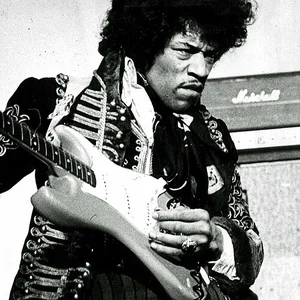

American guitarist, singer-songwriter, and singer, regarded as one of the most influential in the history of rock. Over just a few years of his career, he revolutionized electric guitar playing before his untimely death at the age of 27.
Jimi Hendrix(1942 — 1970)
Jimi Hendrix
États-Unis
5 min read
Frequently asked questions
Key Facts
- Born on November 27, 1942, in Seattle (United States)
- Formed the band The Jimi Hendrix Experience in 1966 in London
- Album Are You Experienced released in 1967
- Memorable rendition of the American national anthem at the Woodstock festival in 1969
- Died on September 18, 1970, in London, at the age of 27
Works & Achievements
First album by the Jimi Hendrix Experience, considered a founding record of psychedelic rock.
Second album, marked by sonic explorations and innovative recording techniques.
Ambitious double album featuring the famous cover of Bob Dylan's “All Along the Watchtower.”
Iconic song that became an anthem of psychedelic rock, famous for its guitar riff.
First single that launched his career in the United Kingdom and entered the British charts.
Instrumental rendition of the American national anthem, which became a symbol of protest against the Vietnam War.
Virtuoso track showcasing his mastery of effects and his wah-wah pedal playing.
Anecdotes
At the Monterey festival in 1967, Jimi Hendrix ended his concert by dousing his guitar in lighter fluid and setting it on fire, kneeling before the burning instrument. This spectacular gesture, captured in a famous photograph, has become one of the most iconic images in the history of rock.
Hendrix was left-handed, but he played right-handed Fender Stratocaster guitars that he flipped over and restrung upside down. This unusual setup altered the tension and tone of the strings, contributing to his unique sound, recognizable among all others.
On August 18, 1969, Hendrix closed the Woodstock festival with a distorted, feedback-laden rendition of the American anthem *The Star-Spangled Banner*. By imitating the sound of bombs and sirens on his guitar, he turned the anthem into a commentary on the Vietnam War that left its mark on an entire generation.
Before becoming famous, Hendrix served briefly in the U.S. Army as a paratrooper in the 101st Airborne Division in 1961, but was discharged after an injury. He then backed numerous soul and rhythm and blues artists as a touring guitarist before launching his own career.
It was in London, in late 1966, that Hendrix's career truly took off, after bassist Chas Chandler convinced him to leave New York. Within a few months, he impressed already-famous British guitarists such as Eric Clapton and Pete Townshend with his virtuosity.
Primary Sources
“Sometimes you want to play loud, sometimes you want to play soft. Music is about feeling, not just technique.”
First studio album by the Jimi Hendrix Experience, showcasing the trio and its revolutionary approach to the distorted electric guitar.
Instrumental rendition of the American national anthem, distorted and overdriven, captured at the Woodstock festival on the morning of August 18, 1969.
Key Places
Jimi Hendrix's hometown, in Washington State, where he grew up and taught himself to play the guitar.
The city where Hendrix truly launched his career in late 1966 and where he died in 1970.
Site of the Monterey Pop Festival in 1967, where his fiery performance introduced him to the American public.
Site of the Woodstock festival in 1969, where Hendrix delivered his famous rendition of the American national anthem.
The city where Hendrix played in clubs in Harlem and Greenwich Village before leaving for London.
Typical Objects

Hendrix's iconic guitar, played upside down because he was left-handed. It became an extension of his creativity and the symbol of his revolutionary playing.

A high-volume stack of amplifiers allowing saturation and controlled feedback. Hendrix turned it into a full-fledged instrument of his music.

A pedal that alters the guitar's sound by mimicking a crying voice. Hendrix popularized its use in spectacular fashion.

A colorful band worn around the forehead, which became a distinctive feature of his stage look inspired by hippie and psychedelic fashion.

An old British uniform jacket that Hendrix wore on stage, repurposed as a symbol of rebellion against the established order.

The main medium for distributing music at the time, on which his albums were released. It allowed millions of listeners to discover his work.
School Curriculum
Vocabulary & Tags
Key Vocabulary
Tags
Daily Life
Morning
Often in bed late after concerts or recording sessions, Hendrix would get up late in the morning. He frequently began the day by playing the guitar, an instrument he almost never parted with.
Afternoon
Afternoons were devoted to rehearsals with his band, interviews, or studio sessions. Hendrix spent hours experimenting with new sounds and electronic effects on his guitar.
Evening
Evenings revolved around concerts, clubs, and the London or New York nightlife. After shows, he would often extend the night with improvised jam sessions alongside other musicians.
Food
Hendrix led the life of a touring musician, with an irregular diet of meals grabbed on the go between tours. Food often came second to music in his priorities.
Clothing
He sported a flamboyant, colorful style, mixing psychedelic-patterned shirts, scarves, vintage military jackets, and headbands in his hair. His extravagant wardrobe embodied the spirit of 1960s counterculture.
Housing
During his years of fame, he lived mainly in apartments and hotels in London and New York, in step with his tours. His London home on Brook Street is now a museum.