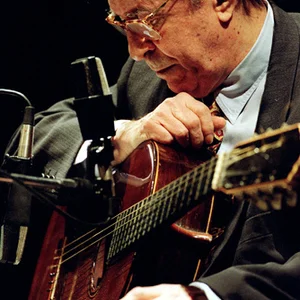

João Gilberto was a Brazilian musician, singer, and guitarist, considered one of the fathers of bossa nova. His syncopated guitar style and whispered voice revolutionized Brazilian popular music in the late 1950s.
João Gilberto(1931 — 2019)
João Gilberto
Brésil
6 min read
Frequently asked questions
Key Facts
- Born in 1931 in Juazeiro (State of Bahia, Brazil)
- Recorded 'Chega de Saudade' (Tom Jobim/Vinícius de Moraes) in 1958, often regarded as the birth of bossa nova
- Released the album 'Chega de Saudade' in 1959, a cornerstone of the genre
- Took part in the 1964 album 'Getz/Gilberto' with saxophonist Stan Getz, a worldwide success that included 'The Girl from Ipanema'
- Died in 2019 in Rio de Janeiro
Works & Achievements
First landmark recording of bossa nova, featuring the syncopated batida. Considered the founding act of the genre.
João Gilberto's first studio album, which codified the language of bossa nova. An absolute benchmark of Brazilian music.
A second album consolidating the singer-guitarist's intimate, refined style. It confirmed the success of bossa nova in Brazil.
Collaboration with Stan Getz featuring "Garota de Ipanema." The first record not strictly American to win the Grammy for Album of the Year.
A spare album recorded during his exile, praised for its sonic purity. It reflects the maturity of his art.
A live album produced by Caetano Veloso, reducing the music to voice and guitar. A pinnacle of artistic minimalism.
Anecdotes
In 1958, João Gilberto recorded the song *Chega de Saudade*, composed by Tom Jobim and Vinícius de Moraes. His revolutionary way of strumming the guitar, known as the *batida*, split the samba rhythm in a completely new way. This single is often regarded as the official birth of bossa nova.
Before he became famous, João Gilberto spent several months shut away in his sister's bathroom in **Diamantina**, tirelessly practising his guitar. He was searching for the perfect balance between rhythm, voice, and harmony, sometimes for up to eight hours a day. This obsessive quest for perfection became the hallmark of his entire career.
In 1964, the album *Getz/Gilberto*, recorded with the American saxophonist Stan Getz, introduced bossa nova to the whole world. The song *Garota de Ipanema* (*The Girl from Ipanema*), sung by his wife Astrud Gilberto, became a global hit. The album won the Grammy for Album of the Year in **1965**, a first for a record that was not strictly American.
João Gilberto was renowned for his extreme perfectionism and his secretive nature. During his concerts, he demanded absolute silence and could stop playing if a member of the audience coughed or if a light bothered him. It is said that he would tune his guitar for long minutes before he began to play.
Nicknamed *O Mito* (“The Myth”) in Brazil, João Gilberto spent his final years as a recluse in Rio de Janeiro. His influence on world music was so great that artists such as Frank Sinatra, Caetano Veloso, and Gilberto Gil acknowledged their debt to him. When he died in **2019**, Brazil paid him a national tribute.
Primary Sources
“Chega de saudade, a realidade é que sem ela não há paz, não há beleza” — Enough of longing, the reality is that without her there is neither peace nor beauty.
João Gilberto's first album, bringing together the recordings that established the language of bossa nova: a restrained voice, jazz harmonies and a syncopated *batida* on the guitar.
A collaboration between João Gilberto, Stan Getz and Antônio Carlos Jobim, including “Garota de Ipanema”; Grammy for Album of the Year in 1965.
A late album by João Gilberto, praised for the stripped-down purity of his singing and guitar, a testament to his fidelity to the intimate style of bossa nova.
Key Places
City in northeastern Brazil where João Gilberto was born in 1931. He grew up there before leaving for the big cities.
City where João Gilberto built his career and where bossa nova was born, notably in the Ipanema neighborhood. He died there in 2019.
City where João Gilberto withdrew around 1956 to stay with his sister and perfect his guitar technique. It was there that he developed his famous batida.
Prestigious venue where a bossa nova concert in 1962 introduced the genre to American audiences. A key milestone in its international rise.
Seaside neighborhood of Rio that inspired “Garota de Ipanema” and became the symbolic birthplace of bossa nova. João Gilberto was connected there to a whole musical bohemia.
Typical Objects

Nylon-string acoustic guitar from which João Gilberto drew his famous syncopated *batida*. The instrument was at the heart of his intimate art, playing both rhythm and harmony at once.

The medium onto which the first bossa nova recordings were cut, such as the single “Chega de Saudade.” Vinyl allowed the genre to spread worldwide.

An essential tool for João Gilberto's whispered singing, as he sang very close to the mic in a hushed voice. This closeness created the intimacy characteristic of bossa nova.

João Gilberto always performed seated, guitar on his knees, in an almost religious silence. The simple stool symbolized the bareness of his concerts.

Sheets notating the complex harmonies borrowed from jazz and the lyrics of Vinícius de Moraes or Tom Jobim. They set down a new Brazilian musical language.

An object used to tune the guitar with extreme precision, a ritual to which João Gilberto devoted long minutes before playing. It reflected his legendary perfectionism.
School Curriculum
Vocabulary & Tags
Key Vocabulary
Tags
Daily Life
Morning
João Gilberto, a notorious night owl, often slept until late in the morning. He woke slowly and quietly, in an apartment where he sought refuge from noise and bright light.
Afternoon
The afternoon might be devoted to long hours on the guitar, tirelessly rehearsing a single chord or phrase. A perfectionist, he searched for the perfect balance between rhythm, voice, and harmony.
Evening
Evening and night were his favorite time to play, record, or host a few close musician friends. He loved the nighttime calm, so well suited to concentration and creation.
Food
Like many Brazilians, he enjoyed simple cooking based on rice, black beans (feijão), and tropical fruits. Even so, he lived frugally and discreetly.
Clothing
João Gilberto favored an understated elegance, often a dark suit or a plain shirt at his concerts. His polished appearance contrasted with his deep reserve.
Housing
He lived in apartments in Rio de Janeiro, which he arranged for silence and isolation. A recluse in his final years, he led a life withdrawn from the world there.