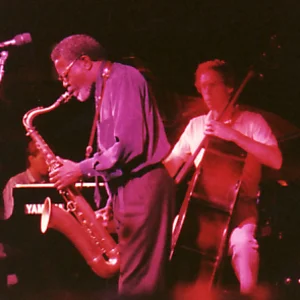

Joe Henderson (1937-2001) was an American jazz tenor saxophonist and composer. A major figure of hard bop and post-bop, he made his name in the 1960s at Blue Note before achieving belated recognition and numerous awards in the 1990s.
Joe Henderson(1937 — 2001)
Joe Henderson
États-Unis
6 min read
Frequently asked questions
Key Facts
- Born on April 24, 1937, in Lima (Ohio) and died on June 30, 2001, in San Francisco.
- Signed with Blue Note in 1963 and recorded the album Page One there, featuring his famous tune Recorda Me.
- Took part in 1964 in Horace Silver's album Song for My Father, one of the label's classics.
- Composed standards covered by many musicians, including Isotope and Inner Urge.
- Made a return to the spotlight in the 1990s with tribute albums (to Billy Strayhorn, Miles Davis, Jobim) that won Grammy Awards.
Works & Achievements
His first album as a leader, which revealed him both as a soloist and as a composer on the Blue Note label.
His most famous composition, with its Latin flavor, recorded on his very first album and since become a jazz standard.
An album whose tenor solo on the title track became a model studied by saxophonists the world over.
His last album recorded for Blue Note, the high point of his most creative period in the 1960s.
A landmark album from his time with Milestone, open to electric sounds and the activist mood of the era.
A tribute to composer Billy Strayhorn; this critical and commercial triumph revived his career and earned him a Grammy.
A tribute to Miles Davis, again rewarded with a Grammy Award, confirming his return to the forefront.
A tribute to the Brazilian composer Antônio Carlos Jobim, extending the series of tribute records from the 1990s.
Anecdotes
In 1963, at age 26, Joe Henderson recorded his first album, Page One. It features his composition “Recorda Me” as well as the famous “Blue Bossa” by his friend, the trumpeter Kenny Dorham. These two pieces have become standards that thousands of young musicians still learn today as their first steps into jazz.
That same year, Henderson was still little known when he played as a sideman on pianist Horace Silver's album Song for My Father. His tenor saxophone solo on the title track is so brilliant that it is now one of the most studied in all of jazz, learned note for note by saxophonists the world over.
In the late 1960s, Henderson surprised everyone by joining Blood, Sweat & Tears for a time, a band that blended rock with jazz horns. This unexpected detour shows his curiosity: he wasn't afraid to leave the jazz clubs behind to explore other kinds of music.
For nearly thirty years, Henderson remained a “musician's musician”: admired by specialists but overlooked by the general public. Everything changed in 1992, when his tribute album to composer Billy Strayhorn, Lush Life, won a Grammy Award. At 55, he finally became a star — proof that recognition can come late.
Joe Henderson grew up in Lyons, a small town in Ohio, in a family of fifteen children. It was one of his older brothers who introduced him to jazz records and encouraged him to play. Very early on, young Joe was already writing his own pieces.
Primary Sources
This debut record, recorded in June 1963, features Henderson's composition “Recorda Me” and Kenny Dorham's “Blue Bossa,” two tunes immediately taken up by jazz musicians.
On this track recorded in 1964, Joe Henderson's tenor saxophone solo became one of the most famous and most studied in hard bop.
Joe Henderson was honored there for the album Lush Life: The Music of Billy Strayhorn, marking a spectacular comeback after years of relative obscurity.
During the 1990s, jazz critics repeatedly voted Joe Henderson best tenor saxophonist and musician of the year.
Key Places
Joe Henderson's home village, where he grew up in a large family and discovered jazz thanks to his brothers.
Here he studied music at Wayne State University and honed his craft in the late 1950s amid a vibrant jazz scene.
The heart of jazz, where Henderson settled in 1962, recorded for Blue Note, and performed in the most renowned clubs.
The legendary studio where many of his Blue Note albums were cut, including Page One, in just a few takes.
The city where he settled in the early 1970s and which remained his home base until his death in 2001.
Typical Objects

His lifelong instrument, from which he drew a supple, veiled, and deeply personal tone, able to whisper as easily as it could roar.

Henderson constantly adjusted his mouthpiece and reeds to shape his instantly recognizable timbre. These small accessories are essential to a saxophonist's sound.

The dominant format of the 1960s, the long-playing record captured his albums for the Blue Note label, such as *Page One* or *Mode for Joe*.

The chart for this Henderson composition appears in the standard songbooks (the *Real Book*); generations of students learn it as an introduction to improvisation.

The label's covers, with their black-and-white photography and clean, minimalist graphic design, became a true visual icon of modern jazz.

A symbol of his belated recognition, Henderson won several in the 1990s, notably for his tribute to **Billy Strayhorn**.

True to the elegance of the hard bop musicians, he performed in a carefully tailored suit and tie, asserting the seriousness and dignity of the professional jazzman.
School Curriculum
Vocabulary & Tags
Key Vocabulary
Tags
Daily Life
Morning
Like many jazzmen, Henderson played late into the night and therefore got up rather late. His quiet mornings were spent practicing his instrument, adjusting his reeds, and putting new ideas for compositions down on paper.
Afternoon
The afternoon could be devoted to rehearsals or recording sessions, often in a studio like Rudy Van Gelder's in New Jersey, where the Blue Note albums were cut in just a few takes. Later in his life, he also passed on his knowledge to young musicians.
Evening
Evening was the heart of his profession: he played one long club gig after another in New York, then on the big festival stages. His solos could stretch on at length, carried by his dialogue with the other musicians.
Food
Life on tour meant irregular meals, grabbed between two gigs. A heavy smoker, Henderson would pay the price: tobacco wrecked his health and caused the lung disease that would kill him.
Clothing
True to the elegance of the hard bop musicians, he took the stage in a sharp suit and tie. This look asserted the seriousness and dignity of the professional jazzman.
Housing
From a modest childhood in a large family in Ohio, he moved on to the life of an artist in a New York apartment during the Blue Note years. Beginning in the 1970s, he settled in San Francisco, his adopted city until his death.