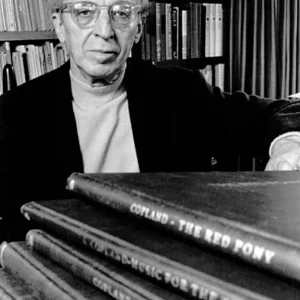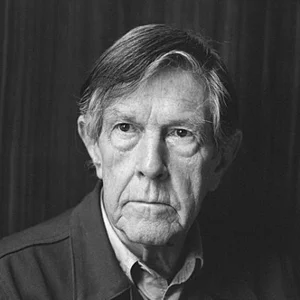

John Cage (1912-1992) was an American composer, theorist, and visual artist, a major figure of the 20th-century musical avant-garde. A pioneer of chance music and of silence as sonic material, he profoundly reshaped the very conception of the musical work.
John Cage(1912 — 1992)
John Cage
États-Unis
6 min read
Frequently asked questions
Famous Quotes
« I have nothing to say and I am saying it, and that is poetry.»
Key Facts
- Born in 1912 in Los Angeles, died in 1992 in New York
- Invented the “prepared piano” in the 1940s by inserting objects between the strings
- Composed *4'33"* in 1952, a work of silence in which the performer plays no notes
- Developed chance music (indeterminacy) drawing on the I Ching and Zen thought
- A central figure of the New York avant-garde, close to painter Robert Rauschenberg and choreographer Merce Cunningham
Works & Achievements
Introduces the prepared piano, turning the instrument into a percussion orchestra.
A cycle regarded as a masterpiece of the prepared piano, inspired by the emotions of Indian aesthetics.
First major work composed with the help of chance, based on the I Ching.
A piece for twelve radios, incorporating the chance of broadcasts picked up live.
Cage's most famous work: a performed silence that reveals ambient sounds as music.
A collection of writings and lectures setting out his thinking on sound, silence and chance.
A vast multimedia work for harpsichords and electronic tapes, created with Lejaren Hiller.
A radical collage of the history of European opera, built on chance and superimposition.
Anecdotes
In 1952, John Cage created 4'33", a piece in which the performer plays no notes at all for four minutes and thirty-three seconds. The “piece” is in fact made up of the unintentional sounds of the room: coughs, whispers, noise from the street. Cage wanted to show that absolute silence never truly exists.
Cage invented the “prepared piano” by slipping screws, bolts, and bits of rubber and felt between a piano's strings. The instrument is thus transformed into a small percussion orchestra with strange sonorities. He came up with the idea to accompany a dance performance in a hall too small for a percussion ensemble.
A passionate mycologist, Cage was a great connoisseur of mushrooms. He co-founded the New York Mycological Society and even won an Italian television quiz show in 1959 by answering questions on the subject, taking home a tidy sum of money.
To compose, Cage used the I Ching, the ancient Chinese “Book of Changes,” drawing numbers at random to decide on notes and durations. This “chance music” allowed him to remove his own tastes from the work and let chance decide.
In 1985, Cage launched in Halberstadt (Germany) the idea of an organ work titled “As Slow as Possible.” One performance, begun in 2001, is meant to last 639 years: each chord change is a genuine event that draws visitors from all over the world.
Primary Sources
“I have nothing to say and I am saying it and that is poetry.”
“There is no such thing as silence. What they thought was silence, because they did not know how to listen, was full of accidental sounds.”
“I believe that the use of noise to make music will continue and increase until we reach a music produced through the aid of electrical instruments.”
Key Places
John Cage's birthplace, where he grew up and later studied under Arnold Schoenberg.
Experimental college where Cage taught and, in 1952, staged a happening that became a founding moment of performance art.
The center of Cage's artistic life for decades; here he created his major works and died in 1992.
Site of the premiere of 4'33", performed by pianist David Tudor in 1952.
Town where the performance of “As Slow as Possible” is taking place, designed to last 639 years.
Cage stayed here as a young man in the early 1930s, discovering architecture, modern art, and European music.
Typical Objects

A piano whose strings are altered with screws, bolts, rubber erasers and pieces of felt to produce percussive timbres. An emblematic invention of Cage.

An ancient Chinese divination text that Cage used to draw numbers at random and compose. It served as a tool for chance-based decisions.

An unconventional notation made of drawings, dots and lines rather than traditional notes, leaving the performer a great deal of freedom.

A time-measuring instrument central to 4'33", where the duration of the silence is strictly timed. Time becomes the true material of the work.

Radio sets, conch shells, pots and pans or car brakes used as instruments in his pieces. Cage expanded music to embrace all the sounds of the world.

An object of his passion for mycology, which he practiced in the forest and which nourished his philosophy of attention to the natural world.
School Curriculum
Vocabulary & Tags
Key Vocabulary
Tags
Daily Life
Morning
Cage rose early and placed great importance on discipline and concentration. He often devoted his mornings to the painstaking work of composition, copying out scores and consulting the I Ching for his chance operations.
Afternoon
The afternoon might be devoted to preparing pianos, rehearsing with performers such as David Tudor, or collaborating with the choreographer Merce Cunningham, his life partner and artistic collaborator.
Evening
Evenings were filled with concerts, lectures, and gatherings with other New York artists. Cage loved to discuss art, Zen philosophy, and new ideas.
Food
Mindful of his health, Cage adopted a macrobiotic diet late in life, based on grains, vegetables, and simple foods. A passionate forager, he also enjoyed wild mushrooms, which he cooked himself.
Clothing
He wore the plain, practical attire of a twentieth-century American intellectual: shirts and simple jackets, with no concern for ostentatious elegance, in keeping with his stripped-down philosophy.
Housing
Cage lived mainly in modest New York apartments, including a loft he shared with Merce Cunningham. His spare interior was home to plants, books, and sometimes his mushroom harvests.