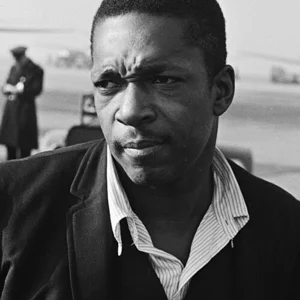

John Coltrane (1926-1967) was an American jazz tenor saxophonist and composer. A major figure of modal jazz and free jazz, he profoundly renewed the language of improvisation and gave his music a spiritual dimension.
John Coltrane(1926 — 1967)
John Coltrane
États-Unis
5 min read
Frequently asked questions
Famous Quotes
« My music is the spiritual expression of what I am.»
« I want to be a force for real good.»
Key Facts
- Born on September 23, 1926, in Hamlet, North Carolina.
- A member of Miles Davis's quintet in the late 1950s, he played on the modal album Kind of Blue (1959).
- Recorded Giant Steps (1960), a demonstration of his harmonic virtuosity.
- Formed his classic quartet and released A Love Supreme (1965), an emblematic spiritual work.
- Died on July 17, 1967, in Huntington (New York) of liver cancer.
Works & Achievements
Coltrane's first major album as a leader, considered a high point of hard bop.
A foundational album of modal jazz; Coltrane delivers solos that have remained famous.
An album with a dizzying harmonic structure (the “Coltrane changes”), a genuine challenge for improvisers.
A modal, hypnotic reworking of a musical-theater song, played on soprano saxophone; a huge popular success.
A four-part suite conceived as a prayer, regarded as his masterpiece and a high point of spiritual jazz.
A collective, tumultuous work that plunges into free jazz and overturns every convention.
Anecdotes
In 1958, the critic Ira Gitler coined the expression “sheets of sound” to describe Coltrane's playing: he played so many notes, so fast and so tightly packed, that they seemed to pour out in continuous cascades. This dazzling technique became one of his signatures.
In 1957, Coltrane was battling a severe heroin addiction that got him fired from Miles Davis's band. He decided to quit cold turkey and went through what he called a “spiritual awakening.” Seven years later, he recorded A Love Supreme, an album conceived as a thank-you to God.
In 1960, Coltrane covered My Favorite Things, a song from the musical The Sound of Music. Instead of a tame melody, he turned it into a long, hypnotic exploration on the soprano saxophone, an instrument that was rare in jazz at the time. The piece became one of his greatest hits.
Coltrane was famous for his relentless work ethic: he could practice his scales for hours, sometimes until he fell asleep with the reed still in his mouth. His bandmates said he was almost never without his saxophone.
After his death in 1967, admirers founded a church in San Francisco that venerates him as a saint: the St. John Coltrane Church. His music is played there during services, proof of the almost religious aura that A Love Supreme had taken on.
Primary Sources
During the year 1957, I experienced, by the grace of God, a spiritual awakening which was to lead me to a richer, fuller, more productive life.
All praise be to God to whom all praise is due. [...] A love supreme, a love supreme.
He developed what might be called “sheets of sound.”
My goal is to live the truly religious life and express it in my music.
Key Places
Coltrane's birthplace, in the segregated South of the United States.
The town where he grew up and got his first taste of music at school.
Coltrane settled here in the late 1940s, studied music, and launched his professional career.
The heart of jazz, where Coltrane performed with Miles Davis, Thelonious Monk, and later his own quartet.
Studio where he recorded several of his masterpieces, including A Love Supreme in December 1964.
Home of his final years, near which he died in 1967; today it is a place of remembrance.
Typical Objects

His instrument of choice, on which he shaped his playing into “sheets of sound.” The Mark VI was the most prized saxophone among the jazz musicians of the era.

Coltrane popularized this instrument, rare in jazz, with his version of My Favorite Things in 1960. Its high-pitched sound became another of his signatures.

Coltrane constantly experimented with mouthpieces and reeds to shape his powerful tone. The search for the right gear was part of his relentless work.

The dominant format of the 1950s and 1960s, the LP allowed him to record long pieces such as the four parts of A Love Supreme.

Coltrane wrote a devotional poem printed on the album cover, which he also “recites” on the saxophone. It is a rare testament to his spirituality.

Like the hard bop musicians, Coltrane performed in an elegant dark suit and tie, displaying the seriousness and dignity claimed by Black jazz musicians.
School Curriculum
Vocabulary & Tags
Key Vocabulary
Tags
Daily Life
Morning
Coltrane devoted his mornings to relentless work on his instrument: scales, motifs, and harmonic explorations for hours on end. His quest for perfection was legendary, and he would barely stop to eat.
Afternoon
Afternoons might be filled with rehearsals with his quartet or recording sessions, often at Rudy Van Gelder's studio in New Jersey, where the music was captured in just a few takes.
Evening
Evenings meant the clubs: Coltrane played long sets at the Village Vanguard or Birdland, where his solos sometimes stretched on for tens of minutes, late into the night.
Food
Life on tour meant meals grabbed on the go. Toward the end of his life, mindful of his health, Coltrane ate more sparingly and took an interest in more natural diets.
Clothing
On stage, he wore elegant dark suits and a tie, in the manner of the hard bop musicians, projecting the seriousness and dignity of the professional jazzman.
Housing
After a modest youth in North Carolina and then years in Philadelphia, Coltrane settled into a house in Dix Hills, on Long Island, where he could compose and rehearse in peace.