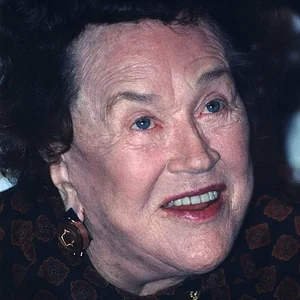

American chef and television host
Julia Child(1912 — 2004)
Julia Child
États-Unis
9 min read
Frequently asked questions
Key Facts
- Julia Child naît en 1912 en Californie et découvre la cuisine française lors de son séjour en France avec son mari diplomate après la Seconde Guerre mondiale.
- Elle étudie à Le Cordon Bleu de Paris dans les années 1950 et cofonde avec Simone Beck et Louisette Bertholle une école de cuisine pour Américains, L'École des Trois Gourmandes.
- En 1961, elle publie 'Mastering the Art of French Cooking', ouvrage de référence qui popularise la cuisine française aux États-Unis.
- À partir de 1963, elle anime 'The French Chef' sur la chaîne publique WGBH, l'une des premières émissions culinaires télévisées américaines, diffusée pendant plus de dix ans.
- Elle reçoit la Légion d'honneur française en 2000 et décède en 2004, laissant un héritage majeur dans la démocratisation de la gastronomie française en Amérique.
Works & Achievements
Co-written with Simone Beck and Louisette Bertholle, this 732-page book is considered the bible of French cooking in English. It made techniques previously reserved for professionals accessible to American home cooks.
The first educational cooking show on American public television, broadcast on PBS for eleven seasons. Julia Child demystified French cuisine with humor and pedagogy, revolutionizing the relationship Americans had with gastronomy.
A second volume co-written with Simone Beck, delving deeper into pastry, charcuterie, and regional French dishes. It complemented the first volume by introducing even more advanced techniques.
A more personal work blending recipes, photographs, and autobiographical stories. It revealed the woman behind the cook and solidified her status as an American cultural icon.
A new-format show in which Julia prepared complete menus for specific occasions (Thanksgiving dinner, summer picnic). For the first time, she incorporated recipes that were not exclusively French.
A comprehensive work illustrated with color photographs, organized by technique rather than by recipe. Considered her most accomplished pedagogical work, it summarizes forty years of learning and teaching.
A collaboration with chef Jacques Pépin for a television series and book blending their two approaches to French cooking. The project illustrates the dialogue between academic tradition (Pépin) and enthusiastic popularization (Child).
Memoirs published posthumously, tracing her years in Paris and the genesis of her culinary passion. The book, completed with her grandnephew Alex Prud'homme, inspired the film Julie & Julia (Nora Ephron, 2009).
Anecdotes
Julia Child stood 6 ft 2 in (1.88 m) tall, an exceptional height for a woman of her era. During World War II, she was rejected by the U.S. Navy because of her height, and joined the OSS (forerunner of the CIA), where she worked as an intelligence analyst in Southeast Asia.
Julia Child discovered French cuisine for the first time in 1948 in Rouen, when she tasted a sole meunière. She described that meal as an absolute revelation that changed the course of her life. She was 36 at the time and barely knew how to cook.
During a live broadcast in 1961, Julia Child dropped a crêpe on the countertop while trying to flip it. Instead of panicking, she picked it up, put it back in the pan, and calmly said: 'You see, when you cook alone, nobody is watching!' That spontaneous reaction won over the American public for good.
The book 'Mastering the Art of French Cooking' was rejected by an initial publisher who deemed it too complex and too long. Finally published in 1961, it became an instant bestseller and is still sold today, more than sixty years after its release.
Julia Child began her television career at the age of 51, an age at which most people think about slowing down. Her show 'The French Chef' on PBS ran for eleven seasons, from 1963 to 1973, and she continued hosting culinary programs well into the 2000s.
Primary Sources
It was a whole new world, a world I hadn't expected, and it was thrilling. The French didn't talk about food, they talked to food — as if it were alive, as if it mattered.
I am a home cook who has worked very hard to learn French cooking. I want to make it accessible to American women who have good kitchens and good ingredients but no idea what to do with them.
This book was written for the servantless American cook who can be unconcerned on occasion with budgets, waistlines, time schedules, children's meals, the parent's income, or the ability to get expert help.
Miss McWilliams displays exceptional organizational skills and a capacity for adaptation in difficult field conditions. Recommended for continued service in the research division.
I think every woman should know how to cook. Not because it's her duty, but because it's one of the great pleasures of life. And the French have understood this for centuries.
Key Places
It was here that Julia Child learned the fundamentals of classic French cuisine starting in 1949, often the only woman among American veterans of World War II. This school, founded in 1895, was at the time the world's leading culinary training institution.
It was in this Norman restaurant, the oldest in France (founded in 1345), that Julia Child tasted her first sole meunière in 1948 — the meal she described as the revelation of her life. A commemorative plaque there marks this defining moment to this day.
The home of Julia and Paul Child in Cambridge, where much of her books were written and where she cooked for decades. Her kitchen, complete with its authentic equipment and utensils, is now on display at the Smithsonian National Museum of American History in Washington.
It was in the studios of this public television channel that 'The French Chef' was filmed starting in 1963. The show, broadcast nationally, transformed American culinary culture and made Julia Child a national star.
A small Provençal house built on the property of her friend and co-author Simone Beck, where Julia regularly stayed to write and cook. This retreat in Provence symbolizes the deep bond she maintained with France throughout her life.
Typical Objects

Julia Child owned a collection of professional-grade French knives and insisted on her shows on the importance of a well-sharpened knife. She regularly demonstrated this on television, confidently gripping the blade to show the proper technique.

A symbol of bourgeois French cooking, the cast iron casserole appeared regularly on her shows for braises and stews. Julia Child recommended it as the most durable kitchen investment an American woman could make.

The whisk (balloon or sauce) was Julia's signature tool for making sauces, mousses, and creams. She devoted several entire episodes to mastering the basic sauces of classic French cuisine.

Julia Child almost always wore a blue apron on her shows, which became a kind of recognizable uniform. This simple, functional apron reinforced her image as an approachable home cook rather than an intimidating chef.

Copper pots, typical of professional French kitchens, adorned the kitchens where Julia filmed. She recommended them for their exceptional thermal conductivity, essential for delicate sauces.

Julia Child worked through her recipes by testing them dozens of times and annotating each copy with corrections, variations, and observations. These working notebooks, preserved at the Library of Congress, bear witness to her methodical rigor.

The fixed camera of 'The French Chef', rudimentary by today's standards, forced Julia to do everything in close-up in a studio mock kitchen. This technical constraint shaped her direct, no-frills teaching style.
School Curriculum
Vocabulary & Tags
Key Vocabulary
Daily Life
Morning
Julia Child woke up early and invariably began her morning with a strong coffee accompanied by fresh fruit. She read the newspapers (French and American) and planned her recipes for the day while annotating her notebooks. On filming mornings, she prepared all her equipment the night before so as not to waste time in the studio.
Afternoon
Afternoons were dedicated to recipe testing in her kitchen in Cambridge or Plascassier. Julia could remake the same recipe ten to twenty times to find the most reliable and accessible version. She also corresponded extensively with her readers and editors, personally replying to many letters.
Evening
Dinners at Julia and Paul's were carefully orchestrated yet always relaxed occasions of conviviality. Julia often served dishes from classical French cuisine — bœuf bourguignon, roast chicken, apple tart — paired with good wine. Conversation revolved around gastronomy, art, and international politics.
Food
Julia Child ate with pleasure and without guilt, rejecting restrictive diets which she considered contrary to the joy of living. She consumed butter, cream, and wine in reasonable quantities, maintaining that moderation — not deprivation — was the key to healthy eating. She was particularly fond of oysters, foie gras, and great Burgundy wines.
Clothing
In town, Julia wore classic American-style outfits — suits, long-sleeved dresses — tailored to her tall frame by dressmakers. In the kitchen and on set, she invariably wore a simple apron, often blue, over practical clothing. She did not seek sartorial elegance but rather an image of approachability and warm professionalism.
Housing
The house on Irving Street in Cambridge was a typical New England bourgeois home, whose kitchen had been entirely redesigned by Paul Child to meet Julia's needs. The walls were covered in hanging utensils, and the shelves overflowed with cookbooks in several languages. La Pitchoune, in Provence, was more modest: a simple bastide with a terrace shaded by olive trees.
Historical Timeline
Period Vocabulary
Visual Style
Esthétique mi-siècle américaine teintée de chaleur provençale : cuisine télévisée des années 1960, cuivres brillants, tons crèmes et ocres, vaisselle rustique française et typographie des livres de recettes d'après-guerre.
Sound Ambience
Sons d'une cuisine de studio télévisé des années 1960 : ustensiles en action, cuisson sur feu vif, ambiance chaleureuse et artisanale de la cuisine française vulgarisée pour le grand public américain.
Liens externes & ressources
Références
Œuvres
Mastering the Art of French Cooking (Vol. 1)
1961
The French Chef (série télévisée)
1963–1973
Mastering the Art of French Cooking (Vol. 2)
1970
From Julia Child's Kitchen
1975
Julia Child & Company (série TV)
1978–1979
The Way to Cook
1989
Julia and Jacques Cooking at Home (livre et série TV)
1999