
American businesswoman (1906–2004)
Estée Lauder(1908 — 2004)
Estée Lauder
États-Unis
7 min read
Frequently asked questions
Key Facts
- Née Josephine Esther Mentzer en 1908 à New York de parents immigrés hongrois et tchèques, elle grandit dans le quartier populaire de Corona, Queens
- En 1946, elle fonde avec son mari Joseph Lauder la société Estée Lauder Companies, spécialisée dans les cosmétiques haut de gamme
- Pionnière du marketing moderne, elle invente la technique de l'échantillon gratuit ('Give a gift with a purchase') pour conquérir de nouvelles clientes
- En 1953, elle lance 'Youth-Dew', un bain parfumé qui devient un succès mondial et transforme l'entreprise en groupe international
- À sa mort en 2004, Estée Lauder Companies est l'un des premiers groupes mondiaux de cosmétiques de luxe, présent dans plus de 100 pays
Works & Achievements
Founded with her husband Joseph, the company would become one of the world's leading luxury cosmetics groups, with brands such as MAC, Bobbi Brown, La Mer, and Jo Malone.
Her first major worldwide commercial success, this bath oil fragrance revolutionized distribution practices and women's autonomous purchasing of perfume.
The first luxury skincare and fragrance line specifically designed for men, a precursor to the high-end male beauty market.
A pioneering brand combining cosmetics with scientific dermatology, sold by white-coated consultants in department stores — an unprecedented concept that revolutionized the industry.
A memoir of life and entrepreneurial achievement in which Estée Lauder shares her business philosophy and her journey from immigrant to global icon.
The highest American civilian honor, awarded posthumously, recognizing her economic and cultural impact on twentieth-century American society.
Anecdotes
Estée Lauder pioneered one of the most revolutionary marketing techniques of the 20th century: offering free samples with every purchase. In 1946, after a New York department store refused to give her advertising space, she simply slipped gift creams into customers' bags. The result: hundreds of orders within days.
Born Josephine Esther Mentzer in Queens, New York, the daughter of Central European immigrants, she began making beauty creams in her kitchen using formulas developed by her uncle, chemist John Schotz. She sold them at local hair salons, convinced that every woman deserved to be beautiful.
In 1953, she launched Youth-Dew, a fragranced bath oil sold at an affordable price. Women of the era did not buy perfume for themselves — it was a gift from men. By presenting it as a bath product, Estée Lauder gave women a way to treat themselves. Youth-Dew became a phenomenal success, transforming the family business into an empire.
As much a socialite as a businesswoman, Estée Lauder cultivated relationships with influential figures with the same precision she applied to formulating her products. She gifted her creams to the Duchess of Windsor and Grace Kelly, understanding before anyone else that luxury is sold through aspiration and identification with admired figures.
In 1968, she created the Clinique brand, the first line of hypoallergenic cosmetics developed with a dermatologist, sold exclusively in department stores by advisors dressed in white like doctors. This groundbreaking concept blending beauty and science redefined the global cosmetics industry.
Primary Sources
I have never worked a day in my life without selling. If I believe in something, I sell it, and I sell it hard.
Beauty is an attitude. There's no secret. Why do some women always look great while others don't? They work at it.
I never dreamed about success. I worked for it. Every woman can be beautiful.
Touch your customer, and you're halfway there. I built this business one face at a time.
Key Places
A working-class neighborhood in New York where Estée Lauder was born in 1908 into a family of immigrants. It was in this modest home that she began making her first creams in the family kitchen.
The iconic Manhattan department store where Estée Lauder secured her first counter in 1948, a founding moment of her empire. The Saks counter remains a symbol of the brand's luxury positioning.
The brand's headquarters, located in Midtown Manhattan, is the nerve center of a group that today owns dozens of beauty brands present in more than 150 countries.
Estée Lauder's secondary residence, a symbol of her social ascent. There she mingled with the American and European elite, reinforcing her image as a socialite as much as a businesswoman.
The emblematic city of fashion and beauty where Estée Lauder established her products as early as the 1960s, challenging French houses on their own turf and making her mark in Parisian department stores.
Typical Objects

Launched in 1956, this ultra-luxurious cream with a scandalously high price for the time symbolizes Estée Lauder's strategy: selling a dream as much as a skincare product. It was the first cosmetic to dare display a high price as a mark of quality.

The bath oil-perfume bottle launched in 1953, with its elegant and affordable design, was the product that transformed the small family business into a cosmetics empire. It allowed women to buy themselves a quality fragrance.

The emblem of her marketing revolution, the sample kit offered with every purchase was the commercial invention that set Estée Lauder apart from all her competitors and built loyalty among generations of customers.

Estée Lauder personally cultivated her relationships through a carefully maintained list of influential clients, journalists, and personalities. Her network was considered one of her major business assets.

When she created Clinique in 1968, Estée Lauder insisted that her saleswomen wear white coats, like healthcare professionals, to associate cosmetics with science in the minds of consumers.

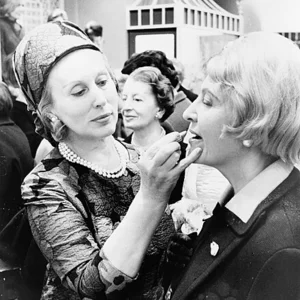
During her in-store demonstrations, Estée Lauder would not hesitate to touch customers' faces to apply her products, creating a uniquely personal connection. Her demonstration compact powder was her most direct sales tool.
School Curriculum
Vocabulary & Tags
Key Vocabulary
Daily Life
Morning
Estée Lauder rose early, meticulously attending to her appearance before any meeting or outing — she considered her own face her best showcase. She spent her mornings studying new product formulations with her teams or meeting department store executives to negotiate prime counter locations.
Afternoon
Her afternoons were often devoted to in-store demonstrations, where she did not hesitate to apply her creams directly to the faces of unknown customers to persuade through action. She also oversaw advertising campaigns and personally received journalists and public figures at her Manhattan offices.
Evening
Estée Lauder's evenings were carefully calculated social events: dinners with influential figures, charity galas, receptions at her luxurious apartments in New York or Palm Beach. Every evening was an opportunity to place her products in the right hands.
Food
Mindful of her image and vitality, Estée Lauder followed a careful diet, favoring light, balanced meals. She enjoyed fine dining at top New York restaurants, where the table was also a place for negotiation and commercial charm.
Clothing
Always impeccably dressed in elegant suits and gowns by European and American fashion designers, Estée Lauder permanently embodied the brand image of her products. She wore her own perfumes and makeup at all times, refusing any gap between her personal life and her public image.
Housing
She lived in luxurious Manhattan apartments and owned a residence in Palm Beach, Florida, and a villa on the French Riviera. Her interiors, decorated with a pronounced taste for antique furniture and fresh flowers, reflected the image of timeless elegance she wished to associate with her products.
Historical Timeline
Period Vocabulary
Visual Style
Esthétique du luxe américain mid-century : tons crème et or, comptoirs de grands magasins, emballages Art déco élégants et publicités aspirationnelles mêlant glamour et modernité scientifique.
Sound Ambience
L'univers sonore d'Estée Lauder est celui des grands magasins américains des années 1950-1970 : élégance feutrée, parfums floraux et bourdonnement discret du commerce de luxe.
Liens externes & ressources
Références
Œuvres
Fondation de l'Estée Lauder Companies
1946
Lancement de Youth-Dew
1953
Création de la ligne Aramis
1964
Lancement de Clinique
1968
Estée: A Success Story (autobiographie)
1985
Presidential Medal of Freedom
2004